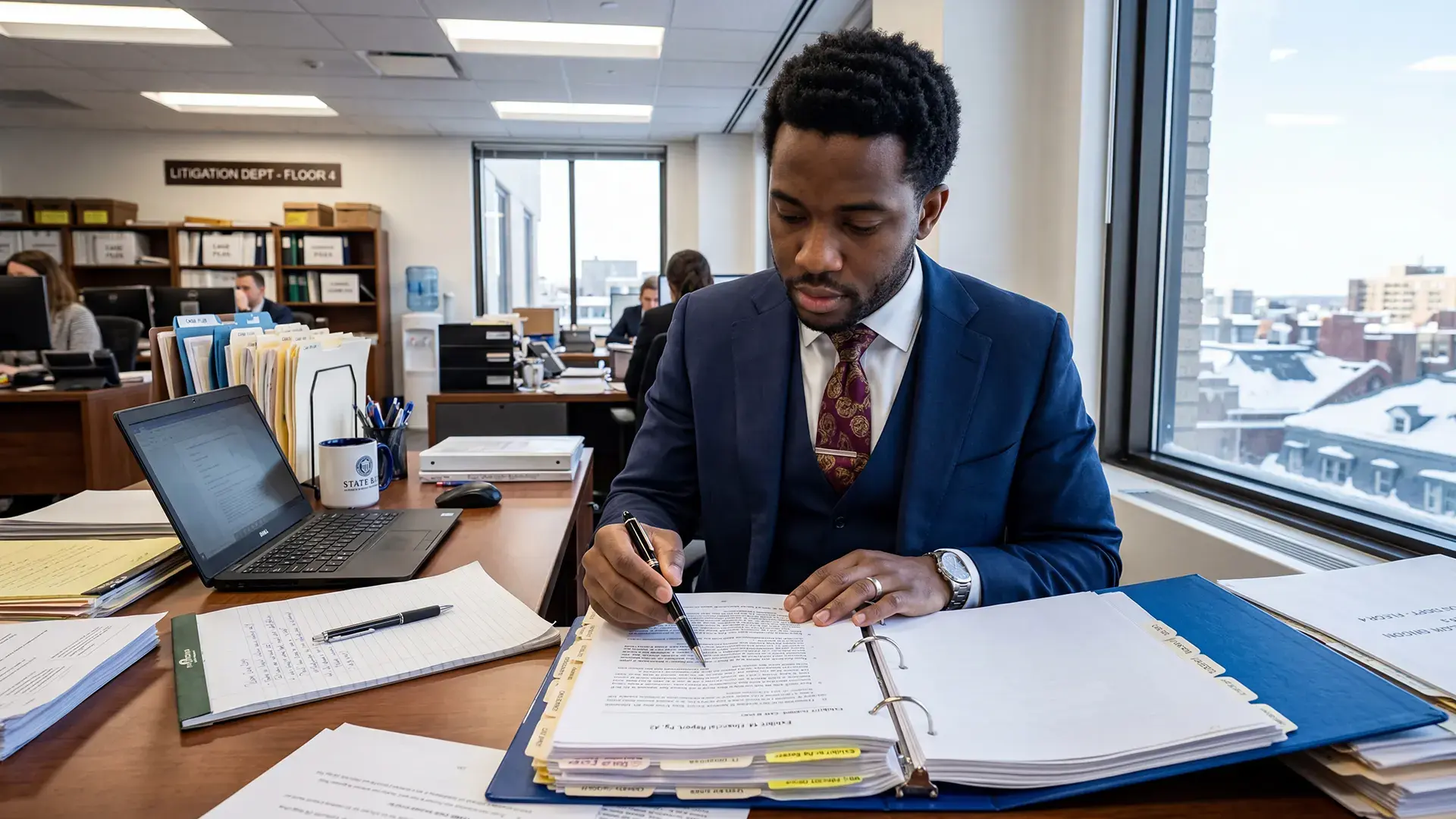
Prosecutor offices across the United States are drowning in paper. A single felony case file routinely contains hundreds of pages of police reports, body camera transcripts, witness statements, lab results, and digital evidence logs. From all of that raw material, an assistant district attorney must draft charging documents, motions in plea agreements, sentencing memoranda, and trial briefs, often under statutory speedy-trial clocks.
That drafting work used to be the slow, careful art of the line prosecutor. Today, it is the bottleneck that determines whether a 40-attorney office can keep pace with a 4,000-case docket.
A new category of tooling has emerged in response: AI criminal case document drafting. It refers to the use of multi-modal artificial intelligence to assemble, summarize, and draft sections of prosecution documents directly from the underlying evidence record, with the prosecutor remaining the author of record. This guide explains what the category is, why it matters now, how to evaluate vendors against the rules that actually bind attorneys, and where VIDIZMO's Intelligence Hub fits.
Key Takeaways
- AI criminal case document drafting automates the assembly of charging documents, motions, plea memos, and sentencing briefs from multi-modal evidence (video, audio, documents, transcripts).
- Generic legal AI tools fall short for prosecutors because they assume a text-only corpus. Most of a modern felony file by volume is video, audio, and image evidence that must be transcribed, redacted, and cited before any drafting can happen.
- For prosecutors, the evaluation framework is governed by attorney ethics rules, privilege protection, and disclosure obligations first, and technical benchmarks second.
- Brady and Giglio obligations make hallucination a career-level risk, not a quality issue. Outputs without source-grounded citations should never enter the workflow.
- Offices piloting in 2026 should start with one document type. Sentencing memos are the typical entry point before expanding to charging documents and trial briefs.
What Is AI Criminal Case Document Drafting?
AI criminal case document drafting is the use of large language models, retrieval-augmented generation, and multi-modal evidence processing to draft sections of prosecution documents directly from the case record. The prosecutor still owns the document. The AI handles the assembly work that used to consume entire afternoons.
The category exists because three systems that prosecutors already use never talked to each other: the case management system holds the docket, the Digital Evidence Management System holds the media, and generative AI assistants can write but cannot see either one. A standalone ChatGPT prompt cannot draft a sentencing memo because it cannot read the body camera footage, cross-reference the lab report, or pull the defendant's prior conviction history with citations to bates-stamped source pages. Drafting tools close that gap by connecting the language model to the evidence record itself. Our guide to AI legal evidence analysis covers how that grounding works across video, audio, and document evidence.
Drafting tasks the category currently handles include charging documents and complaints, motions in limine and suppression responses, plea agreement summaries for victim notification, sentencing memoranda with aggravating and mitigating factors, Brady disclosure logs, and discovery indices. It does not, and should not, handle final substantive legal arguments. Those remain attorney work.
Why Do Prosecutor Offices Need This Now?
Three pressures are converging in 2026. First, evidence volume has exploded. Seven states now mandate statewide body-worn camera use according to the National Conference of State Legislatures body-worn camera laws database, and most others fund or regulate BWC programs, so video now arrives attached to nearly every felony file. Second, prosecutor offices cannot keep seats filled.
ABA Journal reporting quotes the National District Attorneys Association's executive director describing a prosecutor shortage that extends throughout the country, and a BYU Law Review study, The Prosecutor Vacancy Crisis, documents offices of every size carrying heavy vacancy rates, with some smaller offices exceeding 50 percent. Third, speedy-trial statutes have not moved. New York's 30/90/180-day rules, California's 60-day felony clock, and federal Speedy Trial Act deadlines apply regardless of caseload.
The math does not work without automation. An ADA triaging a charging decision has minutes to act on a police packet that runs hundreds of pages plus hours of body camera footage. Nobody can read all of it on the clock the statute allows, so in practice charging decisions get made on the detective's summary rather than the full record.
That is the gap AI criminal case document drafting addresses. Not replacing the prosecutor's judgment, but giving the prosecutor a faithful, citation-grounded first draft to react to.
How Does AI Document Drafting Work in a Criminal Case Pipeline?
The technical pipeline behind credible drafting tools has five stages. Skip any of them and the output is either hallucinated or legally unusable.
-
Multi-modal ingestion. The system pulls in video, audio, images, PDFs, and structured case data from the Digital Evidence Management System, the records management system, and any third-party intake portals.
-
Transcription and OCR. Audio and video are transcribed, and credible platforms publish word error rate benchmarks per language rather than vague accuracy claims. Scanned police reports are OCR'd. The result is a unified text corpus tied back to the source media with timestamps and page numbers.
-
Redaction and PII handling. Sensitive identifiers, juvenile information, and protected witness data are detected and either redacted or flagged. This step distinguishes purpose-built legal AI from generic AI assistants.
-
Retrieval-augmented generation. When the prosecutor requests a draft, the system retrieves only the relevant evidence segments rather than the entire corpus, feeds them to the language model with the appropriate document template, and produces a draft with inline citations back to source pages and timestamps.
-
Attorney review. The draft surfaces with confidence scores, source citations, and flags for unverified claims. The prosecutor edits, approves, or rejects. Nothing is filed automatically.
The retrieval step is where most generic AI tools fail. Without grounding, the model invents facts. With grounding to a verified evidence corpus, the model becomes a research assistant that cites its work.
What Are the 7 Basic Steps in a Criminal Case?
Understanding where document drafting fits requires a quick refresher on the criminal case lifecycle. From a prosecutor's perspective, the seven basic steps are:
- Investigation and intake. Law enforcement gathers evidence and presents it to the prosecutor for charging review.
- Charging decision. The prosecutor reviews the police packet, evaluates legal sufficiency, and decides whether to file charges. (First major document drafting moment: the complaint or information.)
- Initial appearance and arraignment. The defendant is informed of charges and enters a plea.
- Discovery. Both sides exchange evidence under jurisdictional rules and Brady obligations. (Heavy document workload: discovery indices, Brady logs, privilege logs.)
- Pretrial motions. Suppression motions, motions in limine, and discovery disputes are litigated. (Drafting workload: motion responses, evidentiary memoranda.)
- Plea negotiations or trial. Most cases resolve by plea. (Drafting workload: plea agreements, victim notification letters, factual basis statements.)
- Sentencing. If a conviction occurs, the prosecutor submits a sentencing memorandum and may argue at the hearing. (Drafting workload: sentencing memo, victim impact summaries, restitution calculations.)
AI document drafting touches steps 2, 4, 5, 6, and 7 directly. The bulk of an ADA's drafting time sits in those five phases.
Can ChatGPT Write Legal Documents for Criminal Cases?
Technically yes, in the sense that ChatGPT can produce text that looks like a legal document. Practically no, not for any document that will be filed in a real case. Three reasons.
First, hallucination. The well-documented Mata v. Avianca sanction in 2023 and the string of similar incidents through 2024 and 2025 established that consumer chatbots invent case citations. ABA Formal Opinion 512, issued by the Standing Committee on Ethics and Professional Responsibility in July 2024, made clear that attorneys remain responsible for verifying every citation regardless of the tool used. A criminal case sanction is far worse than a civil one.
Second, evidentiary grounding. A consumer chatbot has no access to the body camera footage, the witness statement audio, or the lab report PDF. It cannot ground its draft in the actual evidence. It produces plausible-sounding prose untethered to the case record.
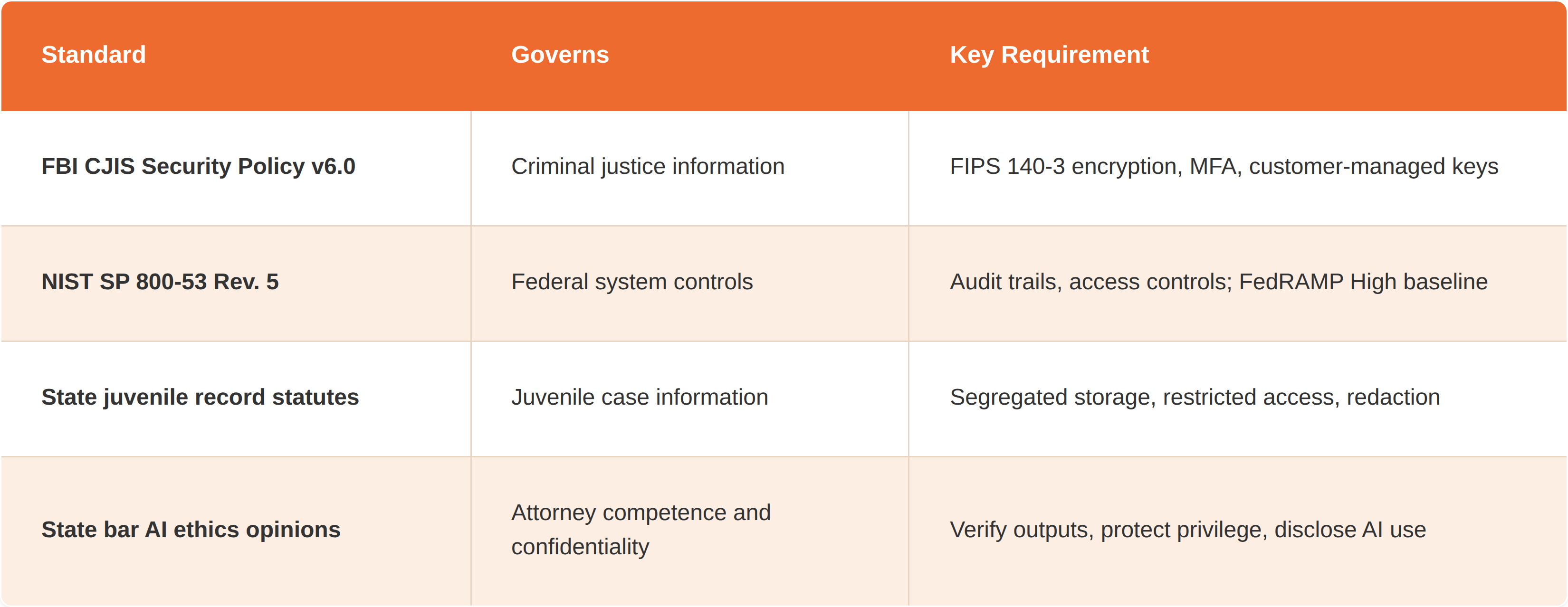
Third, confidentiality and privilege. Pasting privileged work product, victim information, or juvenile records into a consumer chatbot can constitute a privilege waiver under most state ethics opinions, and may violate FBI CJIS Security Policy requirements if the data qualifies as criminal justice information. The current CJIS Security Policy v6.0 requires FIPS 140-3 validated encryption, multi-factor authentication, and customer-managed keys, none of which consumer AI services provide.
The right tool is purpose-built legal AI deployed in a controlled environment, with evidence grounding, source citations, and the ability to operate on-premises or in a government cloud when CJIS data is involved.
Can You Draft Legal Documents Without Being a Lawyer?
For criminal matters, the answer is almost universally no. Unauthorized practice of law (UPL) statutes in all 50 states restrict the drafting of pleadings, motions, and other case-bound documents to licensed attorneys, with narrow exceptions for self-represented litigants drafting their own filings.
This matters for AI tooling because the legal status of AI-drafted documents follows the supervising attorney. The California State Bar's Practical Guidance on Generative AI and Florida Bar Ethics Opinion 24-1 (January 2024) both reached the same conclusion. An attorney using AI to draft a document is the attorney drafting the document. The AI is a tool, not a co-author. The attorney bears full responsibility for accuracy, confidentiality, and competent representation under Model Rule 1.1.
In practice this means three things for prosecutor offices deploying AI drafting. The ADA must review every output before filing. The office must train staff on AI-specific competence requirements. And the technology choice must support attorney oversight, not bypass it. Tools that produce un-editable final outputs or that file documents automatically are non-starters.
What Should Prosecutors Look for When Evaluating AI Drafting Platforms?
Buying AI for a prosecutor's office is not the same as buying it for a police department or a civil firm, because the attorney's license is on the line with every filing. The criteria below follow the rules that actually bind ADAs: ethics opinions, privilege doctrine, juvenile statutes, and discovery obligations.
1. Privilege and work-product protection by design
Drafts, prompts, and notes generated during case preparation are attorney work product. The platform must keep them segregated from the discoverable evidence record, with access controls that mirror the office's existing privilege walls. A system that mixes work product into the evidence corpus creates waiver risk every time discovery is produced.
2. Source-grounded citations on every claim
Every generated sentence should link back to a transcript timestamp, a document page, or a video segment. Under Model Rule 1.1 and Formal Opinion 512, the attorney must verify what is filed. Verification is only possible when the draft shows its sources. Ungrounded prose cannot be verified, and unverified output cannot be filed. Citation-grounded output is also what survives an authentication challenge in court; our digital evidence admissibility guide for prosecutors covers the standards courts apply.
3. Multi-modal evidence processing
Text-only platforms cannot serve criminal prosecutors. The platform must natively process video, audio, images, and documents, with transcription quality good enough to be cited. Look for word error rate benchmarks per language, not vague accuracy claims, because witness statements and jail calls often arrive in languages other than English.
4. Juvenile record and victim PII safeguards
State juvenile statutes require segregated storage, restricted access, and mandatory redaction. The platform must detect protected identifiers automatically (Social Security Numbers, driver's license formats, minor names) and apply configurable redaction rules per case type, not as an afterthought during export.
5. Disclosure-ready audit trail
Defense counsel will eventually ask whether AI was used in drafting, and several state bars are moving toward affirmative disclosure requirements. Every prompt, retrieval, edit, and export must be logged so the office can answer with documentation. The audit trail also lets the office show that an attorney, not the model, made every substantive call.
6. Deployment that satisfies CJIS and the IT department
Evidence that qualifies as criminal justice information needs an on-premises, government cloud, or hybrid deployment that meets CJIS Security Policy v6.0. The full deployment-architecture question is covered in depth in our companion piece on automated police report generation, since the infrastructure requirements are shared across the agency side and the prosecution side.
How Should You Evaluate AI Output Against Brady Obligations?
Brady v. Maryland and its progeny require prosecutors to disclose material exculpatory and impeachment evidence to the defense. The Department of Justice's Justice Manual Section 9-5.001 codifies broad disclosure obligations. When AI assists with drafting, the obligation does not change, but the workflow around it should.
Start with what AI gets wrong here. An AI summary that omits a piece of impeachment evidence does not relieve the prosecutor of the Brady obligation; it just buries the obligation inside a document the office trusted too much. The AI's output is never the case summary. The right approach is to use AI to generate the discovery index and the Brady log, then to review the underlying evidence directly for materiality.
Now the upside, which gets less attention: AI is better at Brady screening than it is at advocacy drafting. Pattern detection across thousands of hours of evidence is precisely the task language models excel at. Agencies have used AI to flag contradictions between officer narratives and BWC audio that human reviewers missed during initial discovery review. An office that deploys drafting tools without also deploying them for exculpatory-evidence screening is using the technology backwards.
One housekeeping rule rounds this out: preserve the AI drafts and edit history. If a draft contained material the final filing removed, defense counsel may argue the draft is discoverable. Retention is cheap; a spoliation fight is not.
What Compliance Standards Apply to AI Document Drafting?
For prosecutor offices, four compliance frameworks set the floor. Any AI tooling that touches criminal justice information must satisfy all four.
Offices should also map the platform's controls against the NIST AI Risk Management Framework (AI RMF 1.0, released in 2023), which has become the de facto procurement reference for state and federal AI buying decisions. For what CJIS alignment looks like in practice when evidence moves to hosted infrastructure, see our guide to CJIS-compliant cloud evidence management.
How the VIDIZMO Intelligence Hub Fits
VIDIZMO's Intelligence Hub, launched as a multimodal AI platform for regulated industries, addresses the gap between general-purpose legal AI and the prosecution-specific drafting workflow. As the AI processing layer within a broader platform that also includes Digital Evidence Management and redaction, it can run document drafting workflows against the same evidence corpus the office already uses for case management, with chain-of-custody and audit logs preserved end to end.
Intelligence Hub supports AI transcription in 82 languages with per-language word error rate benchmarks, which enables drafting workflows that span multilingual witness statements, jail call recordings, and translated documents.
The agentic retrieval-augmented generation architecture is the relevant capability for drafting. Rather than passing entire case files to a language model, which would exceed context limits and produce ungrounded output, Intelligence Hub retrieves only the evidence segments relevant to the requested document, grounds the draft in those citations, and surfaces confidence scores for prosecutor review. The platform is LLM-agnostic, supporting Azure OpenAI, Google Gemini, Anthropic Claude, and self-hosted open-source models via Ollama or VLLM for air-gapped environments. That matters for offices that cannot send criminal justice information to commercial LLM endpoints.
Deployment runs on private cloud, on-premises, hybrid, or SaaS, with on-premises being the typical fit for state and county prosecutor offices that handle CJIS data. Intelligence Hub supports FedRAMP High deployments via Azure Government Cloud and CJIS-aligned deployments on Azure Government. VIDIZMO is ISO 27001:2022 certified at the company level.
See how Intelligence Hub drafts citation-grounded prosecution documents from your existing evidence corpus. Book a demo with the VIDIZMO team.

FAQ
Frequently Asked Questions
What is AI criminal case document drafting?
AI criminal case document drafting is the use of multi-modal artificial intelligence to assemble and draft prosecution documents (charging instruments, motions, plea memos, sentencing briefs) directly from the underlying case record, with prosecutor review and approval at each step. It combines retrieval-augmented generation with evidence transcription, OCR, and PII detection so drafts are grounded in cited source material.
What are the 7 basic steps in a criminal case?
The seven steps are investigation and intake, charging decision, initial appearance and arraignment, discovery, pretrial motions, plea negotiations or trial, and sentencing. AI drafting tools touch the charging, discovery, pretrial motion, plea, and sentencing phases most heavily, since those phases generate the majority of a prosecutor's document workload.
Can ChatGPT write legal documents for criminal cases?
No, not for documents that will be filed. Consumer chatbots cannot ground their text in actual case evidence, they invent citations, and pasting privileged or CJIS-restricted material into them can constitute a privilege waiver or compliance violation. Purpose-built legal AI deployed in a controlled environment, with evidence grounding and source citations, is the only viable approach for real cases.
Can you draft legal documents without being a lawyer?
For criminal matters, no. Unauthorized practice of law statutes in all 50 states restrict the drafting of pleadings and motions to licensed attorneys. AI tools used by attorneys are treated as tools, not co-authors, and the attorney retains full responsibility under ABA Model Rule 1.1 and state-specific 2024-2025 ethics opinions.
Does the defense need to know AI was used in drafting?
Increasingly yes. Several state bars are moving toward affirmative disclosure requirements when AI generates filed or disclosed documents, and judges in some jurisdictions already require certification of AI use in filings. Prosecutor offices should preserve AI drafts and audit logs, and check their state's most recent ethics guidance before adopting any drafting tool.
How does AI document drafting compare to traditional legal templates?
Templates are static and require the attorney to fill in every fact manually from the case file. AI drafting pulls those facts from the underlying evidence automatically, cites the source, and produces a near-complete first draft in minutes rather than hours. The attorney's role shifts from typing to reviewing and refining, which is where the recovered time comes from.
Why is privilege a bigger AI risk for prosecutors than for police?
A police report is a disclosable record from the moment it is signed, but a prosecutor's drafts, notes, and strategy documents are protected work product. AI platforms that mix work product into the evidence corpus, or that send privileged material to external model endpoints, create waiver exposure that an agency-side tool never faces.
TopicsAI Intelligence HubLegal and Privacy

About the author
Nadeem Khan is the CEO and co-founder of VIDIZMO, where he has led the company's growth from a video management startup into an AI-powered platform trusted by federal law enforcement, defense agencies, and Fortune 500 enterprises. He spearheaded the development of VIDIZMO's Digital Evidence Management System, now used by leading public safety agencies across North America. With over 25 years in enterprise software architecture and cloud infrastructure, Nadeem brings hands-on technical depth to every product decision. Before taking the CEO role, he served as CTO and Chief Architect at VIDIZMO and spent 17 years as Principal Consultant at Softech Worldwide, a Microsoft Gold Partner.
You may also like
Fire and Smoke Detection as a Second Set of Eyes in Schools
Let the first sentence of this article do the compliance work: nothing described here replaces, modifies, or competes ...
Weapon Detection in Schools: Detection, Verification, Response
No school safety technology carries more emotional weight than weapon detection, and no school safety technology is ...
School Safety Grants: What the Money Can Buy
School safety improvements have a funding problem that is really a sequencing problem: the need is continuous, the ...