Most organizations aren't worried about robots. They're worried about something smaller and far more likely, a spreadsheet of patient names or a claims file pasted into a public AI chatbot at 5 to 5 on a Friday. Here's how to say yes to AI without that happening. Four industries, one platform.
In healthcare, ask for a patient fall timeline and redact patient faces. In construction, build a cited incident timeline and redact worker faces before files go to the insurer. In education, summarize hallway recordings and redact student faces. In cities and counties, ask what a street camera shows and redact names in 911 calls.
Five risks hold everyone back. Data leaves the building. You can't find it or trust it. Private details get out.
There's no control once it's shared, and the pilot never ships. The rules differ by industry. HIPAA in healthcare, OSHA and legal holds on job sites, FERPA in schools, public records laws in cities. The five risks are the same.
Step one, contain. An adjuster has a claim file full of private data, and the easy move is a public chatbot. Blocking sites doesn't stop it. An approved tool does.
The file moves into private AI on your own network, where it's transcribed, summarized, and its key facts cited with every action logged. It runs where you choose, your cloud, your own servers, or fully offline, with the AI models running there too. It uses your sign-on and roles, logs every view and share, and never trains anyone else's model. VIDIZMO is ISO 27001 certified with a CJIS Security Policy-aligned architecture.
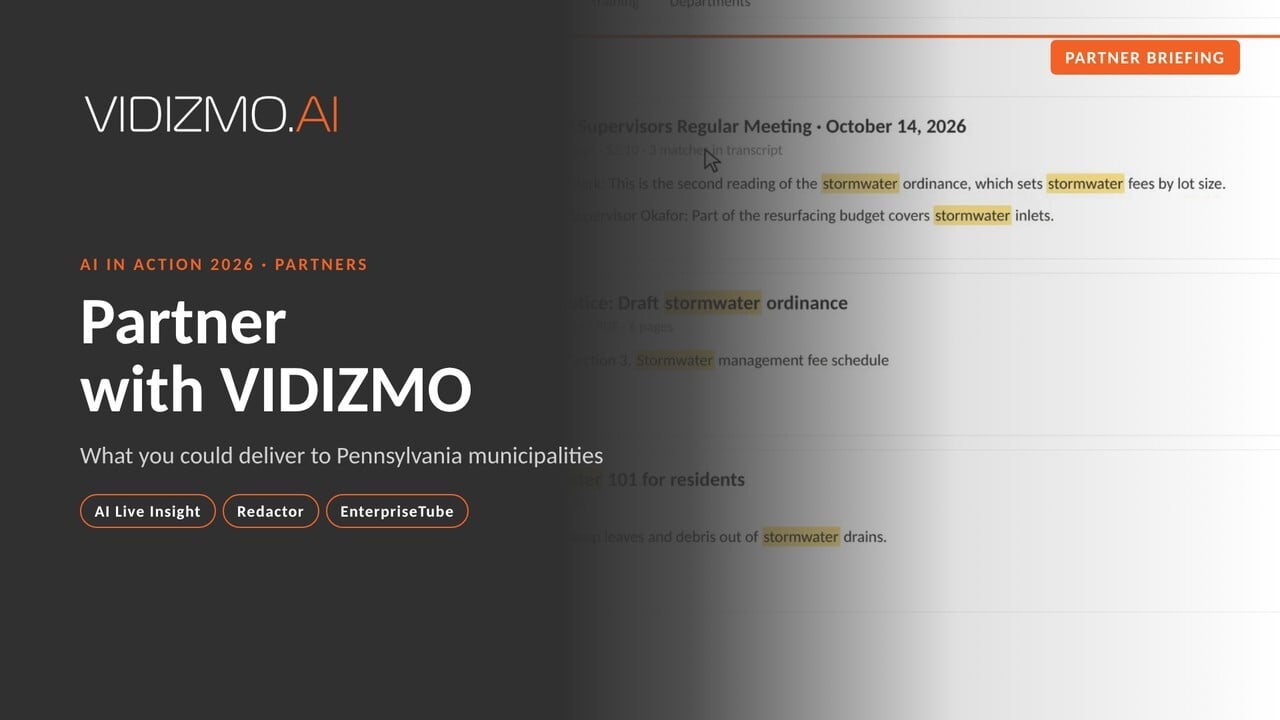
Step two, find. A safety lead asks what happened at the trench yesterday afternoon. AI Intelligence Hub reads the gas log, both trench cameras, the gate log, and the shoring sensor, and answers with one timeline, each line linked to its source. The same pattern works everywhere.
A patient fall timeline from the room camera, nurse call, and clinical note. A minute-by-minute summary of a school hallway. A plain description of what a street camera shows. Ask in plain language, get the answer, check the source.
Step three, protect. Redaction is still done frame by frame in most organizations. Redactor finds faces, plates, screens, names, numbers, and addresses. A blur on video, masking on audio, a black bar on a page.
It works on every kind of content. Worker faces and a name on crew radio before files go to the insurer. Every student's face before hallway video goes to a parent. A person approves every change, and the original stays untouched.
Step four, release. A 911 call for a public records request is redacted and goes out as a secure link that expires when you decide, with a record of who received it and when they opened it. One public safety customer kept the system it already had and added Redactor and AI Intelligence Hub on its own servers. In six months, video release went from 62 days to 7, effort per case from 8 hours to 45 minutes, and overdue requests from 75 to 3, with the same two people doing the work.
It works with what you already run. Cameras like Milestone, Genetec, and Axis, record systems like Epic, PowerSchool, and Tyler, Microsoft 365 and Teams, and your own sign-on. More than 150 systems are in the catalog. And the pilot ships.
Start with one workflow, like parent footage requests in a school district. In the first 30 days, write down how long it takes today and finish the security review first. Run it on your real content for the next 30 with your people reviewing every result. By day 90, compare it to the baseline and decide.
Five risks, five answers. See it with your own kind of content. Request a demo at vidizmo.ai.