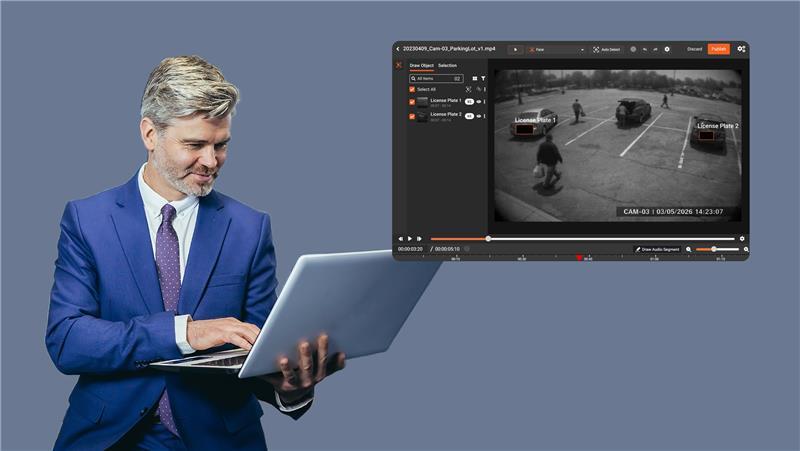
Parking lots rank among the most heavily surveilled spaces in the United States. From retail centers and hospitals to government buildings and university campuses, surveillance cameras capture millions of license plates every day. That footage creates a significant privacy liability the moment it needs to be shared - whether for a FOIA request, an insurance claim, litigation discovery, or an internal investigation.
License plates are legally classified as personally identifiable information (PII) under the California Consumer Privacy Act (CCPA), the federal Driver's Privacy Protection Act (DPPA), and a growing number of state privacy laws. Releasing unredacted parking lot footage can expose organizations to regulatory penalties, civil lawsuits, and reputational damage. The challenge is that parking lots generate continuous, high-volume footage that makes manual redaction impractical.
AI-powered redaction software makes it possible to process parking lot footage at scale - automatically detecting and redacting license plates across thousands of hours of surveillance video while maintaining the compliance documentation and audit trails that legal proceedings demand.
Why Parking Lot Camera Footage Requires License Plate Redaction
A license plate number, on its own, can be used to identify a vehicle's registered owner, their home address, and their movement patterns. Multiple federal and state regulations recognize this risk and impose restrictions on how license plate data can be disclosed.
The Driver's Privacy Protection Act (DPPA) has served as the federal baseline since 1994, restricting the disclosure of personal information obtained through motor vehicle records. While DPPA primarily targets DMV records, its protections extend to any context where plate numbers are linked to identifiable individuals - including surveillance footage.
The California Consumer Privacy Act (CCPA) explicitly classifies license plate numbers as personal information. Any organization that collects, stores, or shares footage containing California plates must treat that data with the same protections as Social Security numbers or financial account information.
State ALPR (Automatic License Plate Reader) laws add another layer. As of early 2026, more than 16 states have enacted legislation regulating the collection, retention, and sharing of license plate data captured by automated systems. States including Arkansas, Idaho, Montana, Illinois, Massachusetts, Minnesota, New York, and Washington have all strengthened their ALPR restrictions.
For government-operated parking facilities, FOIA and state open records laws create additional exposure. When agencies receive public records requests for surveillance footage, they must redact PII before disclosure - including license plates. Failure to do so violates the privacy of every vehicle owner captured in the footage.
Commercial organizations face similar obligations. Retailers sharing footage with law enforcement, property managers providing footage for insurance claims, and healthcare facilities responding to subpoenas all bear responsibility for protecting the plate data in their surveillance recordings.
Common Challenges with Parking Lot Footage
Parking lot surveillance presents a unique set of technical challenges that distinguish it from other redaction scenarios like body-worn camera footage or interview recordings.
Volume is the primary obstacle. A single parking lot camera running 24/7 generates approximately 720 hours of footage per month. Facilities with 10 or 20 cameras produce tens of thousands of hours annually - far beyond what any manual redaction workflow can handle.
Camera angles and distance vary widely. Wide-angle surveillance cameras capture license plates at varying distances, angles, and orientations. A plate that is clearly readable at 10 feet may be partially obscured at 50 feet or captured at a steep angle near the edge of the frame.
Environmental conditions degrade image quality. Rain, snow, glare from direct sunlight, low-light conditions at dusk, and infrared night-vision footage all reduce the clarity of license plate images. Seasonal changes mean the same camera produces dramatically different footage quality throughout the year.
Dense parking lots show multiple vehicles per frame. A busy retail lot may have dozens of plates visible simultaneously, each requiring individual detection and redaction. Vehicles entering, exiting, and maneuvering through the lot create constantly changing plate positions.
Camera systems use different formats. Different surveillance vendors output footage in proprietary codecs and container formats. Legacy CCTV systems, IP cameras, and modern cloud-connected cameras each have their own encoding standards, creating format fragmentation that complicates processing.
Edge cases are common. Temporary plates, dealer tags, paper plates, motorcycle plates, plates partially obscured by trailer hitches or bike racks, and dirty or damaged plates all appear regularly in parking lot footage and still require redaction.
How AI-Powered License Plate Redaction Works
Modern AI redaction platforms automate the detection and redaction of license plates across video frames, replacing what would be hours of manual work with a streamlined, multi-step process.
Step 1: Ingest the footage. Upload parking lot recordings in any format - including proprietary CCTV codecs. Platforms that support CCTV auto-rewrapping can automatically detect and convert H.264 CCTV files into standard containers without manual transcoding, preserving the original quality. Support for 255+ video, audio, image, and document formats ensures compatibility with virtually any camera system.
Step 2: AI detection. Trained object detection models scan every frame to identify license plates automatically. The AI recognizes plates across varying distances, angles, and lighting conditions - including partial plates and plates captured in low-light or IR footage.
Step 3: Frame-by-frame tracking. Once a plate is detected, the system tracks it across consecutive frames as the vehicle moves through the parking lot - entering, parking, and exiting. Configurable frame validation (requiring detection across 3 to 30 consecutive frames) reduces false positives from momentary visual artifacts.
Step 4: Redaction applied. Blur, pixelation, or solid mask effects are applied to every detected plate. Configurable confidence thresholds (adjustable from 25% to 90%) let operators balance between catching every possible plate and minimizing false positives.
Step 5: Human review (optional). Before finalizing, reviewers can inspect the AI's detections - confirming flagged plates, correcting any misses, and removing false positives. This semi-automated workflow combines AI speed with human judgment for high-stakes releases.
Step 6: Export the redacted copy. The system generates a redacted copy of the footage while preserving the untouched original - maintaining chain of custody for legal defensibility. A complete audit trail documents every detection, redaction decision, reviewer action, and export.
Parking lot footage often contains other sensitive information beyond license plates. AI can simultaneously detect and redact faces, persons, vehicle types, and other PII in the same processing pass - eliminating the need for multiple rounds of redaction.
Manual vs. AI Redaction: Time and Cost Comparison
The economics of parking lot footage make manual redaction unsustainable for any organization processing surveillance video regularly.
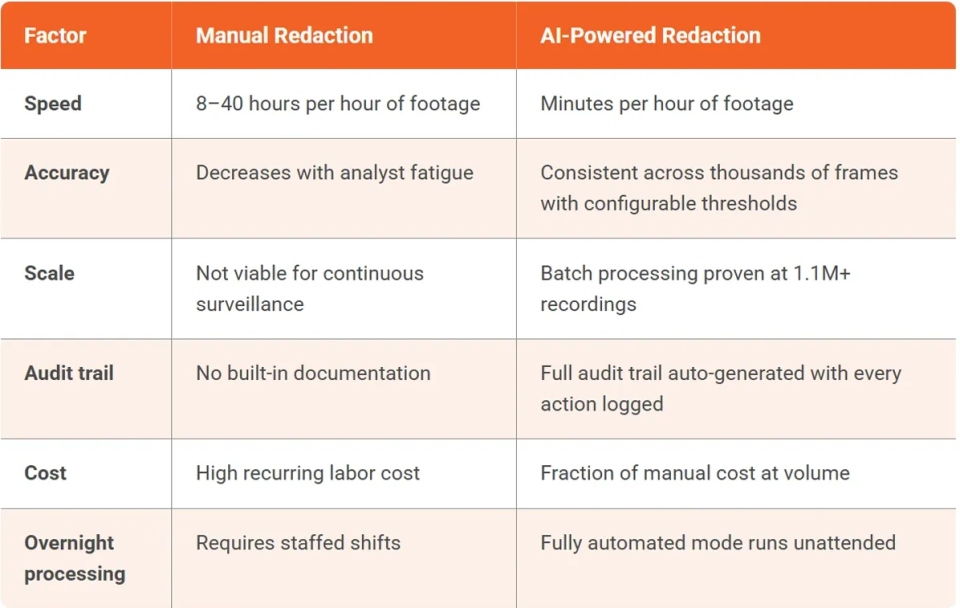
Manual redaction requires an analyst to scrub through footage frame by frame in video editing software, drawing redaction boxes over each plate. A single hour of footage can take 8 to 40 hours depending on plate density, footage complexity, and the required level of precision. Analyst fatigue leads to inconsistent results - missed plates in hour six that would have been caught in hour one.
AI-powered redaction processes the same footage in minutes. Batch automation lets operators queue entire date ranges, camera feeds, or incident windows for processing. Fully automated mode enables overnight processing - queue the day's footage before leaving, and the redacted copies are ready by morning.
For a parking facility generating hundreds of hours of footage per month, the difference is not marginal. It is the difference between a viable compliance program and an impossible one.
Best Practices for Parking Lot License Plate Redaction
Organizations processing parking lot surveillance footage should establish clear operational practices to ensure consistent compliance and defensibility.
1. Define a redaction policy. Document when license plate redaction is required: all public records releases, FOIA responses, insurance claims, footage shared with third parties, internal reviews, and any other disclosure scenario. A written policy eliminates ambiguity and protects the organization during audits.
2. Use automated batch processing. Avoid processing files one at a time. Queue entire date ranges, camera feeds, or incident windows for bulk processing. This approach scales with footage volume and eliminates the bottleneck of file-by-file manual workflows.
3. Set appropriate confidence thresholds. Use higher confidence thresholds (75% and above) for final releases where accuracy is critical. Use lower thresholds for initial passes where the priority is catching every possible plate. Adjust based on the specific conditions of your parking lot - facilities with consistent lighting may tolerate higher thresholds than lots with significant lighting variation.
4. Preserve the original recording. Never modify the original footage. Always generate a separate redacted copy for release. Preserving the original maintains chain of custody and allows re-processing if redaction requirements change.
5. Maintain audit trails. Document who requested the redaction, what was redacted, when, and by whom. Automated audit trails that log every detection, reviewer decision, and export action provide the defensibility that FOIA responses and litigation demand.
6. Consider selective redaction for investigations. In law enforcement contexts, operators may need to redact all plates in a parking lot except a specific suspect vehicle. AI platforms that support selective object exclusion enable this workflow without requiring manual frame-by-frame editing.
7. Validate across conditions. Test your redaction configuration across the range of conditions your cameras capture - daytime, nighttime, rain, snow, IR mode, and different angles. Identify detection gaps early and adjust thresholds or camera positioning accordingly.
Protect Parking Lot Surveillance Data at Scale
Parking lot footage is a growing privacy liability. The combination of continuous recording, dense vehicle traffic, and expanding privacy regulations means that organizations can no longer treat license plate redaction as a manual, ad hoc task. AI-powered redaction is the only approach that scales with the volume of footage modern surveillance systems produce while delivering the audit trails and compliance documentation that legal and regulatory frameworks demand.
See how VIDIZMO Redactor automatically detects and redacts license plates from surveillance footage - request a demo.

FAQ
Frequently Asked Questions
Is it legally required to redact license plates from parking lot footage?
Yes. Under the CCPA, license plates are explicitly classified as personal information that must be protected. The federal DPPA restricts disclosure of motor vehicle records. Over 16 states have enacted additional ALPR-specific regulations. Government agencies must also redact plates before releasing footage under FOIA and state open records laws.
Can AI detect license plates in low-quality CCTV footage?
Modern AI models are trained on diverse conditions including low-light, angled, and partially obscured plates. Configurable confidence thresholds help manage edge cases - operators can lower the threshold to catch more plates in challenging footage, then use human review to validate the results. Learn more about how CCTV redaction software handles these challenges.
Can I batch-process multiple days of parking lot footage at once?
Yes. Enterprise redaction platforms support queue-based bulk processing for hundreds or thousands of files. Fully automated mode enables unattended overnight processing, making it practical to keep up with the continuous footage that parking lot cameras generate.
Is the redaction permanent?
When properly applied, redaction is irreversible on the exported copy. The original recording is preserved separately and untouched, maintaining chain of custody. This dual-copy approach satisfies both compliance requirements and evidentiary standards.
What about other PII in parking lot footage beyond license plates?
AI can detect and redact multiple object types simultaneously - faces, persons, vehicle types, and other identifiable objects - in the same processing pass alongside license plates. This eliminates the need for separate redaction rounds for different PII types.
TopicsRedactionRedactorSecurity and ComplianceCIO and IT Leadership
You may also like
Fire and Smoke Detection as a Second Set of Eyes in Schools
Let the first sentence of this article do the compliance work: nothing described here replaces, modifies, or competes ...
Weapon Detection in Schools: Detection, Verification, Response
No school safety technology carries more emotional weight than weapon detection, and no school safety technology is ...
School Safety Grants: What the Money Can Buy
School safety improvements have a funding problem that is really a sequencing problem: the need is continuous, the ...