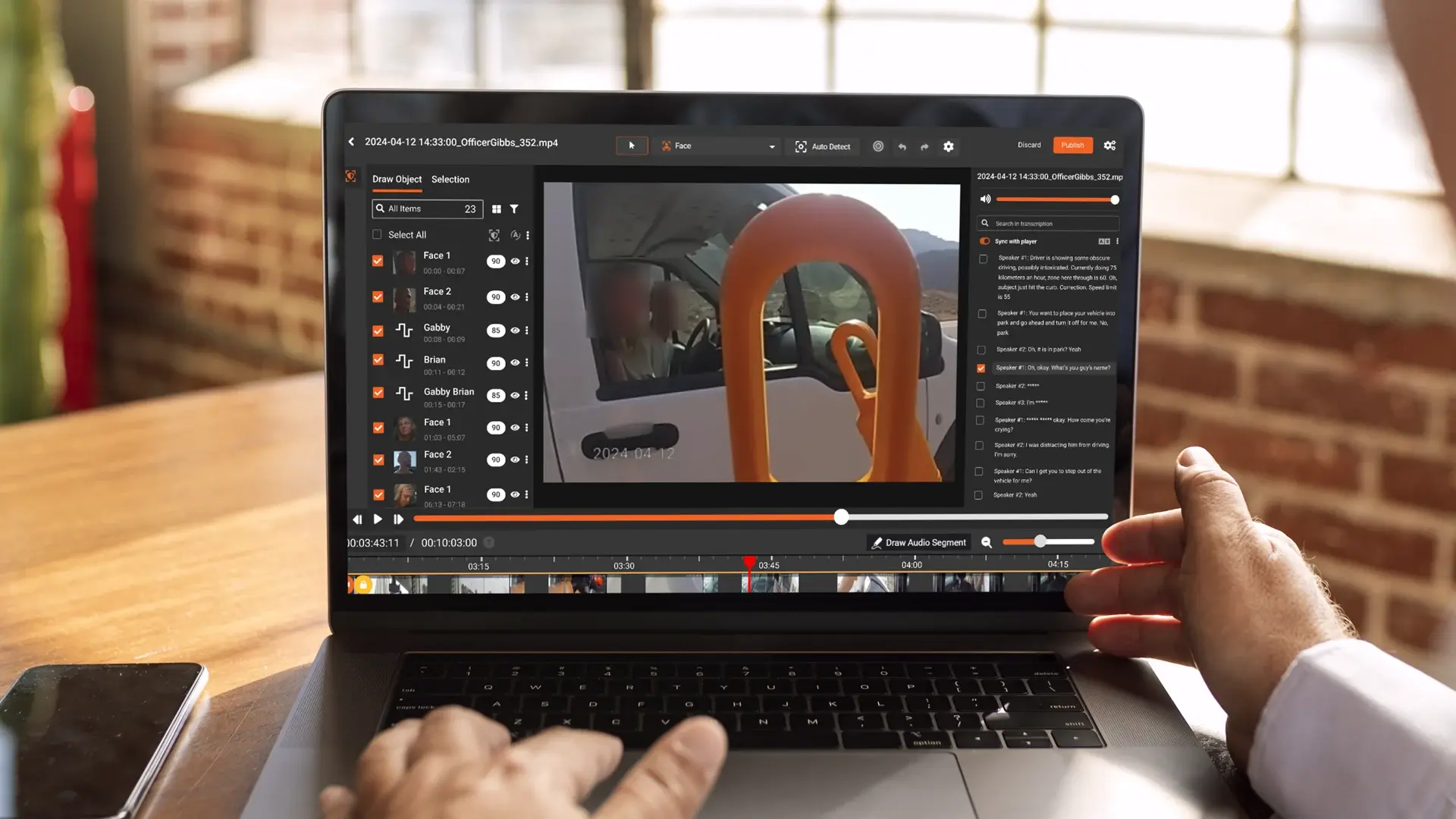
EMS and fire agencies are capturing more video than ever before. Body cameras on paramedics and firefighters. Dashcams on ambulances and apparatus. Caller-submitted footage from emergency video platforms. In-vehicle recording systems on patient transport units.
When public records requests arrive for this footage, and they do arrive, agencies discover a compliance challenge that most redaction guidance does not address directly: EMS and fire agencies face dual compliance obligations. HIPAA protects patients. CJIS governs criminal justice information for agencies that work alongside law enforcement. And public records law requires timely disclosure regardless of which obligation applies.
This post breaks down what EMS and fire agencies need to know about video redaction, what a compliant workflow looks like, and what to require from any redaction tool before processing sensitive footage.
What Types of Video EMS and Fire Agencies Need to Redact
Unlike law enforcement, which has well-established redaction protocols for body camera footage, EMS and fire agencies are often navigating this terrain without clear precedent. The footage they hold includes:
Body-worn camera footage from paramedics and firefighters
Increasingly common as agencies adopt BWC programs for liability protection and training documentation. This footage routinely captures patients in crisis, residential interiors, and bystanders.
Dashcam recordings from ambulances and fire apparatus
Route recordings that capture faces, license plates, addresses, and in some cases the approach to active incidents.
Caller-submitted video from 911 and emergency platforms
Footage shared by callers using video-to-911 tools during emergencies. This content was shared under duress and was never intended for public distribution.
In-vehicle patient care recordings
Systems that capture the patient compartment during transport. These recordings contain PHI by definition since they show a patient receiving medical care.
Training videos that include real incident footage
Internally produced content that may have been edited from live call recordings without the same redaction care applied to released records.
Each format can contain patient faces, spoken medical information, bystander identities, residential addresses, and location data. The compliance requirements that apply depend on the content of the footage, not the device that captured it.
The Dual Compliance Challenge: HIPAA and CJIS
HIPAA
The Health Insurance Portability and Accountability Act defines protected health information broadly. PHI includes any information that could identify a patient and relates to their health condition, medical treatment, or payment for care. Video footage that shows a paramedic treating a patient, including the patient's face, spoken name, address, or medical condition, is PHI.
EMS agencies are almost universally covered entities or business associates under HIPAA. Fire departments that operate or staff EMS services are also covered. This means:
- PHI cannot be disclosed without appropriate authorization or an applicable exception
- Vendors who process PHI on your behalf must sign a Business Associate Agreement (BAA)
- Disclosure in response to a public records request must be structured to protect PHI, typically through redaction, before release
The public records obligation does not override HIPAA. It defines the timeline and format for disclosure. HIPAA defines what must be removed before that disclosure happens.
CJIS
The CJIS Security Policy applies to criminal justice information, which is data associated with criminal proceedings, incidents, and investigations. Fire and EMS agencies may not think of themselves as criminal justice entities, but many are operationally connected to law enforcement in ways that trigger CJIS obligations:
- County-level agencies that operate under a unified public safety or emergency services department alongside a sheriff's office
- Joint dispatch systems where EMS and law enforcement share a single CAD (Computer-Aided Dispatch) platform
- Incidents where EMS or fire responds to an active crime scene alongside law enforcement
- Mutual aid responses where agencies share records or footage
When footage or associated data is shared with law enforcement or is processed under systems covered by CJIS, the Security Policy's requirements for data handling, transmission, and storage apply. This includes the redaction vendor.
For a detailed breakdown of how CJIS requirements apply to audio and video recorded during emergency dispatch, see our 911 Call Redaction for CJIS Compliance Guide.
Both at Once
The most common scenario for county-level EMS and fire agencies is that a single incident, such as a drug overdose at a residence where law enforcement also responds, produces footage that simultaneously contains PHI (the patient receiving care) and criminal justice information (the law enforcement response). Both HIPAA and CJIS apply to the same file.
A redaction workflow and tool that satisfies one obligation but not the other is not a solution.
What Needs to Be Redacted in EMS and Fire Footage
The elements that must be redacted before public release depend on the applicable exemptions and the specific content of each recording, but the following categories apply across virtually all EMS and fire footage subject to public records requests:
Patient faces and full bodies
The most direct HIPAA identifier: a visible patient is an identifiable patient. Full-body redaction matters because clothing, build, and posture can identify an individual even when the face is obscured.
Spoken names, addresses, and medical information
Paramedics state patient names and addresses verbally during radio transmissions and handoffs. Medical status such as "he's a diabetic," "she's on opioids," or "the patient has a history of schizophrenia" is spoken on camera. Audio PII detection is as important as visual redaction. Learn more about how AI audio redaction handles spoken PHI in EMS recordings.
Bystander and minor faces
Family members, neighbors, and bystanders who appear on scene did not consent to appear in a public record. Minor faces are typically exempt from disclosure under most state open records frameworks.
License plates and house numbers
Location-identifying details that, combined with other information, can identify individuals and residences.
On-screen medical monitor data and visible documents
Cardiac monitors, patient care report tablets, and other equipment visible in frame may display identifiable patient data. AI document redaction capabilities can detect and redact visible on-screen text across video frames.
What a Compliant Redaction Workflow Looks Like
Step 1: Receive and identify the request
Determine what footage has been requested and what compliance obligations apply. Is there PHI in the recording? Was law enforcement present? Is there a minor visible?
Step 2: Retrieve the footage
Pull the recording from your evidence management system, dashcam storage, or body camera platform. Log the retrieval in your chain of custody.
Step 3: Upload to your redaction platform
If deploying on-premises, upload directly within your network. If using a cloud-based tool, confirm your BAA is in place and the deployment meets any applicable CJIS requirements before uploading PHI or criminal justice content.
Step 4: Run automated detection
VIDIZMO Redactor's AI scans video and audio simultaneously for:
- Faces and full bodies
- License plates
- Spoken PII: names, addresses, dates of birth, medical identifiers, and 33+ additional spoken PII categories
- Visible text in frame, including on medical equipment and documents
- Custom patterns specific to your agency's data
Detection covers 40+ PII and PHI types in a single processing pass.
Step 5: Human review
Review the AI's detections before finalizing. Confirm that all required elements are covered. Adjust confidence thresholds if the AI has missed anything or flagged elements that should not be redacted. This step is the quality control layer: automated detection reduces the work, but human review ensures accuracy and defensibility.
Step 6: Export the redacted copy, retain the original
The redacted output is a separate file. The original footage remains in your system with its chain of custody log intact. You release the redacted version; the original is your evidentiary copy.
Step 7: Document the release
Your chain of custody log should record who processed the footage, what was redacted, what exemption basis was applied, and when. This documentation is your compliance record if a release decision is challenged.
For a deeper look at how this workflow applies to law enforcement footage, see our guide on body-worn camera redaction and the state-by-state open records compliance guide for law enforcement.
Deployment Considerations for EMS and Fire Agencies
On-premise deployment ensures that all footage, including PHI-containing patient care recordings, stays within the agency's environment. AI processing runs on your servers. Nothing leaves your network. This is the simplest path to satisfying both HIPAA and CJIS simultaneously.
HIPAA-compliant cloud with a signed BAA is an option for agencies with cloud infrastructure. The requirement is not that you avoid the cloud: it is that any cloud environment processing PHI must be covered by a BAA and must meet your data residency requirements. Dedicated or government cloud environments such as Azure Government and AWS GovCloud are typically appropriate; shared commercial SaaS platforms are not.
Multi-user access allows multiple staff, including records clerks, compliance officers, and department administrators, to collaborate on redaction workflows without creating duplicate files or losing chain of custody. Role-based access controls ensure each user sees only what they are authorized to see.
For a broader comparison of deployment options and tool capabilities, see our redaction software guide for secure data disclosure.

Key Takeaways
- EMS and fire agencies face dual compliance obligations: HIPAA for patient data and CJIS when operating alongside law enforcement or under joint dispatch systems
- Any footage capturing a patient receiving care is subject to HIPAA, regardless of whether it was captured by a body cam, dashcam, or caller-submitted video platform
- Public records and FOIA laws require timely disclosure. HIPAA does not exempt agencies from release obligations; it governs how redaction must be handled before that release
- Redaction must cover patient faces, full bodies, spoken PII, license plates, house numbers, and visible medical data
- On-premise deployment or a BAA-backed cloud solution is required to stay compliant when processing patient-containing video
- A structured, repeatable redaction workflow reduces legal exposure and speeds up response times for records requests
- Chain of custody logging provides a defensible record of every action taken on footage before release
FAQ
Frequently Asked Questions
Do EMS agencies need to redact video before responding to public records requests?
Yes. EMS footage that contains PHI must have identifying patient information removed before public release. The public records obligation defines the timeline for response; HIPAA defines what must be redacted before disclosure.
Does HIPAA apply to body camera footage from paramedics?
Yes, when that footage captures a patient receiving care. The recording medium does not change the analysis. If the footage contains identifiable patient information and relates to medical treatment, it is PHI under HIPAA.
What is the difference between HIPAA and CJIS compliance for fire and EMS agencies?
HIPAA governs the protection of patient health information. CJIS governs criminal justice information, which is data associated with criminal incidents, investigations, and proceedings. Fire and EMS agencies may trigger CJIS obligations when they share systems or records with law enforcement or when their footage captures criminal activity as part of a joint response.
Can EMS use cloud-based redaction software for patient video?
Yes, provided the vendor signs a BAA and the cloud environment meets your data residency and CJIS requirements. Shared commercial SaaS platforms without a signed BAA are not a compliant option for PHI-containing footage.
What information must be redacted from EMS incident footage before public release?
At minimum: patient faces and full bodies, spoken names and medical information, bystander and minor faces, license plates, house numbers, and any visible medical monitor data or documents in frame.
Does CJIS compliance apply to fire departments that work alongside law enforcement?
CJIS applies when an agency handles criminal justice information, including through shared CAD systems, joint responses, or mutual aid data sharing. Fire departments that operate in these contexts should consult with their agency's CJIS systems officer to determine the scope of their obligations.
How do EMS agencies maintain chain of custody when releasing redacted footage?
Use a redaction platform that logs every action on the file: who accessed it, what was changed, when, and under what authority. Maintain the original footage separately with its own chain of custody log. Release only the redacted copy. VIDIZMO Redactor's audit logging captures this automatically and stores it within your environment.
TopicsRedactionRedactorSecurity and Compliance

About the author
Ali Rind is a Product Marketing Executive at VIDIZMO, where he focuses on digital evidence management, AI redaction, and enterprise video technology. He closely follows how law enforcement agencies, public safety organizations, and government bodies manage and act on video evidence, translating those insights into clear, practical content. Ali writes across Digital Evidence Management System, Redactor, and Intelligence Hub products, covering everything from compliance challenges to real-world deployment across federal, state, and commercial markets.
You may also like

Making a Digital Recording the Official Record
Most guidance about digital court recording assumes the argument is over. It describes microphones, channels, ...

A Maturity Model for Court Digital Evidence: Foundational, Developing, Advanced
Budget conversations about court technology go badly when the ask is a product and well when the ask is a stage.

Online Evidence Portal or eFiling: Where Should Exhibits Actually Be Submitted?
Courts deciding where exhibits should be submitted are choosing between an online evidence portal for court exhibits ...