The hardest problem in monitoring was never detection. It is deciding what deserves a human, and every failed deployment in this industry failed there: either the system told people everything, and they stopped listening, or it was tuned to tell them almost nothing, and it went silent on the day it existed for. Human organizations solved this problem long ago with a structure so familiar it is invisible, the junior watcher and the senior judge. The guard notices something and calls the supervisor; the triage nurse flags the chart the physician should see; the analyst escalates the transaction the reviewer should read. Cheap, continuous attention at the bottom; expensive, contextual judgment above it; and a deliberate handoff between them. This article is about that structure rebuilt in software, the escalation chain from detector to model to person, which is the architecture underneath everything this series has described, and it belongs to the operations thread under our pillar guide to AI-powered video analytics for manufacturing.
The three tiers
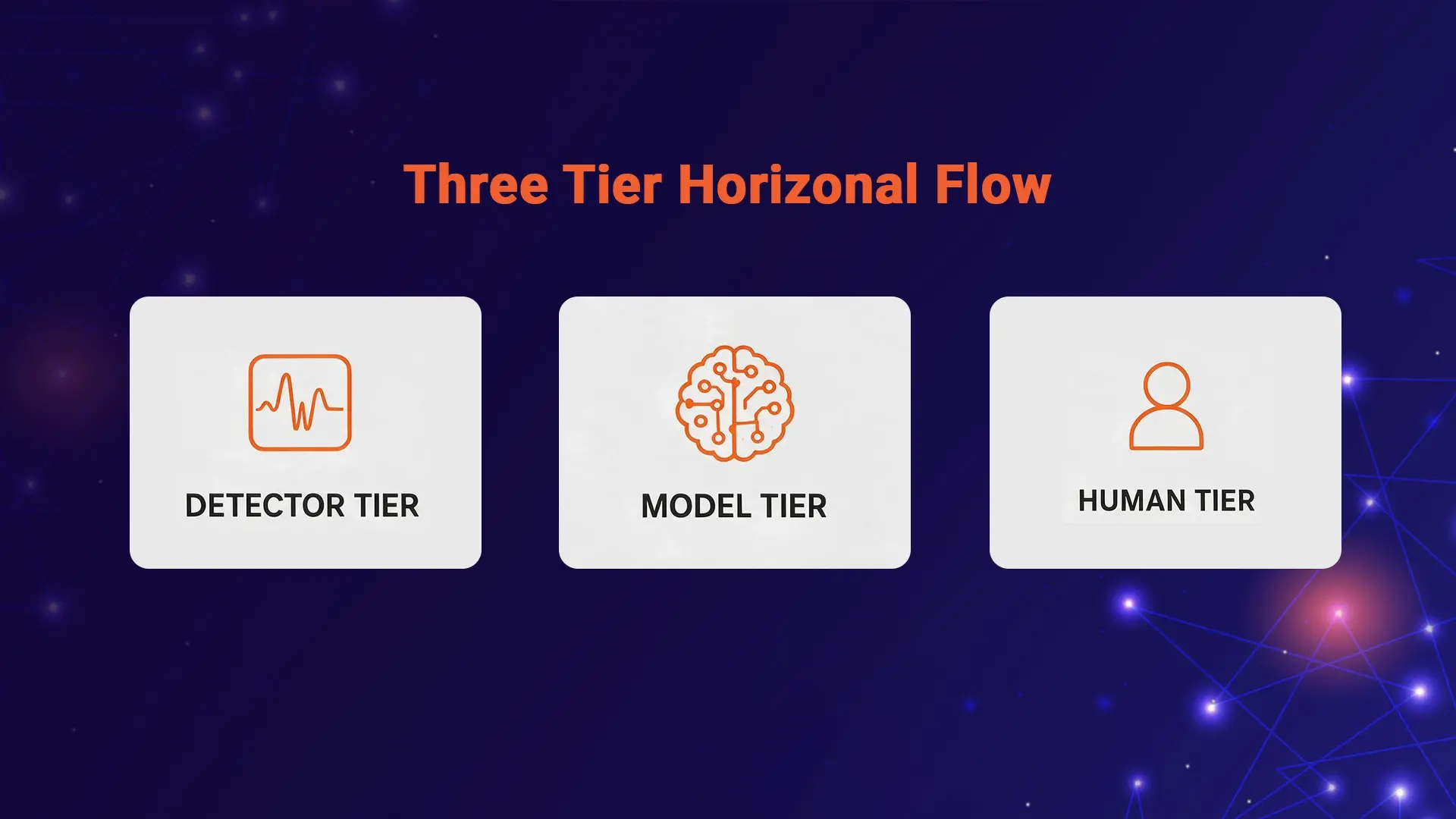
The chain has three tiers, and each exists because of what the tier below cannot do.
The detector tier runs always and everywhere: the trained detection types, zone rules, and tracking this series builds on, evaluating every enrolled camera continuously on the plant's own hardware. Its virtues are vigilance and cost, it never blinks and it scales across hundreds of cameras, and its structural limit is context. A detector knows a person entered the zone; it cannot know whether the entry is the maintenance tech with a live permit or the beginning of the incident the plant will remember. Tuning helps, severity and confidence per the alert-fatigue disciplines, and no threshold manufactures judgment.
The model tier is the new piece, and its job is the second look. When a detection or rule fires something ambiguous, the surrounding clip, cached from the live pipeline, goes to a multimodal model with a written question: describe what the person near the press is doing, does this fallen figure appear to be in distress or working, is this loading operation proceeding normally. The answer arrives seconds later, and it carries what the detector lacked, an account of the situation rather than a classification of an object. The mechanics and the honest limits are the ones the anomaly article establishes: cadence not real-time, no quotable accuracy, prompt shapes answer, prompt preserved in the record.
The human tier receives what the policy routes to it, and receives it enriched: the alert that arrives carries the detection, the model's reading, and the clip, so the supervisor's first glance lands on an assessed situation rather than a raw flag. One thing about the ordering deserves stating plainly, because it is written policy rather than fixed architecture, set per detection type and zone: the ambiguous middle waits for the second look, which is the entire point of the tier, while the gravest detection types, a worker down, smoke in frame, page immediately and the model's reading lands in the same alert seconds behind the page. The design goal of the whole chain is stated in one line: every alert a person acts on should already have been looked at twice, and the gravest page never waits for the second glance.
How the second look reduces interruptions
Run the arithmetic the alert-fatigue article opens with, and the middle tier's role becomes visible in the numbers. A tuned detector layer on a mid-size camera network still surfaces tens of ambiguous events a day, the person-near-machine that is usually maintenance, the dwell that is usually a phone call, the after-hours motion that is usually the cleaning crew, and each one, pre-chain, is a human interruption costing a glance and a context switch. The model tier absorbs precisely this category: the usual cases resolve to descriptions that match expected patterns and settle to the log, the unusual ones escalate with their reading attached, and the human interrupt rate drops by the share of ambiguity the model resolves, which in practice is most of it.
The asymmetry rule from the fatigue article governs the chain's tuning: a false escalation costs a supervisor a glance, a false settle costs whatever the event was, so the model tier is biased to escalate on doubt, and the bias is affordable because the human tier is no longer drowning. The chain does not make attention free; it makes attention hierarchical, spending machine review on the many and human judgment on the few, which is what every functioning organization already does with people.
The user-facing description of this deserves plainness, because vendors fog it: nothing here is instantaneous in the strict sense, and nothing needs to be. The detector fires as the event is tracked; the escalated clip is analyzed seconds behind the moment; the enriched alert lands seconds after that. Against the alternative this series keeps in view, the event discovered at shift end or in the incident review, the chain's seconds are not a compromise, they are the entire improvement, and the one tier that must never wait on a model, the immediate-page severity tier, the fall-zone entry during a lift, pages straight from the detector, chain bypassed by design.
How the chain feeds everything else
Seen from above, the escalation chain is not a feature among the others in this series; it is the junction they all pass through, and its output feeds three directions at once.
Downward, the chain's dispositions become the tuning signal for the machinery underneath. Every human judgment on an escalated alert, confirmed, cleared, wrong question, flows back as the tuning signal the triage workflow captures, adjusting thresholds, rewriting prompts in the governed register, and retiring the escalations that never survive review.
Sideways, the events the model quietly settles still count for something. What the model resolves to the log remains an event, timestamped and classified, feeding the exposure rates, near-miss maps, and correction ledgers of the Key Performance Indicator (KPI) framework, so the quiet outcome of most escalations is measurement rather than silence.
Upward, the events that survive both looks become the triggers for assembly. An escalation the human tier confirms is the starting gun for the investigation graphs of the agentic article: the event that survived two looks now gathers its own context, footage history, machine records, procedure references, and arrives at the reviewer as a briefing. The full chain, detector to model to person to agent, is the plant's monitoring nervous system: reflexes at the bottom, attention in the middle, deliberation on demand at the top.
Known failure modes and countermeasures
An architecture article owes its readers the ways the architecture goes wrong, and the chain has three characteristic failures, each preventable if named. The first is silent-middle decay: the model tier's prompts drift out of date as the plant changes, its settles become misses, and nobody notices because settled events are quiet by design. The countermeasure is the sampling audit, a small random slice of settled events reviewed by a human each week, which prices the tier's real miss rate and catches drift while it is cheap. The second is escalation inflation, the mirror image: reviewers, burned once, tune the middle tier to escalate everything, and the chain degenerates into the raw alert stream it replaced. The countermeasure is the interrupt-rate metric on the monthly review, with the same seriousness as any KPI, because the chain's product is a defensible interrupt rate and a rising one is a defect. The third is provenance loss under pressure: in a serious incident, people bypass the chain, pull clips directly, and the assembled record fragments. The countermeasure is procedural, the incident playbook works through the chain's own artifacts, because the chain's audit trail is precisely what the aftermath will need, and the fastest path to the footage runs through it anyway.
Deploy one tier at a time
The chain deploys incrementally, and the increments are the articles of this series in order. The detector tier stands first, tuned silent-then-ramped, and delivers value alone, most sites run it for months before adding tiers. The model tier arrives next where ambiguity concentrates: pick the two or three alert types whose false-positive burden is highest, put the written question behind each, and measure the human interrupt rate before and after, which is the tier's whole business case in one number. The agent tier arrives last, on the event types whose investigations are formulaic, under the probation discipline the agentic article prescribes.
Governance travels with each tier, and by now the series' pattern is the plant's pattern: processing on site, on the plant's own hardware, for the latency and sovereignty reasons stated throughout; the question register governing what may be asked of footage; the no-discipline and no-identification commitments binding every tier equally; and audit logs across detections, escalations, prompts, and dispositions, so the chain that judges events can itself be judged. The workforce conversation about the model tier is worth having explicitly, and it has a plain sentence available: the second look exists so that people are interrupted less and judged never, and the register of questions is open to the safety committee like everything else.
The chain also travels well across use cases, which is its final economy: the same three tiers serve the safety program in the morning, the quality review at noon, and the security desk overnight, with only the detection types, questions, and recipients changing. A site that builds the chain once owns the architecture for every monitoring conversation this series contains, and the per-use-case cost drops to configuration.
The clip is the chain's quiet workhorse, and its handling deserves a sentence before the summary. Every escalation carries its footage forward, from cache to model to alert to whatever investigation follows, and the same object serves each tier without copies proliferating: the model reads it, the supervisor watches it, the graph cites it, and the audit trail records each touch. That single-object discipline, one clip, one identity, many logged viewers, is what lets the chain's output stand up later as evidence rather than as a folder of screenshots with disputed origins.
What to tell the executive sponsor
The chain resists elevator summaries because it is three technologies, and the version that survives contact with a steering committee is a staffing analogy rather than an architecture diagram. The site is hiring three kinds of watcher. The first never sleeps, costs almost nothing per camera, and reports exactly what it was trained to see. The second reads situations, works in seconds, and filters the first's reports so people see only what deserves them. The third assembles case files on demand. None of them replaces the supervisors and engineers; they change what those people spend attention on, from watching and compiling to deciding. Framed that way, the budget conversation lands on familiar ground, what is an hour of supervisor attention worth and how many are currently spent on glances and assembly, and the metrics this article prescribes, interrupt rate, settle-audit miss rate, investigation backlog, become the program's ongoing answer to the question every sponsor eventually asks, which is whether the watchers are earning their keep.
One rollout sequencing note completes the picture: the chain is also the right order of organizational learning. A site that jumps straight to agents without a tuned detector layer automates the investigation of noise; a site that adds the model tier before fixing its alert routing pours judgment into a channel nobody reads. The tiers are numbered for a reason, and the discipline of earning each one, silent baseline, tuned thresholds, measured interrupt rates, then escalation, then assembly, is the same discipline that makes each tier's evidence trustworthy when it finally matters, in the review, the audit, or the courtroom.
How VIDIZMO fits
The tiers map to the platform the way this series has consistently drawn it. VIDIZMO AI Live Insight is the detector tier, detection types, zones, tracking, severity, and event-driven recording on the plant's existing cameras, processed on premises, plus the frame cache the second look draws on. AI Intelligence Hub is the model and agent tiers, the event-driven workflows that catch a detection and put the written question, the human-in-the-loop gates, and the investigation graphs above them, with every answer returning as a structured event. The Nexus portal holds the clips, the audit trail, and the search surface underneath it all, and the alerting layer delivers the enriched result, detection, reading, clip, to the roles that own the response.
The one-page test for whether a site needs this article's architecture is its current alert log: count last month's alerts, count the fraction a human meaningfully reviewed, and count the ambiguous majority in between. The chain exists for that middle count, and if it is large, the site is already paying for a second look, in supervisor attention, without receiving one.