
by Ali Rind, Last updated: May 21, 2026
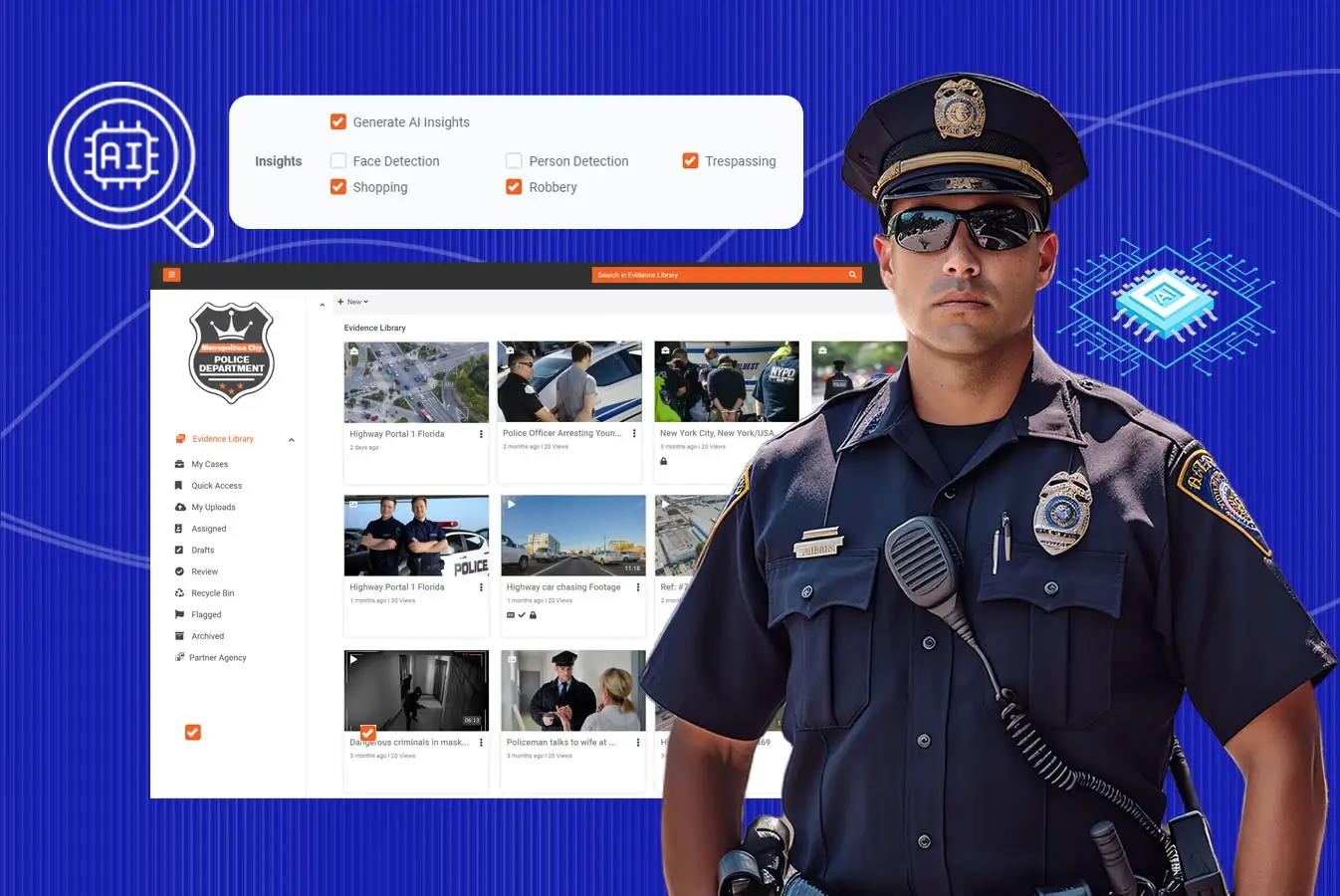
Law enforcement agencies are generating more digital evidence than ever, including body camera footage, surveillance video, audio recordings, and forensic files that investigators must process, analyze, and share under strict chain of custody requirements. In 2015, the Chula Vista Police Department estimated its 200 sworn officers could generate roughly 33 terabytes of body camera data per year, a figure documented in a Yale Law and Policy Review analysis of body camera storage burden. Manual review at that scale is not operationally viable.
AI-powered digital evidence management changes that equation. Modern systems automate transcription and translation across 82+ languages, detect objects, faces, and license plates across hours of footage, accelerate redaction for FOIA and public records compliance, and enable intelligent search that cuts evidence review from hours to minutes, all while maintaining the chain of custody documentation courts require.
This guide covers the core AI capabilities now built into enterprise digital evidence Management Systems, the measurable outcomes agencies are reporting, and what to evaluate before committing to a platform.
How AI Improves Police Evidence Management
Modern police departments generate massive volumes of digital evidence daily which includes footage that traditional review workflows cannot process at the speed investigations require. AI evidence management systems address this at scale through several core capabilities.
AI evidence management systems address this challenge through several capabilities. AI-powered search tools locate relevant information across thousands of files using keywords, facial recognition, and metadata analysis. Object detection algorithms automatically identify and categorize faces, vehicles, weapons, and other items within video evidence. Automatic speech recognition transcribes audio and differentiates between speakers in interviews or intercepted communications.
These tools reduce evidence processing time from hours to minutes while ensuring critical information is not overlooked during investigations.
Core AI Applications for Police Agencies
AI Transcription and Translation
AI-powered automatic speech recognition converts spoken words from body cameras, interviews, and intercepted communications into accurate, searchable text. Advanced systems transcribe audio in over 40 languages and translate content into 50+ languages, eliminating barriers in multilingual investigations. Speaker diarization distinguishes between different speakers, simplifying report writing and evidence review.
Object and Face Detection
Computer vision algorithms automatically identify and categorize faces, persons, license plates, vehicles, weapons, and custom objects within video evidence. Facial attribute prediction estimates characteristics like approximate age and gender when seeking unidentified individuals. This capability proves valuable for suspect identification and tracking stolen property across thousands of hours of footage. For a closer look at how this works in practice, see our breakdown of AI-powered object detection for video evidence.
Activity Recognition and Sentiment Analysis
AI detects specific activities such as trespassing, robbery, or loitering in surveillance footage, enabling proactive responses to potential threats. Sentiment analysis evaluates speech patterns, tone, and word choice to classify speakers' emotions as positive, negative, or neutral. This helps investigators assess witness credibility and identify stress indicators during interviews.
AI-Powered Search and Retrieval
Rather than manually reviewing hours of footage, investigators use AI-powered search to locate relevant evidence using keywords, spoken phrases, detected objects, and metadata tags. Search capabilities span spoken words, on-screen text through OCR, faces, and auto-generated tags, reducing evidence discovery time from hours to minutes. See how AI chatbot search across video evidence works in real investigative workflows.
Automated Summarization
AI generates concise summaries of lengthy video evidence and auto-creates chapters for faster case review. Investigators can ask natural-language questions and receive precise, timestamped insights with citations, accelerating the transition from raw footage to actionable intelligence and court-ready documentation.
For a broader look at how AI is being applied across public safety operations, see AI use cases for public safety.
AI-Powered Redaction for Compliance
Responding to FOIA requests and discovery requirements demands redacting personally identifiable information from evidence before release. Manual redaction of a single video can consume hours of staff time.
AI redaction tools automatically detect and obscure faces, license plates, names, phone numbers, and other PII in videos, audio, documents, and images. Bulk redaction capabilities process multiple files simultaneously while maintaining chain of custody integrity. This automation ensures compliance with privacy laws while dramatically reducing labor costs and response times for public records requests.
Facial Attribute Prediction for Investigations
When surveillance footage captures an unknown individual involved in a crime, investigators often have limited identifying information. AI facial attribute prediction goes beyond recognition. It analyzes footage to estimate attributes like age range, gender, and activity type, narrowing the pool of potential matches and accelerating identification, particularly when combined with other evidence sources.
Responsible deployment requires human-in-the-loop verification: every AI-generated prediction is reviewed by a trained analyst before any action is taken. This approach balances investigative efficiency with the civil liberties protections that public trust demands. VIDIZMO logs all attribute predictions as searchable metadata, giving investigators an additional query dimension without removing human accountability from the process.
AI-Powered Surveillance and Anomaly Detection
Manual video monitoring is one of the most resource-intensive tasks in law enforcement. Operators watching live feeds experience attention fatigue within 20 minutes, and most agencies lack the staff to cover every camera around the clock.
AI video analytics change this equation. Modern systems monitor dozens of camera feeds simultaneously, detecting anomalies in real time without requiring continuous human attention. Algorithms flag abandoned vehicles, trespassing in restricted zones, loitering, and other suspicious patterns automatically. When the system detects an anomaly, it alerts the relevant operator with a timestamp and visual context — cutting response time significantly.
Critically, flagged events enter the evidence management workflow immediately. They are searchable, auditable, and tied to a chain of custody from the moment of detection — not just temporary alerts that disappear when a shift ends.
Benefits of AI for Law Enforcement
AI implementation delivers measurable improvements for police agencies across multiple dimensions.
Investigations that previously required days of manual video review now complete in hours. The Belle Fourche Police Department in South Dakota reduced property crime and vandalism calls from over 1,000 to just over 200 within six months of deploying AI-enhanced cameras.
Key benefits include accelerated evidence processing and case resolution, reduced labor costs through automated transcription and tagging, improved accuracy in suspect and object identification, better resource allocation through predictive analytics, enhanced compliance with CJIS, FIPS, and privacy regulations, and court-ready chain of custody documentation.
FOIA and Public Records Compliance Automation
Public records requests are a growing operational burden for law enforcement agencies. State and local departments routinely receive thousands of FOIA and open records requests each year, many involving body camera or surveillance video. Releasing this footage requires redacting the faces of bystanders, minors, and uninvolved individuals, along with license plates, addresses, and other personally identifiable information.
Manual redaction is slow. A single hour of video can take eight or more hours to process frame by frame. Multiply that across hundreds of requests per month and agencies face a backlog that can stretch response times from days to months, creating compliance risk and legal exposure.
AI automates the end-to-end FOIA workflow. AI models detect and track faces, license plates, and 40+ PII categories across video, audio, documents, and images. Redaction masks follow subjects across frames, handling occlusion, movement, and camera angle changes automatically. Redactions are mapped to FOIA exemption codes (Exemptions 1 through 9), routed through QA review, and packaged for release reducing per-file processing time from hours to minutes. VIDIZMO Redactor supports bulk batches tested at over 1.1 million recordings while maintaining chain of custody throughout the compliance workflow.
AI, Court Admissibility, and Explainable AI
AI tools help investigators work faster, but how those tools handle evidence determines whether findings hold up in court. Three principles govern defensible AI use in law enforcement investigations.
AI as a support tool, not the final arbiter
AI surfaces segments, generates transcripts, and flags relevant material, but human investigators validate every critical finding before it influences a case. This human-in-the-loop structure protects investigative integrity and gives agencies a clear answer when handling practices are questioned under cross-examination.
Chain of custody through the AI workflow
Original files must be preserved in immutable storage with cryptographic hashing. AI-derived metadata, including transcripts, detections, and summaries, must remain separate from raw evidence. Every access event, annotation, redaction, and sharing action must be logged with timestamps and user identities. When a defense attorney challenges how evidence was handled, agencies must be able to produce a complete, system-generated record, not a reconstruction from emails or memory.
Explainability for the courtroom
Agencies should document the AI model versions applied, the confidence thresholds used, and the human verification steps followed at each stage. This documentation supports expert testimony and allows prosecutors to explain how AI assisted, and did not replace, the investigative process. For more on courtroom-ready evidence handling, see our guide on how to present video evidence in court.
Strategic Adoption: How to Roll Out AI Evidence Management
The agencies that get the most operational lift from AI evidence management are not the ones that buy the most capable platform. They are the ones that plan the rollout in stages, train their people, and pick a partner that can support the work past the initial deployment.
A workable adoption plan has four steps. Assess current capabilities and gaps by mapping how evidence is currently collected, stored, redacted, and disclosed, and where the bottlenecks are. Define objectives and success metrics before evaluating platforms, so the procurement is driven by operational outcomes rather than feature checklists. Phase the implementation to manage cost and refine processes, often starting with a single high-volume use case like FOIA redaction or body camera review before expanding to the full evidence lifecycle. Invest in training and change management, since the technology only delivers value if investigators, analysts, and command staff actually use it.
Partnering with an experienced technology provider matters more than most agencies realize. The difference between a platform that lands well and one that stalls is often the quality of implementation support, training, and ongoing system optimization, not the underlying software.
Evaluating AI Evidence Analysis: What to Test Before You Commit
Feature demonstrations rarely reflect real-world performance on an agency's own evidence types. When piloting AI evidence analysis, focus on workflow impact metrics rather than capability checklists.
Review time reduction
Measure how long an investigator takes to locate a specific segment without full playback, using actual case material. If AI search doesn't reduce this from hours to minutes on your evidence types, including body-worn camera, in-car footage, and interview recordings, the capability isn't production-ready for your environment.
Investigator usability
Can investigators locate relevant segments without specialist AI training? Mature platforms abstract AI complexity so investigators work within familiar evidence review workflows. If the system requires a dedicated AI operator, adoption will stall.
Prosecutor usability
Test whether AI-generated transcripts and metadata packages are usable in actual disclosure workflows, not just demo material. Discovery packages with time-coded transcripts and audit logs should be ready for prosecutor handoff without manual reformatting.
Redaction accuracy across formats
Accuracy must be consistent across your actual evidence types, not just clean studio footage. Test against the proprietary camera formats, poor lighting conditions, and audio quality typical of your agency's material.
Security and governance alignment
Verify CJIS-aligned controls, encryption in transit and at rest, granular role-based access, multi-factor authentication, and configurable retention and legal hold policies before any procurement decision, not after.
For a complete framework on managing digital evidence across the full investigative lifecycle, see our guide on digital evidence management best practices for law enforcement.
Implementation Requirements and Considerations
Successful AI adoption in law enforcement requires addressing security, compliance, and ethical factors.
CJIS compliance is mandatory for systems handling criminal justice information. Platforms must provide encryption, multi-factor authentication, tamper verification, granular access controls, and automated chain of custody tracking. Deployment options should include cloud, on-premises, or hybrid configurations based on agency requirements.
Data quality directly impacts AI accuracy. Agencies must ensure databases contain reliable, unbiased information. Community engagement builds public trust through transparency about how AI informs policing decisions.
VIDIZMO Digital Evidence Management System: AI Built for Law Enforcement
VIDIZMO Digital Evidence Management System is a CJIS and FIPS-compliant platform recognized in the IDC MarketScape 2023, trusted by agencies including Adams County Sheriff's Office, DuPage County Sheriff's Office, and California DMV.
AI-Powered Evidence Analysis Transcribe and translate evidence in 40+ languages, detect faces, objects, and license plates automatically, recognize activities, and analyze speaker sentiment to surface critical insights in minutes.
Intelligent Search and Retrieval Search across spoken words, on-screen text, detected objects, and metadata tags. Ask natural-language questions and receive timestamped answers with citations for faster case review.
Automated Redaction Bulk redact faces, license plates, PII, and custom objects from videos, audio, documents, and images to meet FOIA, discovery, and privacy compliance requirements.
Secure Evidence Management Centralize body camera footage, CCTV, 911 audio, drone video, and case files in one repository with encryption, tamper verification, granular access controls, and automated chain of custody.
Flexible Deployment Deploy on cloud, on-premises, or hybrid infrastructure. Integrate seamlessly with existing RMS, CAD, and case management systems through open APIs.
Ready to accelerate your investigations with AI?
See how VIDIZMO Digital Evidence Management System helps law enforcement agencies manage, analyze, and redact digital evidence faster. Get a personalized walkthrough of AI-powered transcription, search, and redaction features built for your agency's needs.

The Future of AI in Law Enforcement
Artificial intelligence is no longer a future concept for law enforcement. It is an operational necessity for agencies facing growing caseloads with limited resources. Departments that implement AI-powered evidence management, automated transcription, intelligent search, and compliant redaction position themselves to deliver faster justice while maintaining evidence integrity.
The challenge lies in selecting AI solutions that balance capability with security and ethical considerations. Successful implementation requires CJIS-compliant infrastructure, quality training data, proper staff education, community transparency, and ongoing oversight to ensure AI serves both law enforcement effectiveness and public safety.
About the Author

Jump to

AI Transformation in Law Enforcement: Improving Evidence Management

Streamlining Redaction in Law Enforcement for Privacy and Compliance


No Comments Yet
Let us know what you think