If you searched for what happened to Vimeo, something probably prompted it: a news story, a support ticket that sat unanswered longer than usual, or a colleague asking whether the videos are safe. The short version is that Vimeo was acquired, taken private, and then lost most of its staff, all within about four months. The platform is still running. What comes next is less certain, which is why many teams are quietly reviewing Vimeo alternatives while they still have time to choose calmly.
Here is the full timeline, what it means in practice, and what is worth doing about it.
The Timeline
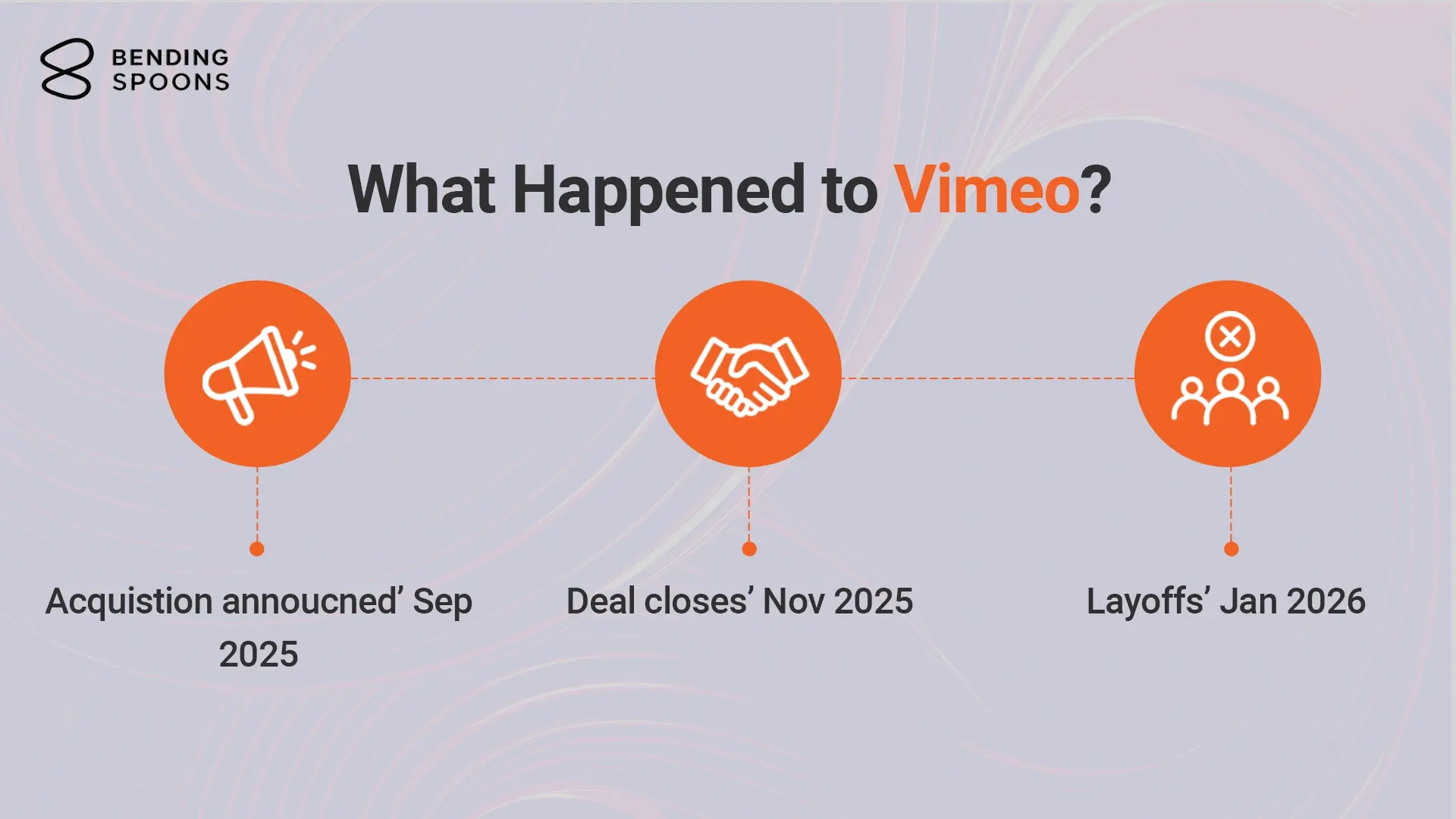
September 2025. Vimeo announced it had agreed to be acquired by Bending Spoons, a Milan-based technology holding company, in an all-cash deal valued at about $1.38 billion. The offer of $7.85 per share represented a premium of roughly 91 percent over Vimeo's trading price, a number that says as much about how far the stock had fallen since its 2021 spinoff as it does about the buyer's enthusiasm.
November 24, 2025. The deal closed. Vimeo's shares stopped trading on NASDAQ and the company became a wholly owned subsidiary of Bending Spoons.
January 20, 2026. Vimeo laid off the majority of its staff, reportedly including the entire video team. Vimeo had about 1,100 employees at the end of 2024.
Who Is Bending Spoons?
Bending Spoons is not a video company. It is a serial acquirer that buys established software products and runs them for efficiency, and it has been busy: Evernote in 2022 for about $200 million, Meetup and the Mosaic Group in 2024, Brightcove, the enterprise video platform it took private in February 2025 for $233 million, then Vimeo, AOL for about $1.4 billion, and Airtable for about $1.285 billion in August 2026. The company itself went public on NASDAQ in July 2026 at a valuation near $20 billion.
The pattern across those acquisitions has been consistent: deep staff reductions shortly after closing, followed by an emphasis on subscription revenue. The clearest precedent is Evernote, which laid off its entire existing staff in July 2023 and relocated operations to Europe. Whether Vimeo follows the same path on pricing is not yet known, but the playbook is public and the staffing cuts have already happened.
This also means that two of the best-known names in business video hosting, Vimeo and Brightcove, now answer to the same owner. Anyone leaving Vimeo specifically because of the ownership change should factor that in when choosing a destination.
Is Vimeo Shutting Down?
No. Vimeo continues to operate, videos play normally, and its plans, including Vimeo Enterprise, are still being sold. Nothing about the acquisition suggests the service is closing.
The practical concern is different. A platform with a fraction of its former engineering and support staff ships fewer improvements, fixes bugs more slowly, and answers tickets less quickly. Vimeo's revenue was already roughly flat, around $417 million in its final year as a public company, so the new owner's most direct lever is cost, and it has pulled it. For a personal portfolio, that may not matter much. For an organization running training, town halls, or a customer-facing video library on the platform, it is a real dependency risk.
What This Means If Your Organization Uses Vimeo
A sensible response has three parts, none of which require panic:
Know what you have. Inventory your library: how many videos, how much storage, which ones are embedded where, and which teams depend on them. Organizations are often surprised by how much accumulated in five or six years. Our guide to organizing a video library covers the audit process.
Know your exposure. Match what you actually use Vimeo for against what would hurt if support or development stalled. Live events and webinars are most sensitive to platform reliability. Compliance-sensitive content (training records, HR communications, anything with retention requirements) is most sensitive to roadmap neglect. Public marketing embeds are least sensitive; they will keep playing.
Know your exit, even if you never use it. Vimeo allows bulk export of your original video files. The harder parts of a migration are metadata, permalinks, and replacing embeds across your sites and intranets. The step-by-step Vimeo migration guide walks through the whole process, and the Vimeo alternatives comparison maps the main destinations by use case. If your requirements include running video inside your own cloud or data center, that comparison explains why deployment flexibility is the sharpest dividing line between platforms, with AI capability over the library increasingly the second.
Renewal time is also negotiation time. If you stay, this is the moment to ask for roadmap commitments and support SLAs in writing; the breakdown of Vimeo's pricing and plan limits covers what to press on.
The Larger Lesson
Vimeo's story is not unusual. Platforms get acquired, priorities change, and content that took years to build sits on infrastructure someone else controls. The organizations that handle these transitions well are the ones that treated their video library as an asset with an exit plan rather than a set of uploads. That means keeping source files, keeping metadata exportable, and preferring platforms that do not lock the door behind you.