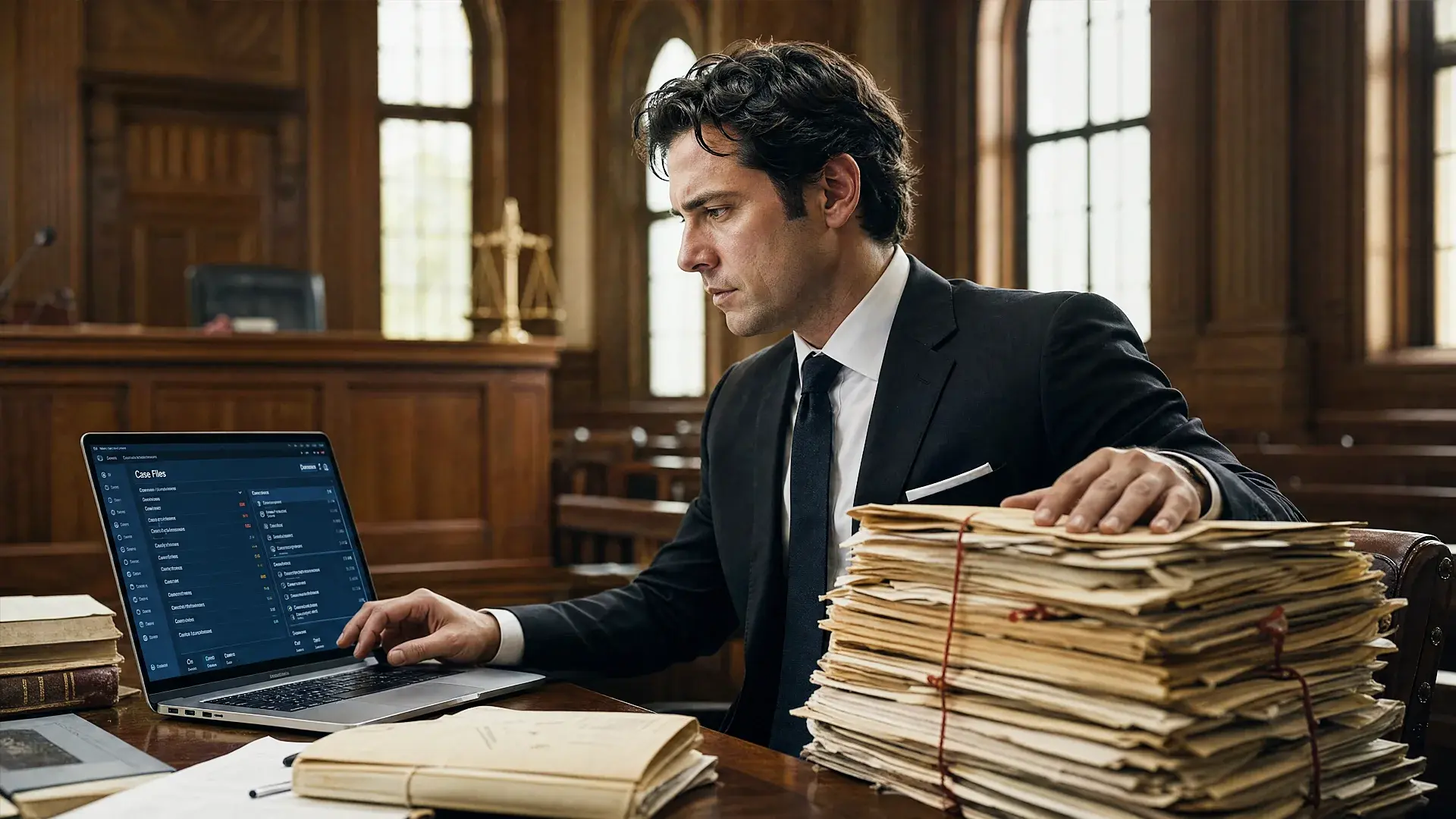
Court records digitization projects fail in a specific and repeatable way. A judiciary funds scanning, boxes are collected, images are produced, and eighteen months later the court has a large archive of pictures of documents that nobody can search and everybody still uses the paper.
The error is in the framing. Scanning converts paper to images. Digitization makes a record findable, readable by systems, and usable in a workflow. They are different projects with different costs, and only the second one delivers what the funding was actually for.
The guide to running a judicial digitalization program treats the paper backlog as a prerequisite that blocks everything downstream. This article covers scope and method.
Why the backlog blocks the rest
A court running new systems alongside a paper archive is running two record systems, and the paper one wins whenever a case predates the cutover.
The practical effects are pervasive. Staff check both. New systems hold partial case histories. Any analysis covers only recent matters. Remote working is impossible for anything touching an older file. And a case reopening after several years drops back into a manual process.
That is why sequencing puts active-material digitization early, as covered in sequencing a court digitalization program. Not all of it, and not first, but before the program depends on a complete digital record.
Scanning against digitization
The distinction determines cost and value.
Scanning produces an image. It is measured in pages per hour and priced accordingly. The output is storable and viewable and nothing more, because the text is pixels.
Digitization adds optical character recognition to make text machine-readable and searchable, classification to identify what each document is, extraction of the identifiers linking a document to a case, indexing so retrieval works, and quality assurance.
Courts that fund only the first and expect the second are the ones with the unusable archive. The additional cost is real and it is the difference between an expensive storage exercise and a usable record.
Handwriting, older typefaces, and non-Latin scripts
Court archives are harder material than the average digitization project.
Older records include handwritten annotations, marginalia, signatures, and sometimes entirely handwritten documents. Typescript from the mid-twentieth century may use typefaces and carbon copies that defeat systems trained on modern print. Stamps, seals, and overlapping impressions confuse layout analysis. And in many jurisdictions the material is in non-Latin scripts, sometimes several across one archive.
Handwriting recognition and non-Latin script support are therefore not optional extras for court archives; they are the requirement. A court evaluating suppliers should test on its own worst material rather than a clean sample, because the difference between systems shows up there and nowhere else.
Deciding what to digitize
Comprehensive digitization is rarely affordable and frequently unnecessary. Scoping is where a program protects its budget.
The categories that usually justify it: active cases, since they are in use; matters within an appeal window, since they may become active; material subject to a legal hold; and records with a statutory retention requirement that outlasts the paper's physical condition.
The categories that usually do not: closed matters beyond any retention requirement, which can be dealt with by disposal rather than digitization; and archival material of historical rather than operational value, which is a different project with different standards and often a different funder.
A middle category exists where courts digitize on demand, converting a file when it is next requested, which spreads cost over time and ensures effort follows actual use.
Indexing so a file is findable by case, not by box
The point of the exercise is retrieval, and retrieval requires that a document be locatable by the things people actually know.
That means extracting case identifiers, party names, document types, and dates, and connecting them to the case record. A digitized archive searchable only by the physical location it came from has recreated the box in software.
Where identifiers are missing or inconsistent across decades of practice, some reconciliation is unavoidable. Courts should budget for it rather than discovering it, and should accept that a proportion of the archive will resist automated matching and require human attention.
Long-term storage and retention of the resulting digital archive is covered in archiving court proceedings for retention and retrieval.
Quality assurance, and accepting imperfection
Some pages will not read cleanly, and a project that requires perfection will not finish.
The workable approach sets an accuracy target by material class, samples output rather than checking everything, flags low-confidence pages for human attention, and retains the source image alongside the extracted text so that a doubtful reading can be checked against the original.
Retaining the image matters legally as well as practically. For court records, the scanned image is frequently the authoritative artifact and the extracted text is an aid to finding it.
The corollary is that extraction errors are recoverable in a way that scanning errors are not. A misread word can be corrected later from the retained image; a page skipped during scanning, or scanned so poorly that the original has since been destroyed, cannot. That asymmetry argues for spending the quality-assurance effort at the capture stage rather than the recognition stage, which is the opposite of where most projects concentrate it.
How VIDIZMO AI Intelligence Hub fits
The platform sits above the scanner rather than replacing it.
Optical character recognition with handwriting recognition handles the material that defeats print-oriented systems. Script coverage includes Perso-Arabic, which matters for judiciaries across South Asia, the Middle East and parts of Africa whose older records are not in Latin script at all. Classification and extraction identify document types and pull the identifiers needed for indexing. Format conversion moves proprietary formats to open standards. Archival export in EAD, METS, and CSV supports handover to an archival system where one exists. And search across the resulting text is what makes the archive usable.
Stated plainly: VIDIZMO does not perform physical scanning and does not provide bureau services. A court needs a scanning operation, whether in-house or contracted, and this is the processing layer that turns its output into a record.
Scoping a project that finishes
Decide what actually needs digitizing and be willing to exclude. Fund processing rather than only scanning. Test suppliers on your worst material. Budget for identifier reconciliation. Set an accuracy target and sample rather than checking everything. Retain source images alongside extracted text.
Courts that scope narrowly finish and expand. Courts that scope comprehensively tend to run out of money holding a partial archive of images.
Request a demo to test recognition and extraction on a sample from your own archive, including the difficult material.