
by Nadeem Khan, Last updated: June 3, 2026

Criminal legal research used to mean a Westlaw subscription, a stack of statute books, and a paralegal with three highlighters. That model is breaking, and it is breaking in a specific place: the gap between what the research question now requires and what the research tools were built to answer.
A line prosecutor in a mid-sized district attorney's office carries somewhere between 80 and 120 active matters. Each one arrives with body-worn camera footage, jail call recordings, digital forensics reports, and a discovery deadline measured in hours rather than weeks. The research question has changed with the caseload.
It is no longer just "what case controls this evidentiary issue." It is "what does the controlling case say, how have the appellate courts in our circuit read it since 2024, what factual pattern matches our defendant's, and what does this witness's testimony in three prior matters say about credibility."
A paralegal cannot answer that in an afternoon. Neither can a legal research tool that only reads text. That second part is the problem this post is about.
What criminal legal research actually covers in 2026
Criminal legal research is the structured investigation of legal authorities, evidentiary materials, and factual history needed to prepare a charging decision, motion, plea, trial, or appeal. A first-year law student pictures Lexis and a treatise. A working prosecutor or defender pictures three workstreams that all have to land at the same time.
The first is doctrinal research: statutes, controlling case law, model jury instructions, sentencing guidelines. Legacy tools handle this well, and they have for decades. The second is evidentiary research: searching the actual record of the case, which now means hours of body camera footage, recorded interviews, jail calls, surveillance video, and forensic reports alongside the documents produced in discovery. The third is contextual research: a witness's prior testimony in other matters, defendant history across jurisdictions, expert witness publications, similar fact patterns in adjacent cases.
These streams collide on every motion. A suppression motion is not just Mapp v. Ohio and its progeny. It is the officer's body camera footage reviewed frame by frame, the radio dispatch transcript compared against the written report, and a check on whether that same officer testified consistently in three prior suppression hearings. A pure case-law tool answers one third of that question. The other two thirds still happen by hand, and that is where the time goes.
Why manual research is falling behind
The short answer is volume. The longer answer is volume colliding with constitutional deadlines.
Discovery in a routine felony has grown several times over in the past decade as digital evidence became standard. Public defender offices report single matters that generate hundreds of hours of body camera footage, all of which someone has to review before trial. Our guide on video evidence in e-discovery covers how this volume reshapes the review process. On the prosecution side, the caseload math is similar. The material multiplied. The number of hours in a workday did not.
Manual research at that scale fails in predictable ways. Exculpatory evidence sits unwatched in a discovery folder for months because nobody had time to scrub the footage. A prosecutor misses an intervening appellate decision because the research happened at charging and was never refreshed before a trial six months later. These are not edge cases. They are what happens when you ask humans to scan more material than humans can scan.
The fix is not more paralegals. Most offices have tried that. The marginal hire helps for about a quarter, then the caseload absorbs the new capacity and the backlog returns. The constraint was never labor. It is the ceiling on how much heterogeneous material one mind can hold during one matter.
How AI is changing the workflow
Three separate shifts are happening, and they are worth separating because they involve different tools and different risks.
The first is in doctrinal research. Generative AI now drafts case summaries, finds circuit splits, and surfaces analogous fact patterns. Westlaw, Lexis, and a wave of newer entrants have built this in. The risk here is well documented: hallucinated citations to cases that do not exist. Stanford RegLab's Large Legal Fictions study found that general-purpose LLMs invented legal citations in 69 to 88 percent of test queries, and a follow-up study found that even purpose-built legal research tools hallucinated 17 to 33 percent of the time. Any tool that does not retrieve from a verified case-law database and cite the passage it relied on is unsafe for filing. Full stop.
The second shift is in evidentiary research, and this is where the larger productivity gain lives. AI transcription, computer vision, and semantic search make it possible to ask questions across the whole record. Show me every jail call where the defendant says the word "gun." Find every body camera segment where Officer Diaz is on scene. Surface every reference to the silver Honda in the witness statements. Six years ago each of those questions took a paralegal a week. With the right platform, ninety seconds. We covered the mechanics of this in our post on the AI chatbot for video evidence search.
The third shift is in contextual research. Agentic retrieval systems can connect a witness's prior trial transcripts, deposition testimony, and recorded statements into one searchable corpus. Most teams overlook this one because the source material is scattered across court reporters, opposing counsel's productions, and the agency's own archives. Getting it into one place is the win.
Where generic AI legal research tools fall short
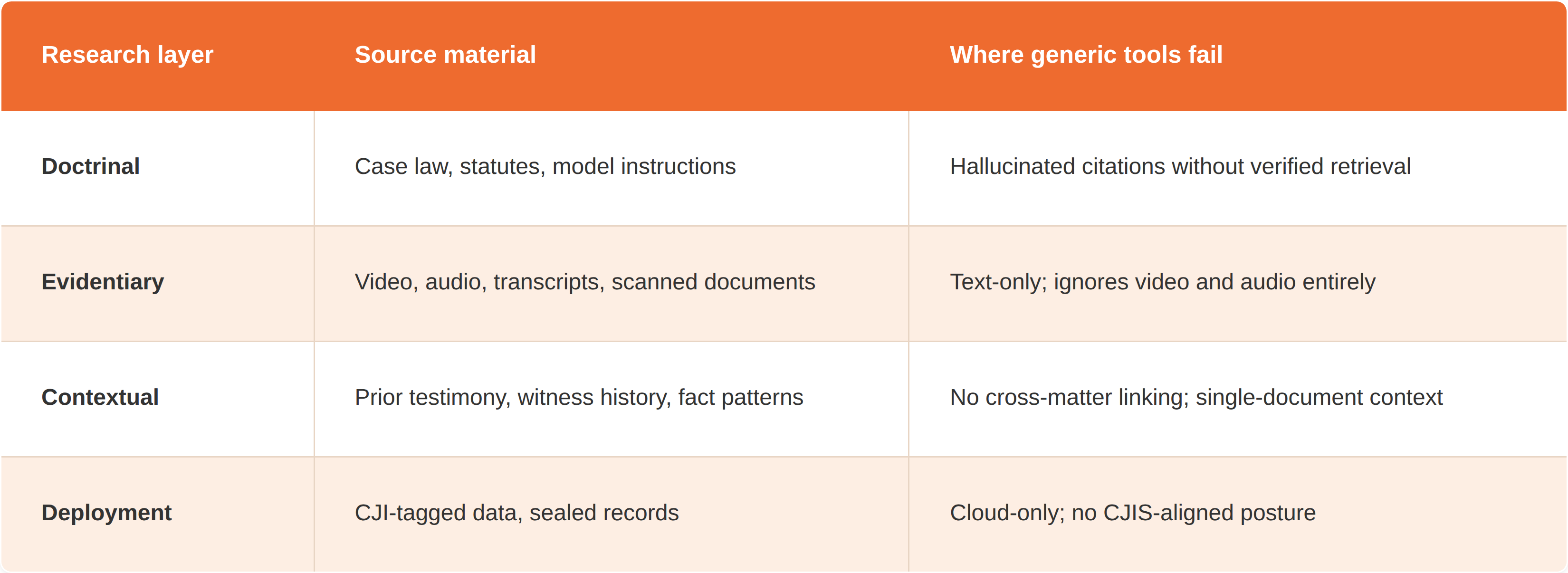
Most AI legal research tools were built for civil practice, and the fit for criminal work is poor in three specific ways. None of this makes the tools bad. They are accurate to their category. The question is whether the part of criminal work they leave out is small enough to ignore.
First, text-only retrieval. The dominant architecture is text RAG over case law and statutes. Criminal matters are not text-first. Digital media, including video, audio, and image content, now makes up the bulk of evidence volume in felony prosecutions. A text-only system cannot index any of it, which means the lawyer is still reviewing footage by hand.
Second, cloud-only deployment. Several leading tools require sending queries and documents to a multi-tenant cloud. That conflicts with the FBI CJIS Security Policy, which moved to version 6.0 in December 2024 and now maps its requirements for encryption, personnel access, and continuous monitoring to NIST 800-53 controls. A few vendors offer FedRAMP-authorized deployments. The list is short and the procurement timeline is long.
Third, no source grounding outside the doctrinal layer. A generic chatbot will summarize a witness statement that does not exist or invent a date for prior testimony. Citation is now table stakes for case-law answers, but it is uneven for evidentiary answers, and that is exactly where the consequential errors happen.
What to evaluate before buying
A practical rubric for criminal practice comes down to four questions. We have used a version of it with offices we work with, and it filters out wrong-fit tools quickly.
Does the system cite the specific passage, timestamp, or page behind every answer, and can a reviewer click through to the source in one step? If not, the tool is not usable for filing. This is the first question because it ends the most conversations. Our post on legal AI for evidence analysis goes deeper on what source grounding looks like across media types.
Can it process video, audio, images, and documents in one workflow, or is it text-only? A text-only tool covers maybe 30 percent of a modern criminal record. For the rest, a paralegal is still scrubbing footage.
Can it deploy in a CJIS-aligned posture? Some jurisdictions have not authorized commercial cloud for criminal justice information, and CJIS Security Policy 6.0 raised the bar on identity controls, encryption, and audit accountability for everyone handling CJI, with full compliance expected by October 2027. On-premises and private cloud options matter more in this segment than almost anywhere else in legal tech.
Does it surface confidence scores and route flagged outputs through human review before they move forward? A black-box chatbot that answers confidently with no audit trail will eventually produce a sanctionable error. The architecture that avoids this has a name, which brings us to the last point worth making before the product section.
The architecture matters more than the model
The 2025 conversation was about which model was best. The 2026 conversation has moved on, because model performance on legal benchmarks is now close enough that the orchestration layer is the differentiator. Agentic RAG with retrieval verification, source citation, multi-step reasoning, and human review checkpoints will outperform a raw chat session with any frontier model. The architecture is what produces a defensible answer. The model is just one part inside it.
How VIDIZMO Intelligence Hub fits
Intelligence Hub, the platform we build at VIDIZMO, was designed for exactly this workload. It is one option in a growing category, but a few things are worth flagging for buyers working through the rubric above.
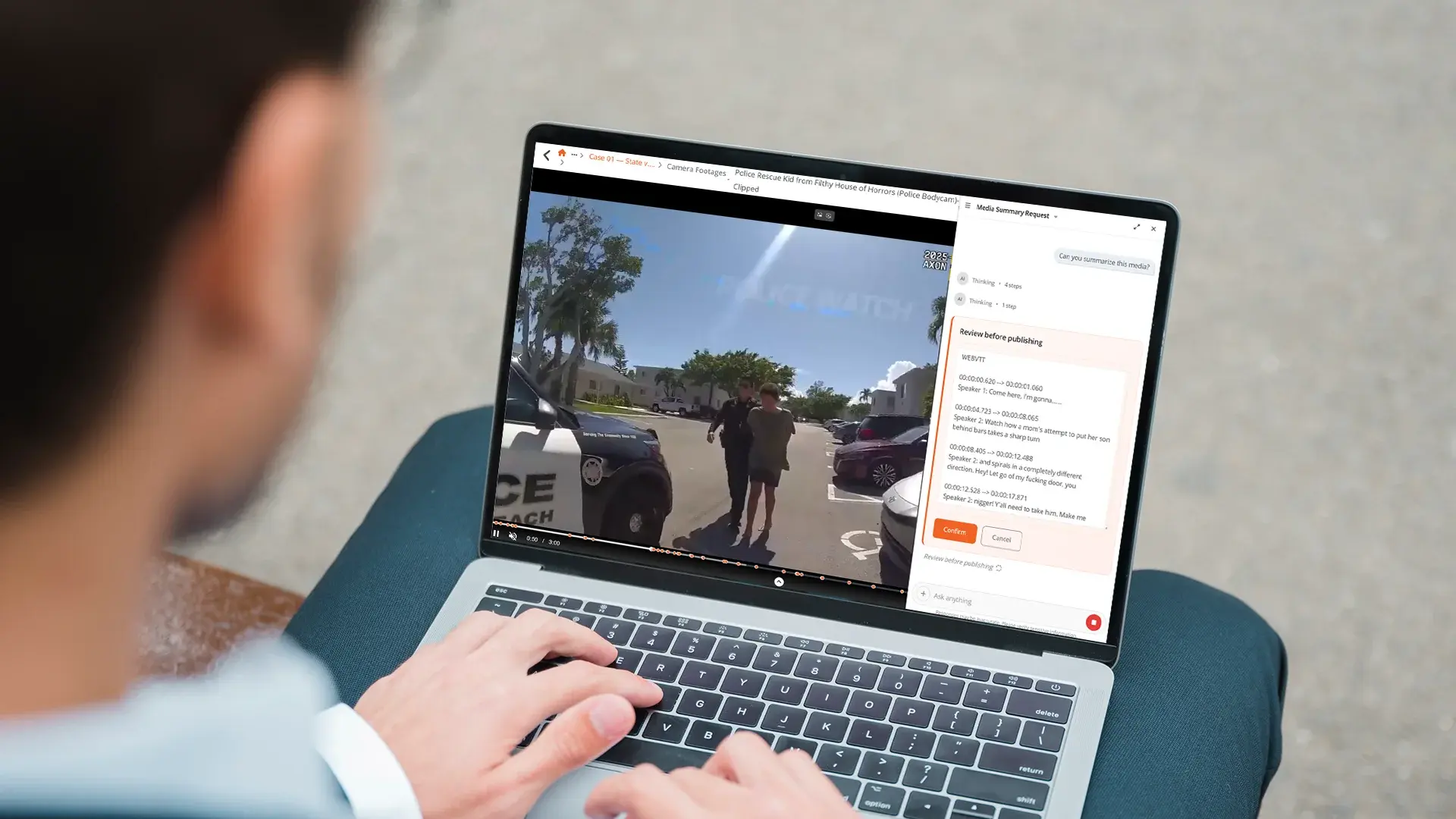
An attorney asks one question and gets an answer from everything in the case: body camera footage, jail calls, recorded interviews, scanned reports. What took a paralegal a week of scrubbing footage now takes seconds. Every answer cites its exact source, so it holds up when a judge asks where it came from. The South Carolina Attorney General's office already uses this through CaseBot for prosecution evidence search. Nothing moves into a filing without human review.
If your research tool only reads text, it only sees part of the case. Request a demo of Intelligence Hub to see the rest.

Where this is heading
Two predictions for the next eighteen months. Text-only legal research tools will add multi-modal capability or lose the criminal practice segment, because the economics are too obvious to ignore. And the courts will start producing standards for AI-assisted legal work, including citation verification and disclosure. The 2024 sanctions against attorneys who filed hallucinated briefs were the first wave. The rulings coming in 2026 and 2027 will define what verification actually requires.
The offices that adopt agentic, multi-modal, source-grounded systems now will be positioned for those standards when they land. The ones still running text-only research over partial records will be doing rework. For smaller jurisdictions, cloud-first is usually the right call and on-prem is an unnecessary fight. For state attorneys general and federal prosecutors handling sealed material, on-prem or hybrid almost always wins.
About the Author

Jump to
Why Document-Only Legal AI Misses Half the Case Record

AI Case Timeline Generation: Build Prosecutor Chronologies Faster

No Comments Yet
Let us know what you think