
by Ali Rind, Last updated: May 18, 2026
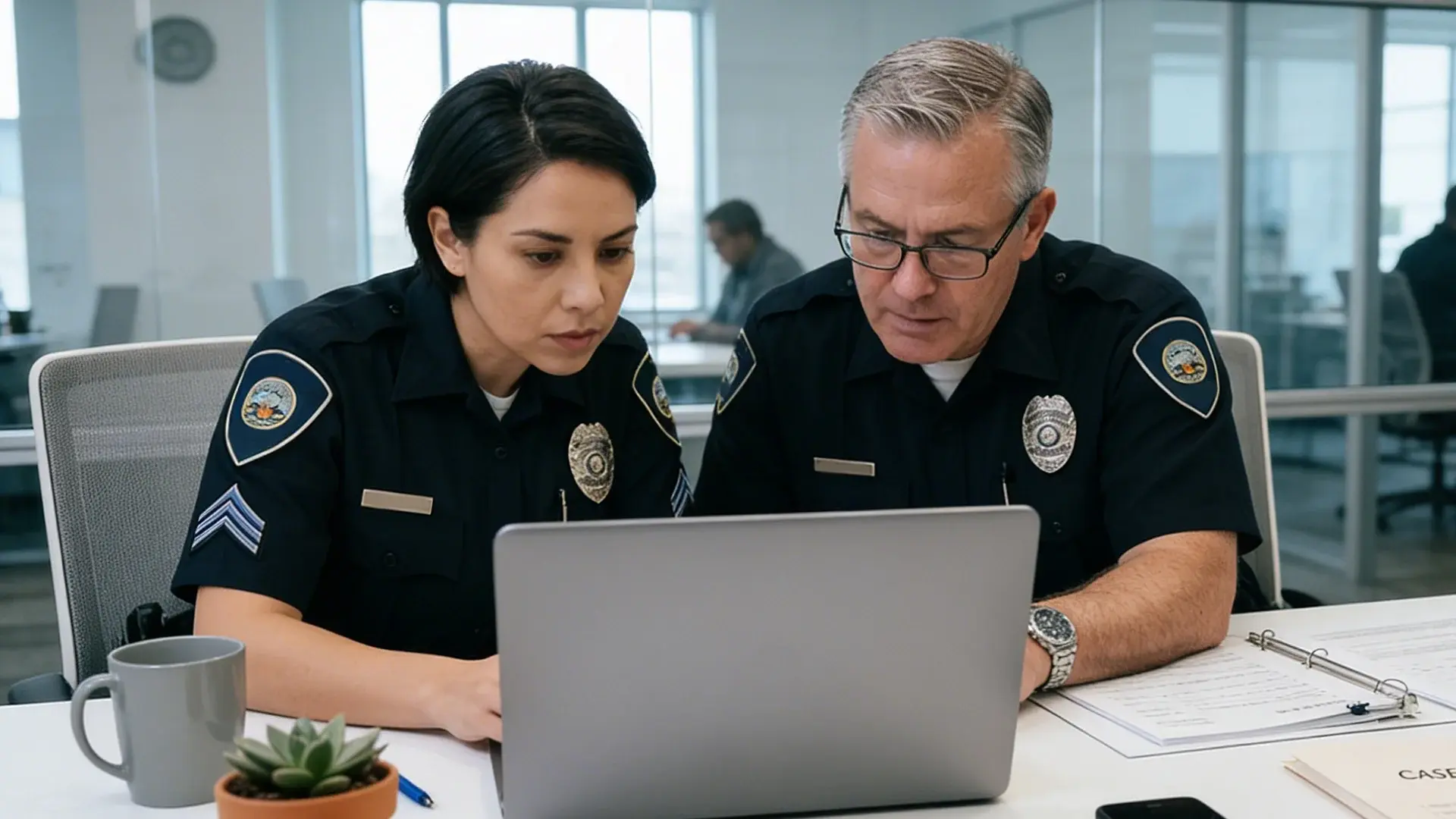
Small police departments do not get fewer open records requests than large ones. They often get more, relative to staff. A department of 15 officers may have one person handling public records, typically a records clerk, an administrative assistant, or a sergeant who picked up the duty when someone left. That person is also answering phones, processing reports, and managing court submissions.
When a video request comes in, it lands on that same desk.
This guide covers what open records video requests actually involve at the operational level, where the process breaks down, and what departments are doing to manage it without adding headcount.
Why Small Agencies Carry a Disproportionate Burden
The reason is structural rather than situational. Large agencies absorb volume through specialized roles and team capacity. Small agencies do not have that buffer.
In a department of 15 to 50 officers, the records function often sits with one person who is also answering phones, processing reports, and managing court submissions. There is no dedicated FOIA team, no overflow capacity, and no surge support. When the workload spikes, the queue stops moving.
Single point of failure compounds the problem. When the records clerk is on vacation or out sick, the FOIA queue stops moving. When they leave the role, knowledge transfer is informal and the next person inherits a partial process. Statutory deadlines do not pause for staffing transitions.
BWC adoption has outpaced staffing. A typical small agency that adopted body cameras five years ago equipped officers but did not add records staff to handle the resulting redaction work. The volume of video that has to be reviewed and redacted before release has grown materially while the records function has stayed the same size.
Public scrutiny has risen at the same time. Online content creators submit bulk requests. Civil rights groups file pattern requests across multiple agencies. Local press tracks response times. A pattern of late responses at a small agency surfaces faster than it used to, and the political consequences land on a smaller leadership team. State deadlines which is five business days in some states, twenty in others apply identically to a 25-officer agency and a 2,500-officer agency.
What Open Records Video Requests Actually Involve
A request for body camera footage sounds straightforward. In practice, it involves five distinct steps, each with its own time cost.
Intake and logging. The request arrives by email, postal mail, online portal, or in person, and someone has to log it, assign a tracking number if the department uses one, and calculate the response deadline. State statutes vary, but most give departments five to ten business days for initial response. To understand how these deadlines differ across jurisdictions, the state-by-state open records compliance guide for law enforcement is a useful reference.
Locating the footage. The request may reference a date, a location, an incident report number, or all three. Someone has to cross-reference those details against the camera system, pull the correct clip or clips, and verify they have the right footage before touching it.
Reviewing for redactable content. This is where the work begins. The reviewer watches the footage, often in real time or close to it, to identify anything that must be redacted before release. Juvenile faces, victim identity, sensitive medical information in the audio, and license plates in some contexts all require attention. The department's legal counsel or supervisor may have opinions about what else requires redaction.
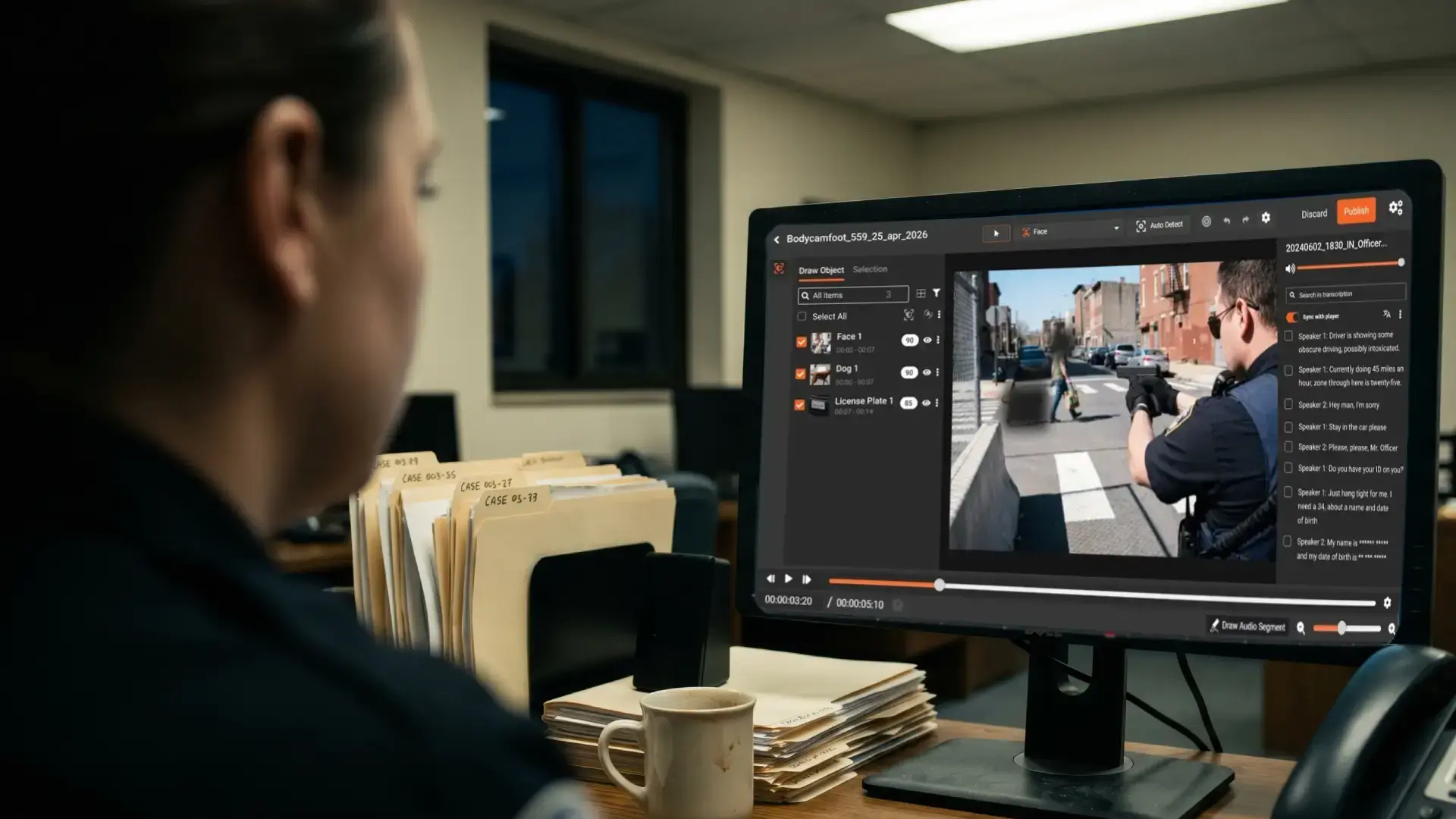
Redacting the footage. Once the reviewer knows what needs to come out, they have to actually remove it. In video, that means covering faces, blurring regions, or muting audio spans frame by frame. How long this takes depends entirely on what tool the department is using and what the footage contains.
Fulfillment. The redacted file has to be delivered by email, secure link, disc, or whatever method the requestor and department agree on. The request has to be closed in the log. If footage was withheld in part or whole, a written explanation is required.
That is five steps for every request. At low volume, it is manageable. As volume grows, or as individual requests get more complex, it stops being manageable quickly.
Where the Process Breaks Down
The bottleneck in almost every small department's open records video workflow is the same: redaction.
Intake and logging take minutes. Locating footage takes minutes to an hour, depending on how the camera system is organized. Fulfillment takes minutes. Redaction can take hours for a single clip.
The reason is how most basic video tools handle it. They detect a face or a region at one point in the video. After that, the reviewer has to manually reposition the redaction box every time the subject moves. Body camera footage makes this especially painful because the camera is always moving, subjects are always moving, and the clips are long. A 20-minute clip with one juvenile who moves through the scene continuously can take two to three hours to redact manually.
A department handling two or three of those requests per month is spending six to nine hours per month on redaction alone, more than a full workday, before accounting for any other records work.
Two other failure modes show up regularly at small departments.
No dedicated staff. When the person who handles records is also handling five other job duties, redaction work gets pushed. Deadlines get missed. When deadlines get missed, departments get complaints, appeals, and in some states, fines or litigation. The legal and financial consequences of non-compliance are covered in detail in this body-worn camera redaction legal and privacy guide.
Inconsistent review. When redaction is manual and rushed, reviewers miss frames. A face that drifts outside the redaction box for three seconds in a 20-minute clip may not get caught during review. That missed frame is in the released footage. In the case of a juvenile, that is a compliance failure, not an inconvenience.
Mixed media in a single request. A typical FOIA request now spans BWC video, dashcam video, 911 audio, the incident report, and attached photographs. Departments using separate tools for each format export separately and assemble the response by hand. The format-switching overhead is invisible in any individual file but compounds across a queue. A request covering three formats easily doubles the processing time of a single-format request.
Legacy footage from discontinued systems. Agencies that have changed BWC vendors face a specific problem: the new vendor's redaction tool will not ingest the older MP4 archive. Requests covering incidents from the legacy period either get processed manually in a generic video editor or get sent to a managed redaction service, both slow and expensive. Legacy footage is the most common reason a request sits in queue past the statutory window.
How Departments Are Handling It Today
Small departments managing open records video requests have generally settled into one of a few patterns.
Batch processing on a schedule. Instead of processing each request as it arrives, a records officer sets aside a block of time once or twice a week to work through the queue. This reduces context-switching and makes the workload more predictable. It works at low volume but creates deadline pressure when requests cluster.
Tiered review by complexity. Simple requests, such as footage with no people visible or footage from fixed cameras with stationary subjects, get processed first. Complex requests involving body camera footage with multiple people, long duration, or sensitive content get queued for more careful handling. This keeps simpler requests moving without letting hard ones block everything else.
Supervisor sign-off before release. Most small departments have someone senior review the redacted footage before it goes out. This catches missed frames that a single reviewer might not catch. It adds time, but it reduces the risk of a compliance error reaching a requestor.
Written request requirements. Some departments have moved to requiring written requests for video specifically, even when their state law does not mandate it. This creates a paper trail and gives the department a clear record of what was requested, what was released, and when.
Standardize redaction policies so decisions are not made case by case. Most small agencies have informal redaction practice. The clerk applies what they have learned, and decisions vary across reviewers and over time. A written policy that defines what gets redacted in which record type removes per-request decision overhead and produces consistent output across the queue. It also makes the work defensible: when challenged, the agency points to its policy rather than relying on individual judgment.
Move batch processing to off-hours. When the redaction tool supports batch operation, queue the day's work to run overnight. The clerk reviews completed output the next morning rather than waiting on processing during the workday. This single change typically doubles effective throughput because reviewer time stops being spent watching a progress bar.
These are reasonable adaptations. None of them solve the redaction time problem. They manage around it.
What Changes as Volume or Complexity Grows
A department that handles five video requests per month and processes them manually can survive. A department handling 15 or 20 per month runs into a wall.
The volume threshold varies, but the pattern is consistent: at some point, manual redaction consumes more staff time than the department has available, and something starts slipping. Deadlines, review quality, and other records work all suffer.
Several situations accelerate that threshold.
Multi-officer incidents. A use-of-force call or a large incident may involve three or four officers, each with their own camera. A single FOIA request may cover all of that footage. That is not one clip but four clips, each requiring independent review and redaction.
Surge requests after high-profile incidents. After a significant incident, departments often receive multiple requests for the same or related footage within a short window. The department that was processing one or two requests per week suddenly has eight to process simultaneously, all with the same deadline.
Audio redaction. Body cameras capture audio. A juvenile's name, a victim's address spoken by the officer, or medical information may all be present in the audio track. Departments that redact video but leave audio unreviewed are releasing footage with PII still in it. Adding audio review to the workflow increases per-clip time significantly. For a closer look at how audio redaction works in practice, see this overview of AI audio redaction software for law enforcement compliance.
Requests that include in-car footage. Dashboard cameras and in-car systems capture footage with license plates, bystanders, and sometimes sensitive documentation. That footage requires the same redaction review as body camera footage, with similar challenges around moving subjects and long clip duration.
What a Streamlined Workflow Looks Like
Departments that have brought redaction time down significantly are typically doing two things differently from the manual approach.
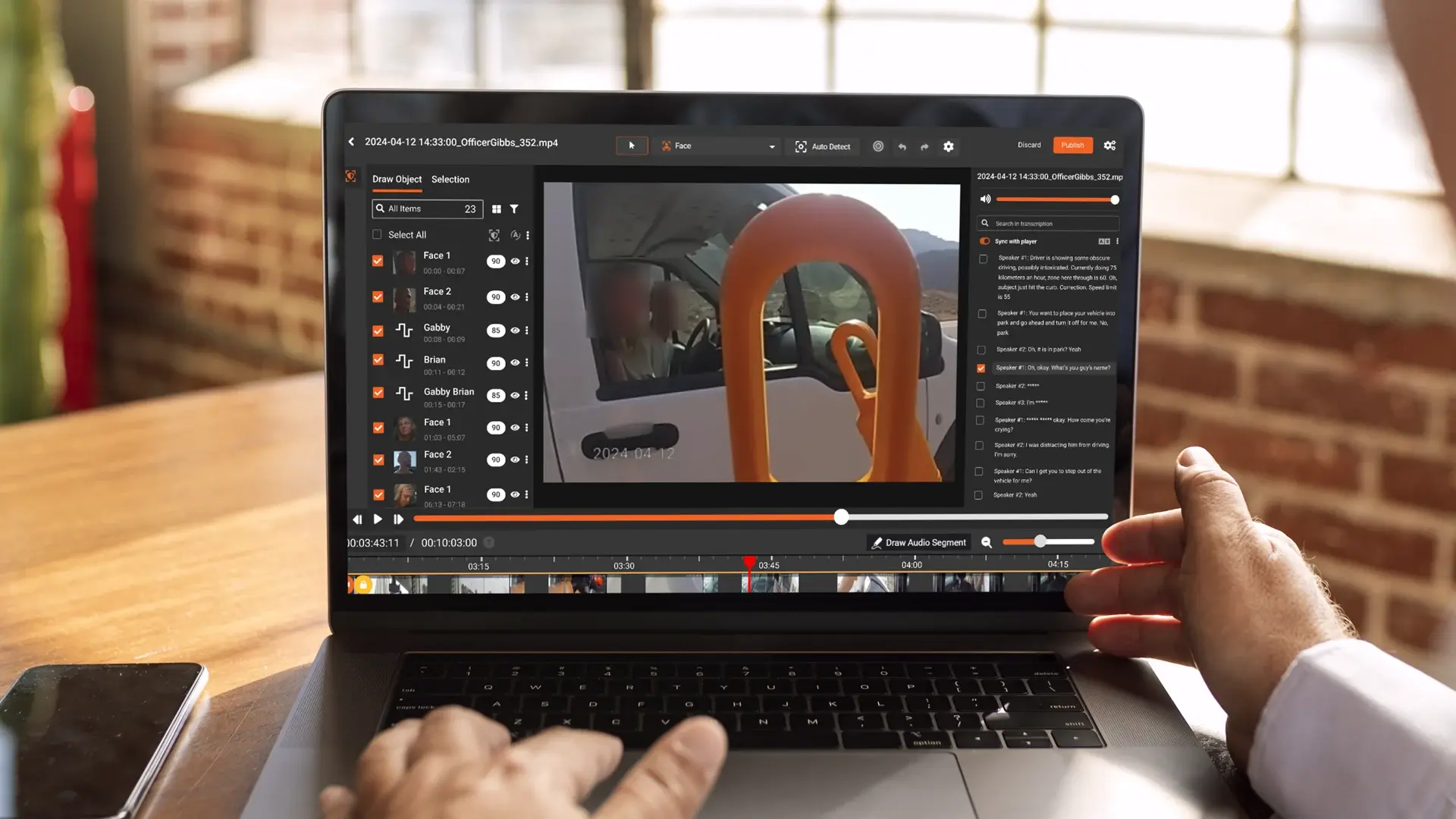
Using a tool with auto-tracking. When a reviewer marks a face or region for redaction, the tool follows that target through the rest of the clip automatically. The reviewer does not reposition the box every few seconds. They confirm the initial target, monitor for edge cases, and adjust where needed. The same clip that took two hours manually takes 15 to 20 minutes with tracking in place. This is one of the core capabilities covered in VIDIZMO's guide on law enforcement AI redaction software.
Processing audio alongside video. A tool that handles both in the same interface eliminates the second-pass problem. The reviewer watches the clip once, flags the visual redactions and the audio spans in a single session, and exports a file with both applied. This is faster and less prone to gaps than running two separate tools.
The operational change is not just speed. It is review quality. When a reviewer is not spending most of their time repositioning a box, they can actually watch the footage and catch things a rushed manual review would miss.
Contact us to see how VIDIZMO Redactor can reduce open records video processing time at your department.

Key Takeaways
-
Small departments carry the same open records compliance burden as large ones, with a fraction of the dedicated staff. The workflow itself is not complicated. Intake, locate, review, redact, fulfill. But redaction is where the time goes, and at scale, it is where the process breaks down.
-
Manual redaction with basic tools is not sustainable beyond low volume. The combination of body camera movement, long clip duration, and the need for per-frame accuracy makes manual repositioning slow and error-prone.
-
Departments that have brought the workload under control are using tools that track redaction targets automatically and handle audio in the same workflow. The time savings are real, but the more important outcome is consistency: every frame reviewed, every request documented, and a defensible record when questions arise.
About the Author

Jump to
State-by-State Open Records Compliance Guide for Law Enforcement
How to Redact Audio in Police Body Camera Footage

No Comments Yet
Let us know what you think