
by Nabeel Ali, Last updated: May 12, 2026
The digital evidence management market has consolidated around two competing philosophies. On one side sits the closed ecosystem model, where hardware, software, and storage come bundled from a single vendor. On the other sits the open platform model, where evidence management software is decoupled from camera procurement and deployment infrastructure. Axon Evidence and VIDIZMO Digital Evidence Management System are the most visible representatives of each approach.

Most comparisons between the two stop at feature checklists. That framing misses what actually decides the contract. The choice between Axon and VIDIZMO is rarely about which platform has more boxes ticked on a capabilities matrix. It is about which platform fits the agency's procurement model, deployment requirements, multi-vendor reality, and five-year cost trajectory.
This piece reframes the comparison around five strategic decisions that shape the next half-decade for any agency adopting a DEMS. Each decision sets the floor for what is possible afterward.
What Is A Law Enforcement Agency Looking For?
There are several factors that set the criteria leading to a law enforcement agency adopting a digital evidence management system. Notably, the elements they consider are entailed below:
- A system that reduces the manual workload on law enforcement officers.
- A system that digitizes the process of storing, managing, and sharing digital evidence, while also keeping security a priority.
- A system that saves the valuable time of law enforcement officers and makes policing faster and more efficient.
- A system that makes processing and analyzing terabytes and petabytes of ingested data much easier.
- A system that makes use of AI-based algorithms and methodologies to further enhance and automate law enforcement processes.
- A system that is software agnostic and flexibly integrable with existing RMS, CMS, and other systems.
- A system that is hardware agnostic and can ingest from all possible sources of digital evidence.
- A system that can be deployed over the cloud, or in an on-premises option such as local data center.
- A system that allows you to meet the necessary data rights and compliance requirements necessary for law enforcement that handles digital evidence data.
VIDIZMO Digital Evidence Management System vs Axon Evidence: The Core Difference
Axon evolved from a hardware company. Its TASER and body camera businesses gave it deep entry into agencies, and Evidence.com became the cloud destination for footage those devices produced. The platform is engineered around Axon's own hardware, which is why the integration is so clean inside the Axon ecosystem and so friction-heavy outside of it.
VIDIZMO comes from the other direction. It started as a video content management platform and grew into digital evidence by extending that core into compliance-grade workflows. The architecture was never tied to a specific camera vendor, which is why hardware-agnostic ingestion is not a marketing claim but a foundational design choice.
Every feature comparison that follows flows from this difference. Read the two product sheets side by side and the gaps look incremental. Read them through the lens of architectural philosophy and the gaps become structural.
Hardware Compatibility: Open Platform vs Axon Ecosystem
The first question every agency leader has to answer is whether they want their evidence management software tied to a specific hardware lineup or independent from it.
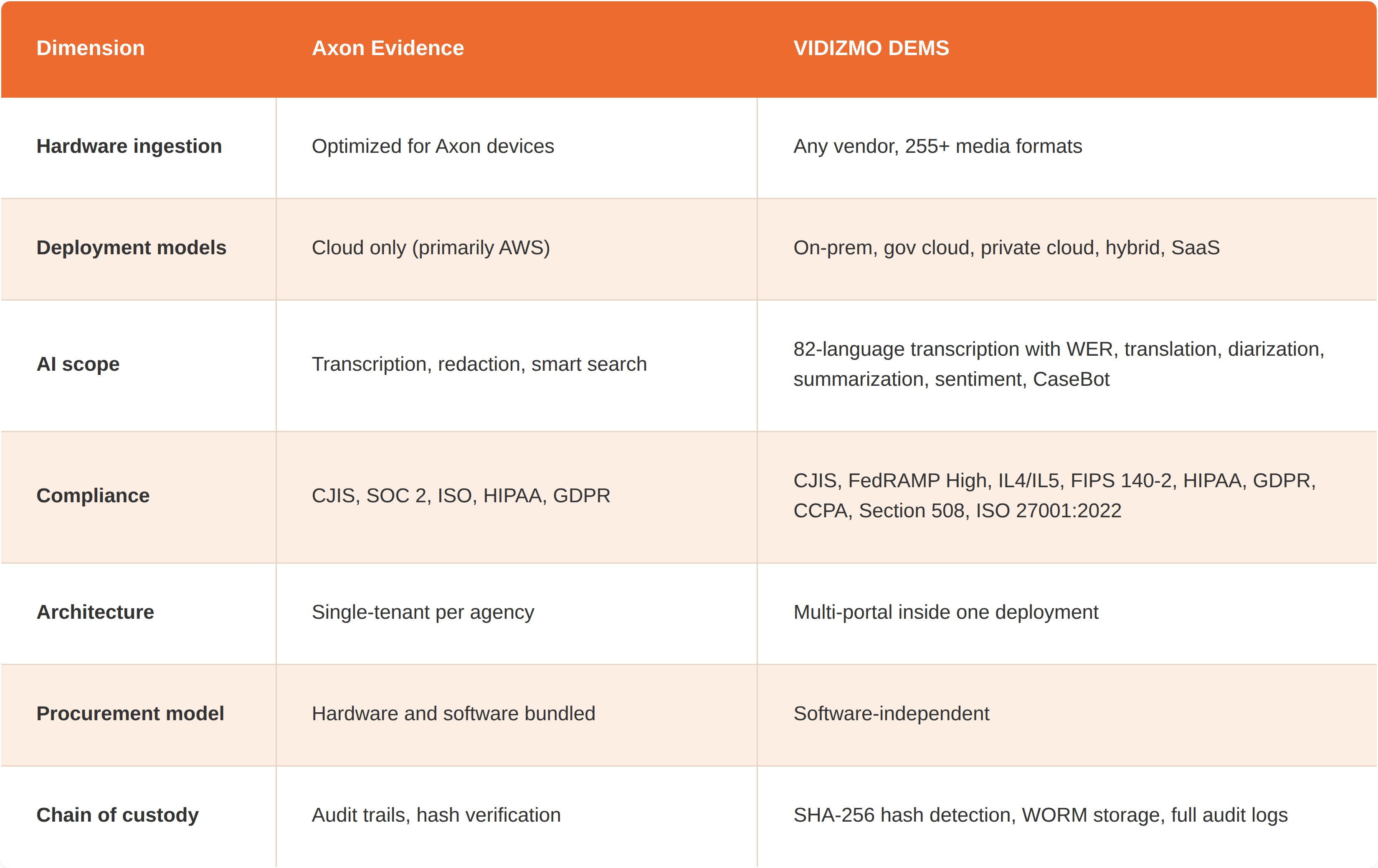
Axon's position is openly ecosystem-first. Body cameras, TASERs, in-car cameras, interview room systems, and the cloud platform are designed to work together, and the experience inside that ecosystem is strong. Agencies running an all-Axon hardware stack benefit from tight metadata flow, automatic uploads, and minimal configuration. Outside that stack, the experience degrades. Bringing footage from Motorola, Panasonic, or any non-Axon source into Evidence.com requires workarounds, additional integration cost, or both.
VIDIZMO is built to ingest evidence from any source. The platform supports more than 255 media formats and accepts input from any body camera brand, dash camera, CCTV system, drone, interview room, or mobile device. There is no preferred hardware vendor because there is no hardware business behind the software. This is the same architecture that allows VIDIZMO to integrate directly with existing CMS, RMS, and CAD systems rather than replacing them.
At year three of an Axon contract, the cost of switching hardware vendors compounds because every camera procurement decision is also a platform decision. With VIDIZMO, hardware and software stay decoupled, which means the agency can change camera vendors without changing evidence platforms, and vice versa.
Deployment Options: Cloud-Only Axon vs VIDIZMO's Five Models
Axon Evidence is a cloud-hosted platform delivered primarily through AWS, with no on-premises or air-gapped option for general agency deployment. For agencies whose compliance, data residency, or defense affiliation requirements rule out a commercial cloud, this is not a configuration limitation. It is a disqualifier.
VIDIZMO offers five deployment models from the same product. On-premises keeps evidence data and processing entirely inside agency-controlled infrastructure, which is the only viable path for agencies with intelligence, defense, or strict data residency mandates. Government Cloud runs on Azure Government with FedRAMP High and DoD Impact Level 4 and 5 authorization. Private Cloud provides dedicated infrastructure with cloud scalability in an isolated environment. Hybrid keeps routine evidence in the cloud and sensitive evidence on-premises, managed through one interface. SaaS handles agencies without dedicated IT capacity.
The strategic consequence is straightforward. Deployment flexibility is not a preference for a large share of the public-sector market. It is a compliance requirement. Any agency under data sovereignty obligations, federal contracting rules, or defense-sector security mandates cannot adopt a cloud-only platform as designed.
Procurement and Total Cost of Ownership
The procurement consequence of the ecosystem model deserves its own decision frame.
When the same vendor supplies cameras, TASERs, storage, software, training, and support, contract leverage shifts decisively toward the vendor. Each renewal compounds the cost of switching because every dependency has to be replaced at once. Agencies that have run all-Axon stacks for five or more years often describe the renewal conversation in similar terms: the price is set by the vendor, and the only realistic counteroffer is to accept it.
Decoupling evidence management software from camera procurement restores competitive balance. Camera contracts can be bid separately from software contracts, software contracts can be bid against multiple DEMS vendors, and storage costs can be negotiated independently. State and federal procurement teams increasingly require this structure for exactly this reason, with multi-vendor procurement strategies now standard in federal contracting under guidelines like the DoD Cloud Computing Security Requirements Guide.
For an agency, the practical effect is predictable budgets across renewal cycles instead of compounding cost escalation tied to a single vendor's pricing strategy.
AI Capabilities in VIDIZMO DEMS vs Axon Evidence
Both Axon and VIDIZMO offer AI capabilities, and on a feature-name basis they sound similar. Both platforms transcribe audio, both redact, both surface objects, both support keyword search. The differences appear in scope, in measurement, and in how AI is exposed to the user.
Axon's AI is structured as features inside the evidence workflow. Transcription Assistant produces English-language transcripts on demand. Redaction Assistant automates facial and license plate redaction. Smart search runs across document content and transcribed media. These capabilities work well for the workflows Axon prioritizes.
VIDIZMO treats AI as a platform layer underneath the evidence workflow. Transcription runs in 82 languages with published Word Error Rate benchmarks, which means agencies can verify accuracy against measurable standards rather than rely on vendor claims. Translation runs across more than 50 languages. Object detection covers faces, persons, vehicles, license plates, weapons, and personal protective equipment violations. Speaker diarization identifies and differentiates speakers within recordings.
AI-powered redaction automates PII removal across video, audio, documents, and images. Summarization extracts key points from long audio and video without manual review. Sentiment analysis and activity recognition support investigative pattern detection. CaseBot, a natural-language AI assistant, allows conversational querying of evidence and case data, which is a capability Axon Evidence does not currently offer.
The strategic difference is whether AI is something the platform does to specific media types, or whether AI is the substrate the entire evidence workflow runs on. For agencies processing multilingual evidence, complex investigations, or large volumes that exceed human review capacity, the platform model scales further.
Multi-Agency Architecture and Evidence Sharing
The final decision concerns how the platform handles more than one agency inside one deployment.
Axon Evidence is single-tenant per agency. Each agency operates its own instance with its own users, policies, and storage. Sharing across agencies happens at the case level through controlled access, but the underlying architecture is built around one agency at a time.
VIDIZMO's multi-portal architecture supports separate, security-isolated portals inside one deployment. Each portal can represent a different agency, department, internal affairs unit, prosecutor's office, or partner organization, with independent access controls, branding, and security policies. The same physical deployment can host a regional task force, the participating municipal agencies, a state-level oversight body, and a prosecutor's office, each with their own walled environment.
For agencies operating as standalone entities, the difference is minor. For regional task forces, state-run evidence platforms, prosecutor-agency collaborations, and multi-jurisdictional investigations, the multi-portal model removes the need for separate deployments and the integration costs that go with them.
VIDIZMO DEMS vs Axon Evidence: Feature Comparison Table
When to Choose VIDIZMO DEMS vs Axon Evidence
Axon Evidence is the right choice for agencies running an all-Axon hardware stack, operating in cloud-acceptable jurisdictions, working as a single agency without significant multi-agency or prosecutor-shared workflows, and comfortable with vendor consolidation as a procurement strategy. Inside that profile, the platform delivers tight integration and reduced configuration overhead.
VIDIZMO Digital Evidence Management System is the right choice for agencies running mixed-vendor hardware, operating under compliance or data residency mandates that require on-premises or government cloud deployment, participating in regional or state-level multi-agency platforms, processing multilingual evidence at scale, or following procurement policies that mandate decoupling software from hardware. The platform is also the only viable option for defense, intelligence, and air-gapped requirements. For agencies evaluating these criteria in detail, the 10 key features to consider in a DEMS provides a structured checklist.
The decision is rarely about which platform has more features. It is about which platform's architectural assumptions match the agency's operational and procurement reality.
Final Verdict: Choosing Between VIDIZMO DEMS and Axon Evidence
Axon Evidence is a strong product for the agencies it was designed for. Its dominance in US law enforcement is not accidental, and the integration with Axon hardware is genuinely best-in-class for agencies that have committed to that hardware path.
VIDIZMO Digital Evidence Management System is built for the agencies Axon's model does not fit, and that group is larger than it appears. Mixed-vendor hardware environments, federal compliance requirements, multi-agency platforms, multilingual evidence volumes, and procurement teams under pressure to decouple contracts all push agencies toward an open architecture. For those agencies, VIDIZMO is not a feature-for-feature swap of Axon. It is a fundamentally different operating model with different long-term economics.
For a deeper technical breakdown including migration steps, compliance certifications, and deployment specifics, see the full Axon Evidence alternative guide on digitalevidence.ai.

About the Author
Jump to

Choosing the Right Police Evidence Management Software for Your Agency
Cloud Evidence Management: CJIS-Compliant Digital Evidence Storage

No Comments Yet
Let us know what you think