
Let’s just keep it straight, an organized corporate video library is a must-have for you. Know why? Because your digital content mess holds the power to make your mind a mess. Don’t believe us? A publication by The New York Times reports that digital clutter can lead to stress and anxiety shooting up.
A study by the International Data Corporation (IDC) reported that data professionals spend as much as 30% of their time in a week searching for relevant content. Now, imagine the amount of productivity lost that can never be gained back.
This should be stopped. But how? By efficiently organizing your video library. Various online video platforms offer users the capability to organize and manage increasing video content on their corporate video library.
While a video library platform can help you store and efficiently organize your on-demand video content, unleashing the true potential of a VOD platform is only possible when you become aware of the best practices for organizing the video library.
As organizations produce more video content for training, internal communication, marketing, and compliance, managing these assets becomes increasingly complex. Without a structured corporate video library, teams struggle with poor discoverability, duplicated content, access control issues, and wasted time searching for the right video.
An effective corporate video library solves these challenges by bringing structure, governance, and searchability to enterprise video content.
If you still think you can do away with a cluttered video content library, we recommend you read our article on why you need to organize your video library.
Newsflash! This blog encapsulates the best practices for efficiently organizing your video library. In this blog, we present actionable tips for streamlining your corporate video library, complete with why they should be followed.
What Is a Corporate Video Library?
A corporate video library is a centralized system used by organizations to store, organize, manage, and securely share video assets such as training videos, internal communications, marketing content, and recorded meetings. A well-organized video library improves searchability, collaboration, governance, and long-term content reuse. Managing that library as a strategic asset is the broader discipline of video asset management.
Tips for Organizing Your Corporate Video Library
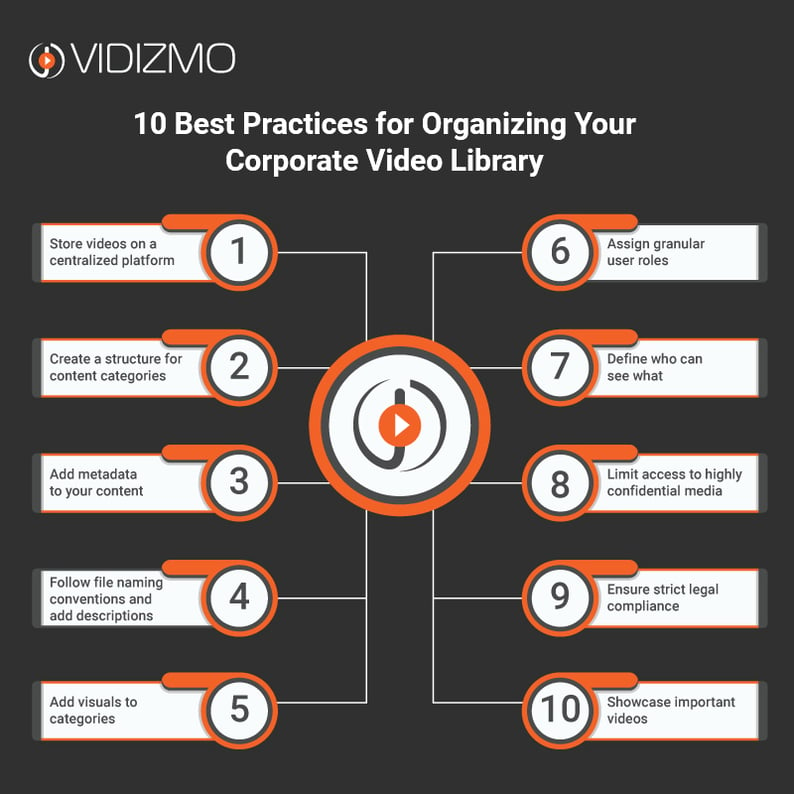
- Store videos on a centralized platform.
- Create a structure for content categories.
- Add metadata to your content.
- Follow file naming conventions and add descriptions.
- Add visuals to categories.
- Assign granular user roles.
- Define who can see what.
- Limit access to highly confidential media.
- Ensure strict legal compliance.
- Showcase important videos.
- Standardize video quality and formats.
- Automate data retention.
- Back up your video data.
Store Videos on a Centralized Platform
If you’re a digital content manager, you might feel the pain of content being scattered all over the place. There will be times when you will be faced with great difficulty finding relevant content stored on online video platforms.
Do you know what this means? Yes, you guessed it right, wasted time and lost revenue.
Hence, a centralized video content library is essential for organizing a multitude of enterprise video content, thus ensuring convenient accessibility to all. With advanced video library software, precious time and file search costs can be saved big time.
EnterpriseTube’s corporate video library allows you to host video content on a centralized VOD platform and ensures stringent compliance with accessibility standards, such as Section 508, the Americans with Disabilities Act (ADA), and the Web Content Accessibility Guidelines (WCAG).
Create a Structure for Content Categories
It is a no-brainer to understand that a logical content structure results in your logical mind acting with greater potential, thereby enhancing your productivity. Online video platforms offer the ability to create a hierarchical content structure to minimize time and search costs.
Creating a folder structure comprising folders and subfolders can help professionals organize their corporate video library. For instance, a typical folder structure for investor relations videos might look like the following:
Investor relations videos >> Sequoia Capital >> Series C round
Unlike many other online video platforms, VIDIZMO EnterpriseTube’s category access rights management allows you to create as many folders (categories) and subfolders (subcategories) as you want, with no strings attached.
The following illustration highlights how information can be sorted into categories and subcategories:
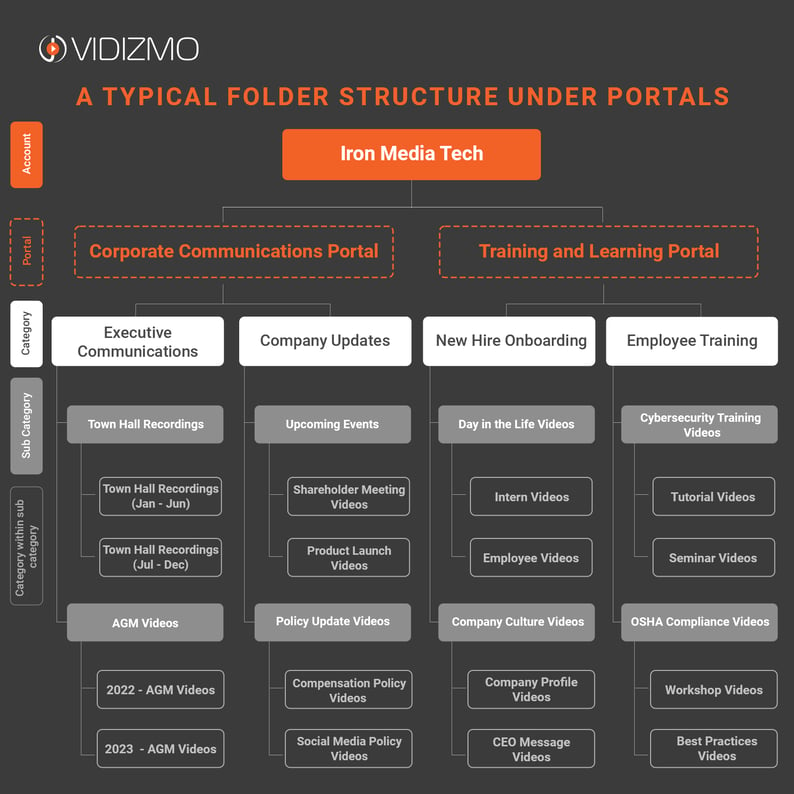
Key takeaway: In VIDIZMO, you can create as many categories and subcategories as you want, unlike other platforms, which have limitations.
Also, IT administrators need not worry about manually removing global access from each subcategory, as our platform allows users to replicate access rights and permissions from the category to the subcategory with just a click.
Add Metadata to your Content
Imagine if someone told you about a concert happening this week. However, there are no additional details about who is performing, the venue, or how much it will cost to see the singer live. That would be frustrating, right?
Similar is the case with video content stored in a video content library if the additional details, i.e., metadata, are not provided.
Suppose someone asked you to send them the recording of a particular webinar. In that case, you might not be able to locate the specific video recording among a stash of other recorded webinars since the file does not contain information regarding the speaker and the topic (or, in general, metadata).
Don’t worry, as VIDIZMO EnterpriseTube is one of those online video platforms that offers superior metadata management by allowing you to add metadata of your own using custom attributes. This might be anything, like author name, location information, unique ID, to name a few. Also, the platform automatically generates tags through AI for your videos and other digital media stored in your corporate video library.
Follow File Naming Conventions and Add Descriptions.
Consistency is key, and following file naming conventions is one way to achieve it. Especially if you are a video producer or content creator, you’ll know how important it is to ensure that videos are correctly named to streamline the post-production process.
Moreover, adding video descriptions allows you to locate and find files more easily and can help search engines, like Google, index the content in your corporate video library, provided relevant keywords are used.
What’s more to ask for when EnterpriseTube allows you not only to add video titles and descriptions but also make video retrieval easy by offering search through tags and metadata with its AI-powered search functionality in its video library software.
Add Visuals to Categories
With hundreds and thousands of folders stored in your corporate video library, it can be a tiring effort to look for the specific folder. It’s like walking inside your nearby Walmart, Target, or Costco store and not finding department names. You’ll be clueless, wandering here and there, right?
This is why various content management systems, such as Microsoft SharePoint and Google Drive, allow you to color-code your folders to distinguish them from the rest. However, color coding does not suffice in most cases.
For instance, using an extensive color palette for your numerous folders can overwhelm the user and would be counterproductive, causing you to lose more time finding the right color-coded folder.
EnterpriseTube goes several steps further and addresses the limitations of color-coding folders by allowing you to add a folder thumbnail and background image, apply custom CSS, and more. This allows you to distinguish various file folders or categories fairly and effectively communicate your brand identity.
Assign Granular User Roles
Not keeping a check on the rights and privileges available to your employees in an organization might result in great harm to your company data, revenue, and reputation, essentially everything important for your business to survive and thrive.
Not so long ago, in 2022, a disgruntled employee at Cash App vented his feelings by exposing the data of 8 million customers. There’s too much data privacy at stake if you ask us.
Hence, you need to assign appropriate user roles in your corporate video library to limit access and avoid the chances of potentially grave consequences.
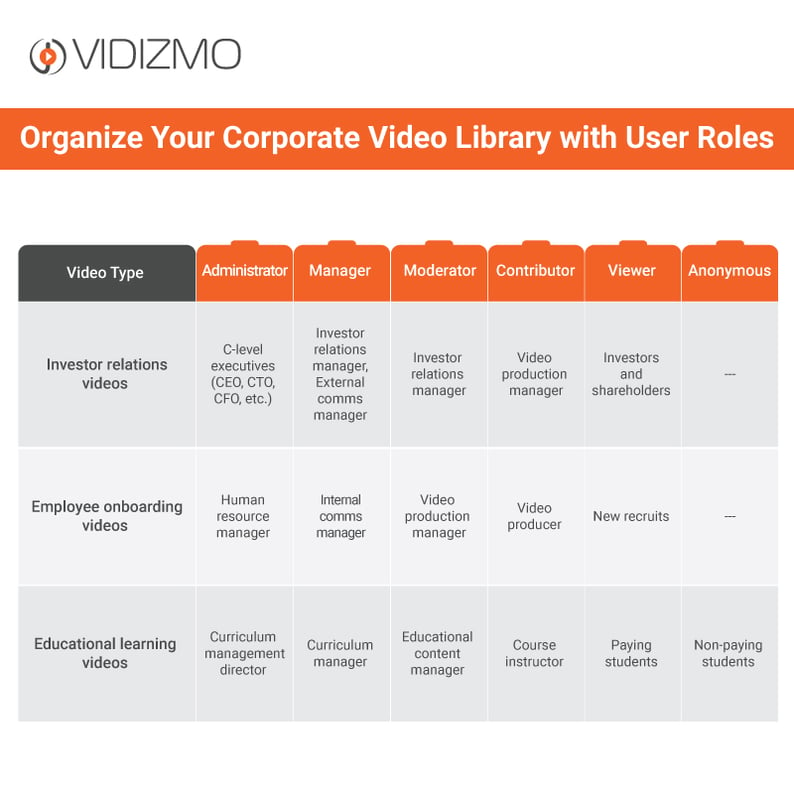
EnterpriseTube offers a granular role-based access control mechanism comprising the following roles:
- Administrator
- Manager
- Moderator
- Contributor
- Viewer
- Anonymous
Here is how role-based access control in EnterpriseTube can work for you:
Define Who Can See What
It might be a shocker, but an employee in your organization might have access to almost 11 million files. This is quite scary from a data privacy standpoint. What if a whistleblower leaks sensitive information about your company? Organizations as large as Apple have faced this situation.
However, this can be prevented by choosing what files to make available for whom. For instance, internal meetings involving the C-suite discussing an upcoming product should not be made available to all employees in an organization and only to key stakeholders.
EnterpriseTube allows you to define access to enterprise videos present in the video library software. You can choose whether to make a specific folder available for all, to users of a particular portal, users of the entire account, and more.
All of the above capabilities make EnterpriseTube a highly secure enterprise video platform.
Learn why a secure online video library is vital for your organization, and try our secure online video platform today.

Limit Access to Highly Confidential Media
With companies storing a variety of sensitive content in their corporate video library, it is important to ensure data privacy and protection to avoid harsh consequences.
For instance, a healthcare professional exposing a recorded video of a patient’s surgery will bring a bad name to the healthcare entity that employed them. Moreover, violating HIPAA compliance will result in the healthcare provider losing money, a lot of it.
Similarly, an education service provider might be faced with various video-based education records of students posed at risk of unauthorized access to scattered videos. The Family Educational Rights and Privacy Act (FERPA) mandates it to protect student records.
To avoid the above adversity, you need to share video content and digital media stored within folders securely. EnterpriseTube allows you to securely share temporary links to files with specific users or groups limited by time duration or the number of allowed views.
Ensure Strict Legal Compliance
As found in the PwC’s Risk Atlas database, more than 2,500 data protection laws govern organizations of all sizes. Navigating them can be quite challenging for your business regardless of the industry you’re in.
Another PwC publication reports that 40% of global organizations burn more than $10 million to comply with the General Data Protection Regulation (GDPR) alone. Other common compliances include but are not limited to HIPAA, GLBA, CCPA, Sarbanes-Oxley Act, and PCI-DSS.
Organizations like yours can leverage EnterpriseTube to effectively organize your content into categories and subcategories, thereby ensuring that it remains sorted and protected from prying eyes. Did we mention that VIDIZMO EnterpriseTube is a GDPR-compliant platform?
Showcase Important Videos
Some videos are so important that they need to be seen by almost everyone in your organization. For example, a video showcasing your brand voice, a day-in-the-life video of an employee, a webinar recording, or a virtual video tour of your workplace.
However, given the wealth of information, it is safe to say that this information will be difficult to find for others who are not familiar with the folder structure (if any) of the video content library. It is your job to highlight them.
With EnterpriseTube, you can showcase important video content by making the folder available on the top of the VOD platform homepage for quick access. Simply select Mark as featured to display featured categories on the leading enterprise video platform.
Standardize Video Quality and Formats
Video files arrive in many formats and resolutions, which creates inconsistent playback and compatibility problems across devices. Standardizing formats keeps the viewing experience consistent. EnterpriseTube transcodes uploads into multiple renditions so videos play smoothly on any device and bandwidth, and regular quality checks keep the library consistent.
Automate Data Retention
Managing old or outdated videos by hand is tedious, and some recordings must be kept for a set period for compliance, often one to seven years. EnterpriseTube lets you set a retention or auto-deletion policy per video or category, so content is removed automatically once its retention window ends.
Back Up Your Video Data
Backing up video protects against hardware failure and accidental deletion. EnterpriseTube supports RAID, local redundancy, and geo or cloud redundancy, replicating files across data centers so a single failure does not lose your content.
Organize your Corporate Video Library with EnterpriseTube
Organizing your corporate video library is an unwieldy task if you do not have the right Video library software in your organization. VIDZMO EnterpriseTube allows you to pick up all 10 best practices and try them out to easily organize your video library.
Key Takeaway: VIDIZMO EnterpriseTube offers robust category access rights management for efficiently organizing video content and digital media into categories inside your online video library. This allows you to save time and preserve your productivity from getting used up in dealing with cluttered content.
Read more on how you can simplify organizing your video library with category access rights with our platform.
Start organizing your corporate video library by opting for VIDIZMO EnterpriseTube – an AI-powered enterprise video platform recognized by Gartner.
No cluttered video library from today onwards, right?
Sign up for a 7-day free trial of VIDIZMO EnterpriseTube or book a demo session.
FAQ
Frequently Asked Questions
How do you organize a large corporate video library?
Start by storing everything on a centralized platform instead of scattered drives, then create a consistent category structure, add metadata and clear file-naming conventions, and use AI search so videos are findable by what is said or shown in them. Layer on role-based access, retention automation, and standardized formats so the library stays governed and usable as it grows.
What is a corporate video library?
A corporate video library is a centralized system organizations use to store, organize, manage, and securely share video assets such as training, internal communications, marketing content, and recorded meetings. A well-organized library improves searchability, collaboration, governance, and long-term content reuse.
How do companies organize videos across departments?
Companies use a single platform with per-department structure and granular access control, so each team manages its own content and audience while security policies stay consistent. Multi-portal setups let one deployment run separate, branded libraries for different departments without duplicating infrastructure.
What is the best way to manage a corporate video library?
The most effective approach combines a secure, centralized video platform with AI-powered search, consistent metadata and naming, role-based access, and automated retention. An enterprise video platform such as VIDIZMO EnterpriseTube brings these together, so the library stays findable, governed, and compliant as it scales.
TopicsVideo Content ManagementEnterpriseTubeCIO and IT Leadership

About the author
Rafey Iqbal is a Product Marketing Analyst at VIDIZMO specializing in enterprise video, digital evidence management, and AI redaction technology. He translates complex product capabilities into sharp, practical content that speaks directly to IT leaders, compliance officers, and operations teams.
You may also like
What Is a Real-Time Crime Center? A Guide for Cities and Counties
Somewhere in the last two years, someone asked your department whether it should have a real-time crime center. Maybe a ...
Staffing a Real-Time Crime Center When Software Does the Watching
Most chiefs who hear a pitch for a real-time crime center ask the same question before any other, which is whether they ...
RTCC, EOC or Situational Awareness Center: What Each Room Is For
Walk into a real-time crime center, then into a city's emergency operations center, and you will see much the same ...