EnterpriseTube, Compliance, Financial Services, Enterprise Video Platform, Security and Compliance
 Updated August 29, 2026

Every technology decision inside a financial institution carries compliance implications. From the New York Department of Financial Services (NYDFS) cybersecurity regulations to the General Data Protection Regulation (GDPR) and the Swiss Financial Market Supervisory Authority (FINMA), regulators set a high bar. An enterprise video platform for financial services must clear that bar without slowing down communication, training, or client engagement.
Consumer tools like YouTube and Vimeo lack the audit trails, retention policies, or Single Sign-On (SSO) that regulators require. Banks, insurers, and wealth management firms need a purpose-built platform.
Why Consumer Video Tools Fall Short
Consumer video platforms create several compliance gaps that financial institutions cannot afford. They provide no configurable audit log retention, yet NYDFS requires 3+ years of audit logs for systems handling financial data. Access controls are limited to basic "public" and "private" toggles rather than the granular, role-based permissions regulators expect. Without SSO through Azure Active Directory (Azure AD) or Okta, organizations cannot enforce Multi-Factor Authentication (MFA). Many video hosts also embed advertising trackers, creating data leakage risks, and offer no data residency controls that satisfy sovereignty laws.
These gaps make consumer platforms unsuitable for institutions subject to NYDFS 23 NYCRR 500, GDPR, the California Consumer Privacy Act (CCPA), or rules from FINMA, the FCA, or the MAS.
Regulatory Frameworks Shaping Video Platform Requirements
NYDFS 23 NYCRR 500 requires audit trails that reconstruct material transactions and detect unauthorized access, a minimum three-year log retention period, least-privilege access controls, encryption at rest and in transit, and MFA for external and privileged access.
GDPR requires data residency within the EU/EEA (or an adequate legal basis for transfers), data subject rights over recordings and metadata, a formal Data Processing Agreement between Controller and Processor, and breach notification within 72 hours.
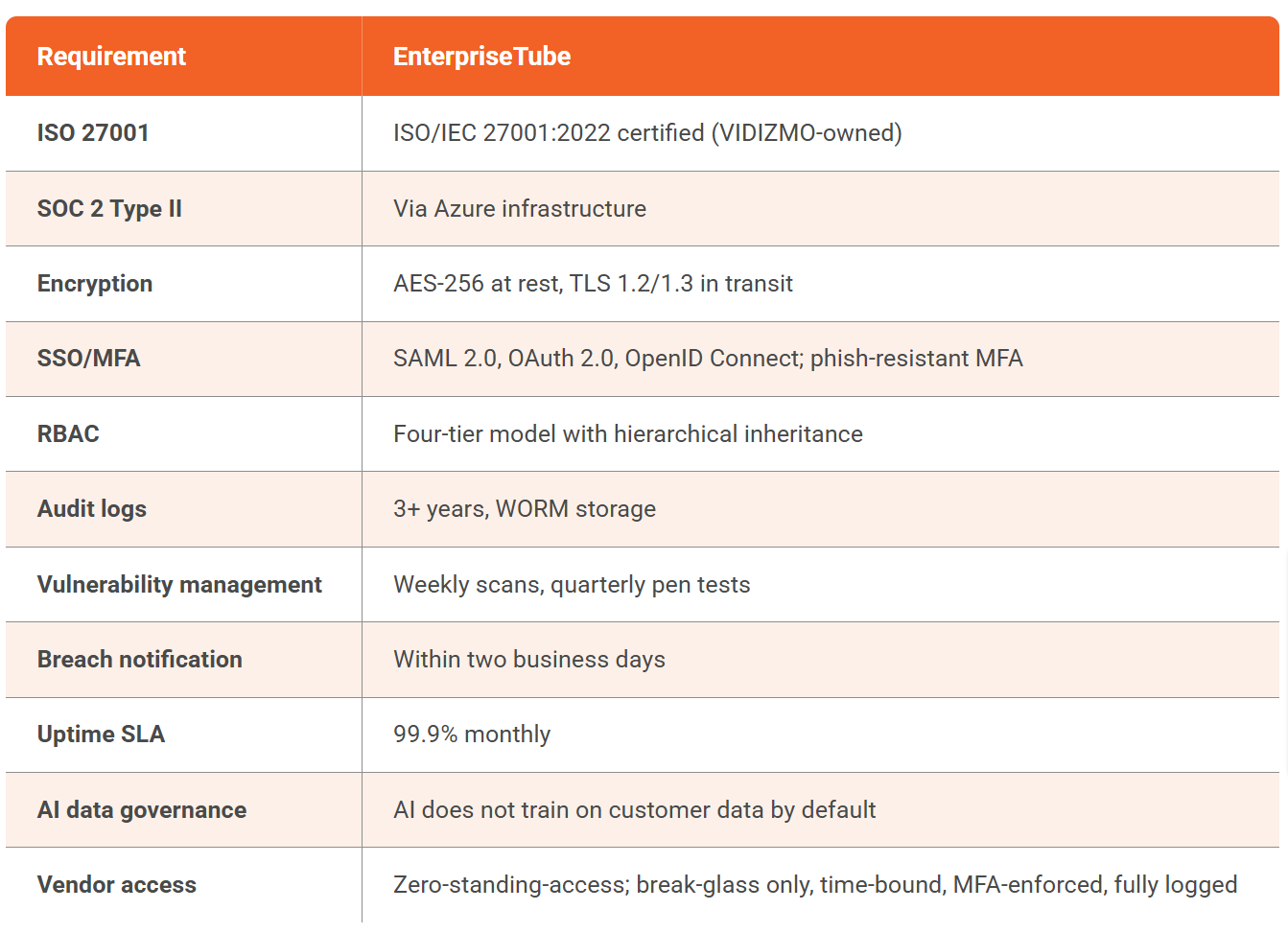
SOC 2 and ISO 27001 are not regulations, but financial institutions routinely require both during vendor due diligence. VIDIZMO holds ISO/IEC 27001:2022 certification (Certificate #RA-2507091, certified by Risk Associates Europe Ltd). EnterpriseTube deploys on SOC 2 Type II certified Azure infrastructure.
Data Residency
A compliant platform must support deployment in specific Azure or AWS regions (including Azure Government, Azure Commercial Canada, and EU regions), within the customer's own cloud subscription, on-premises, or in a hybrid model.
EnterpriseTube supports all of these. Confirmed deployments include Canadian data centers (PIPEDA, BC FIPPA), EU regions for international organizations, and UAE for NESA-regulated entities.
Encryption
EnterpriseTube encrypts all data at rest using AES-256 with keys managed through Azure Key Vault and rotated biennially. Data in transit is protected by TLS 1.2 (minimum) with TLS 1.3 support. FIPS 140-2 validated cryptographic modules are supported through Azure infrastructure for institutions subject to federal oversight.
Role-Based Access Control
EnterpriseTube implements four hierarchical roles: Admin, Manager, Contributor, and Viewer. Permissions inherit from portal to collection to content item, allowing broad policies with targeted exceptions. Additional controls include domain restriction, IP whitelisting/blacklisting, geo-restriction, password-protected content, token-based authentication, view-only access (preventing downloads), and configurable session timeout and lockout policies. Each portal can maintain independent security policies, so a single deployment can serve multiple business units.
Audit Logging
The platform logs every viewer interaction, content access event, share event, administrative action, upload, and authentication attempt. Logs are stored in Write Once, Read Many (WORM) enabled storage and retained for 3+ years, a capability confirmed through deployments with major financial institutions subject to NYDFS. Exportable Excel reports cover viewer activity, completion rates, quiz scores, and content access patterns.
SSO and Identity Management
EnterpriseTube integrates via SAML 2.0, OAuth 2.0, and OpenID Connect with Azure AD, Okta, Ping Identity, ForgeRock, and OneLogin. The platform inherits the organization's authentication policies (MFA, conditional access, session management). SCIM provisioning automates user lifecycle management. Phish-resistant MFA is supported through FIDO2/WebAuthn security keys and smartcards via Azure AD (Entra ID).
Deployment Models
EnterpriseTube supports six deployment models for financial institutions:
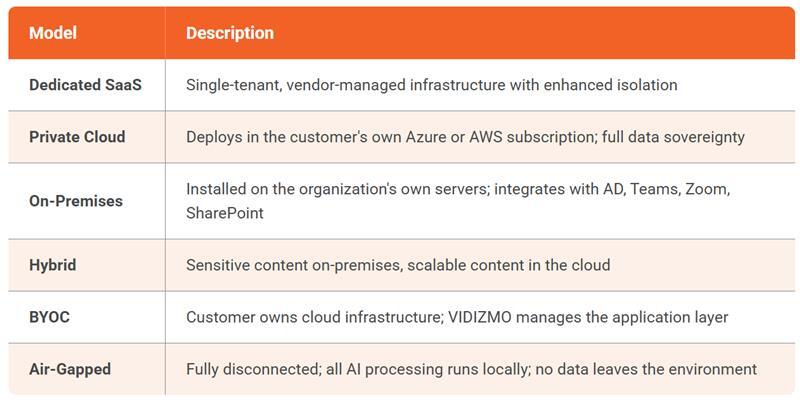
Azure Government Cloud deployment is also available for institutions with federal compliance requirements.
Compliance Training
Financial firms must prove employees completed mandatory AML, KYC, insider trading, and ethics training. EnterpriseTube provides embedded quizzes, automated certification upon course completion, structured learning plans, and exportable completion reports for audits. SCORM 1.2/2004 and LTI 1.3 integration enable progress sync with Canvas, Moodle, and Blackboard.
Scale and Pricing
A built-in enterprise CDN (eCDN) with P2P edge caching reduces WAN strain during live events across branch networks. The platform has been deployed at 57,000 viewer licenses at a major U.S. bank and supports up to 20,000 simultaneous live participants. At 50,000+ viewer deployments, pricing reaches $1.00 to $1.11 per user per year.
CISO Approval Checklist
Conclusion
Selecting an enterprise video platform for financial services is a compliance decision as much as a technology decision. EnterpriseTube provides the audit trails, encryption, access controls, deployment flexibility, and compliance training capabilities that CISOs, DPOs, and regulators require.
Ready to evaluate EnterpriseTube for your financial institution? Request a personalized demo to see how the platform addresses your compliance and deployment requirements.

FAQ
Frequently Asked Questions
Why do financial institutions need a compliant enterprise video platform?
Financial institutions handle sensitive financial and customer data, which makes compliance critical. A compliant enterprise video platform provides features like audit logging, encryption, role based access control, and Single Sign On (SSO) integration to meet regulatory requirements such as NYDFS 23 NYCRR 500, GDPR, and FINMA.
Why are consumer video platforms like YouTube or Vimeo not suitable for financial institutions?
Consumer video platforms lack enterprise security controls required by regulators. They typically do not provide configurable audit log retention, granular role based access control, SSO with MFA enforcement, or data residency options. These gaps create compliance risks for banks, insurers, and financial services firms.
What compliance regulations impact video platforms used by financial institutions?
Several regulatory frameworks affect video platforms used in financial services, including NYDFS 23 NYCRR 500, GDPR, FINMA regulations, and regional laws like CCPA. These regulations require secure data handling, access controls, audit trails, encryption, and breach notification capabilities.
What security features should a compliant enterprise video platform provide?
A compliant enterprise video platform should support encryption at rest and in transit, role based access control, detailed audit logs, SSO integration with identity providers, data residency options, and secure deployment models. These capabilities help organizations meet strict regulatory and security standards.
How does audit logging support financial services compliance?
Audit logs record all user activity within the platform, including content access, sharing events, authentication attempts, and administrative actions. These logs help institutions detect unauthorized access and reconstruct events during audits or investigations, which is required by regulations such as NYDFS.
Why is data residency important for financial institutions using video platforms?
Data residency ensures that video content and metadata are stored within specific geographic regions. Many regulations require financial institutions to keep data within national or regional boundaries to comply with privacy laws and sovereignty requirements.
How does Single Sign On improve security for enterprise video platforms?
Single Sign On allows organizations to integrate the video platform with their identity providers such as Azure AD, Okta, or Ping Identity. This enables centralized authentication, Multi Factor Authentication enforcement, and automated user lifecycle management.
Can enterprise video platforms support compliance training for financial institutions?
Yes. Enterprise video platforms can support compliance training by providing structured learning modules, embedded quizzes, certification upon completion, and detailed reporting. These capabilities help organizations track employee completion of mandatory training programs such as AML, KYC, and ethics training.
TopicsEnterpriseTubeComplianceFinancial ServicesEnterprise Video PlatformSecurity and Compliance
About the author
Ali Rind is a Product Marketing Executive at VIDIZMO, where he focuses on digital evidence management, AI redaction, and enterprise video technology. He closely follows how law enforcement agencies, public safety organizations, and government bodies manage and act on video evidence, translating those insights into clear, practical content. Ali writes across Digital Evidence Management System, Redactor, and Intelligence Hub products, covering everything from compliance challenges to real-world deployment across federal, state, and commercial markets.
You may also like

Fire and Smoke Detection as a Second Set of Eyes in Schools
Let the first sentence of this article do the compliance work: nothing described here replaces, modifies, or competes ...

Weapon Detection in Schools: Detection, Verification, Response
No school safety technology carries more emotional weight than weapon detection, and no school safety technology is ...

School Safety Grants: What the Money Can Buy
School safety improvements have a funding problem that is really a sequencing problem: the need is continuous, the ...