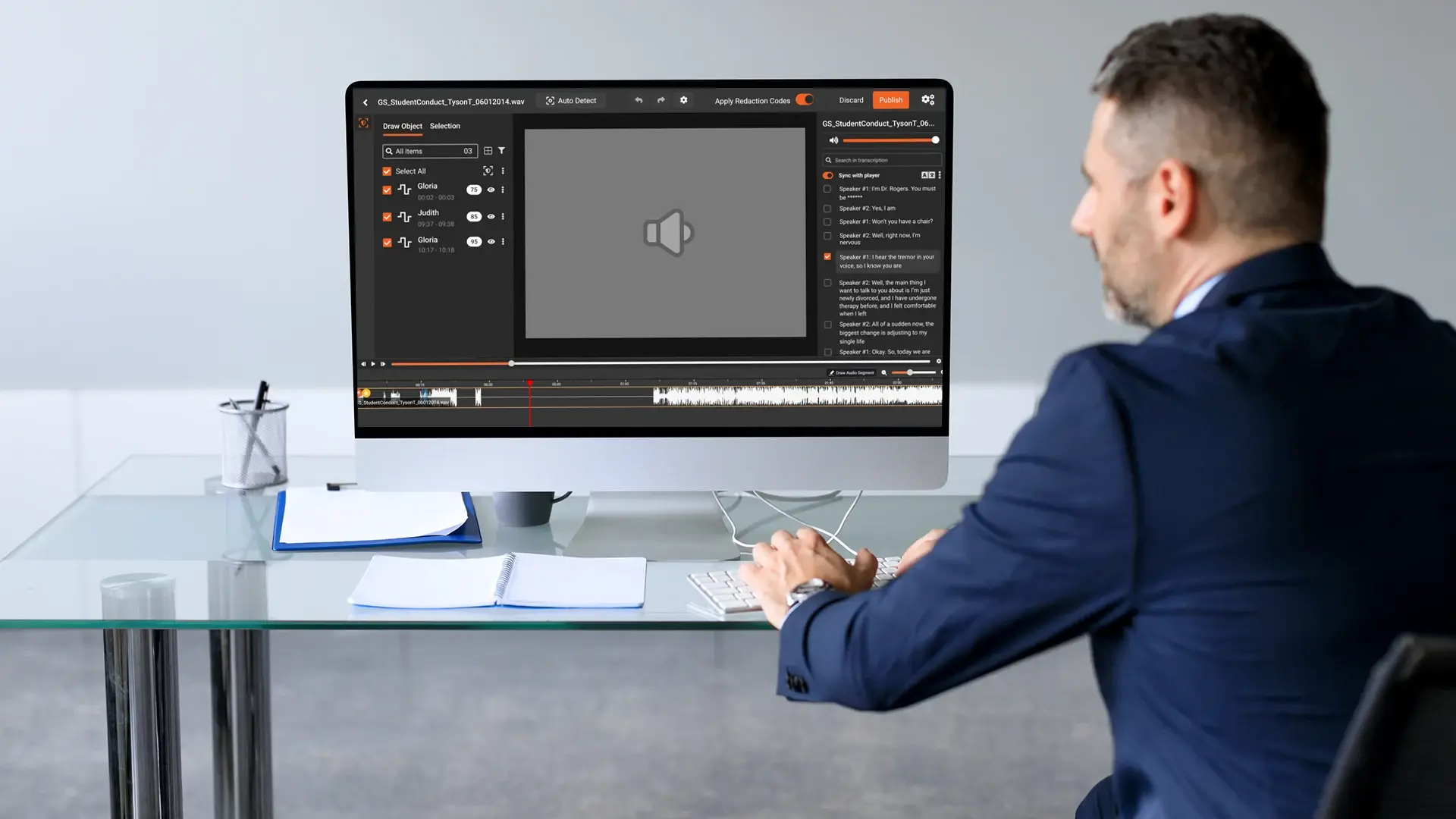
TL;DR. Consumer-grade redaction tools fail at enterprise scale. This guide defines six platform requirements every enterprise audio redaction evaluation should apply: scale, multilingual accuracy, deployment flexibility, compliance readiness, PII coverage, and recoverable bulk workflows. Written for buyers running a structured evaluation, not a casual reader.
Enterprise audio redaction is a category with very different requirements from the consumer-grade tools that dominate the top of search results. A tool that handles a few hundred recordings from a single team is not the same tool that handles tens of millions of recordings across a global contact center estate. The operational, compliance, and architectural requirements diverge sharply at scale.
This guide is written for buyers running a structured evaluation of enterprise audio redaction platforms. It defines six requirements every serious evaluation should apply, identifies the hidden costs of choosing wrong, and closes with a checklist usable in an RFP.
Why Consumer-Grade Redaction Tools Fail at Enterprise Scale
The most common failure pattern is not bad technology. It is a mismatch between the scale of the tool and the scale of the workload.
Consumer-grade or departmental redaction tools are built for use cases where volume is measured in hundreds of files, languages in one or two, and the operators are in the same team as the reviewers. The design assumptions that make those tools good at that scale become liabilities at enterprise scale: UI-centric workflows, manual file handling, limited API surface, shared-tenant architecture, and audit logs built for user accountability rather than regulatory defensibility.
Run an enterprise workload through that architecture and three things break. First, throughput. Processing a million-hour archive through a UI-first tool takes longer than the compliance deadline allows. Second, governance.
Audit logs that tell you what a user did are useful; audit logs that produce a defensible record across thousands of automated operations are not the same thing. Third, trust. When a tool is used across dozens of business units in a regulated enterprise, the deployment and isolation model has to support cross-unit separation, not assume a single team.
Enterprise evaluation has to start from these requirements rather than from a feature comparison of UI capabilities. Our primer on AI-powered redaction software covers the broader platform scope; the rest of this guide focuses specifically on audio.
Six Platform Requirements for Enterprise Audio Redaction
1. Scale: Millions of Recordings, Not Thousands
Enterprise volume is measured in millions of hours of audio, annually or in a single backlog project. A platform that has not been tested at that volume will reveal its limits in production.
Evaluation criteria: documented processing volume tested at scale; concurrency model; queue architecture; storage IO profile; failure modes under sustained load.
VIDIZMO Redactor's bulk processing has been tested at 1.1 million recordings and is deployed in engagements at that scale. A major California county uses the platform to process 1.1 million call recordings for CCPA and CPRA compliance, operating inside the county's own cloud infrastructure. The Georgia Attorney General's Office runs VIDIZMO across 29 law enforcement agencies on a multi-year contract valued at approximately $1 million.
Our deeper look at bulk audio redaction software covers the call-center-specific workflows that scale this volume sustainably, and for enterprises with an existing multi-year archive, our guide on call recording archive redaction walks through clearing a backlog as a distinct project.
2. Multilingual Coverage: Real Accuracy, Not a Supported-Language List
A "supported languages" list is meaningless without accuracy figures. Any platform can claim support. What matters is the Word Error Rate (WER) on transcription and the PII detection accuracy on real audio in each production language.
Evaluation criteria: published per-language WER; validation methodology; PII detection accuracy per language; country-specific identifier coverage; handling of accented speech and code-switching.
VIDIZMO Redactor supports 82 languages for transcription with published WER per language, and translation across 74 languages. Major European languages run in the Excellent tier (Spanish 3.5, Italian 4.2, Portuguese 4.8, German 5.5, French 7.7). Japanese is in the Excellent tier at 6.4. Korean and Chinese sit in the Good tier where output is usable with review rather than fully automated. Country-specific PII patterns cover the US, UK, Canada, India, and EU. Enterprise buyers with non-standard market coverage should validate identifier patterns for their specific markets during evaluation rather than assuming coverage. Our companion guide on redacting PII in non-English call recordings covers per-language evaluation methodology in more depth.
3. Deployment Flexibility: SaaS, Private Cloud, On-Premises, Hybrid
Enterprise deployment is rarely a single choice. Different business units, markets, and data classifications typically require different deployment models within the same enterprise. A platform that only supports one deployment model forces compromises that surface later as architectural debt.
Evaluation criteria: SaaS (shared and dedicated); private cloud in customer's own Azure, AWS, or GCP; on-premises; hybrid; air-gapped; government cloud.
VIDIZMO Redactor supports all of these. Commercial SaaS is the lowest-friction entry point. Dedicated SaaS or private cloud handles data residency and single-tenant requirements. On-premises serves classified or contractually restricted data. Azure Government supports CJIS and federal data handling. Hybrid combines on-premises processing for sensitive data with cloud processing for everything else. The ability to mix these models inside a single enterprise license is a material procurement advantage.
4. Compliance and Audit Readiness: Chain of Custody, Logs, Defensibility
For regulated industries, audit readiness is not a nice-to-have. It is the point of the platform. A redaction tool whose output cannot be defended in a regulator review or a legal proceeding has failed on its primary function.
Evaluation criteria: chain of custody documentation per file; tamper-proof audit logs; log retention and export; regulator mapping (PCI DSS, GDPR, CCPA, HIPAA, CJIS); third-party certifications.
VIDIZMO Redactor logs every operation with user ID, IP address, timestamp, and action type. Logs are stored in WORM (write once, read many) storage, making them tamper-proof. The platform holds ISO/IEC 27001:2022 certification (Certificate #RA-2507091, issued July 2025, valid through July 2028). Compliance coverage includes PCI-DSS, HIPAA, GDPR, CPRA/CCPA, CJIS, FIPS 140-2, FERPA, and Section 508/WCAG 2.2 AA. Mapping for the NIST Privacy Framework is available in deployment documentation. For the regulator-facing view of how audit-ready workflows combine automated detection with analyst review, see the AI audio redaction software feature page.
5. PII and PCI Coverage Across 33+ Spoken Entity Types
Enterprise compliance spans multiple regulations, each with its own in-scope entity categories. A redaction platform needs to cover the union of them: PCI cardholder data, PHI under HIPAA, PII under GDPR and CCPA, country-specific identifiers, and the less obvious categories that show up in real call recordings.
Evaluation criteria: entity type coverage; country-specific identifier coverage; custom entity support; confidence threshold controls; detection accuracy metrics.
VIDIZMO Redactor detects 33+ spoken PII categories, including names, addresses, phone numbers, Social Security numbers, credit card numbers, CVVs, dates of birth, ages, VINs, usernames, passwords, IP addresses, MAC addresses, URLs, passport numbers, and country-specific identifiers (UK National Insurance/NHS, Indian Aadhaar, US SSN, EU-specific identifiers). Confidence thresholds are configurable from 25 to 90 percent, enabling the trade-off between recall and precision to be tuned per workload. PCI data (PAN, CVV, expiration dates) is covered as a first-class subset aligned to PCI DSS requirements.
6. Bulk and Batch Processing with Recoverable Workflows
Enterprise throughput requires batch processing that runs continuously, resumes from failure rather than restarting, and operates without manual per-file intervention. The architecture of the batch layer determines whether large workloads finish inside compliance windows.
Evaluation criteria: batch API surface; queue resumability; failure recovery; parallelism controls; operational visibility into running jobs.
VIDIZMO Redactor supports bulk redaction workflows with queue-based processing, overnight and off-hours batch runs, and integration into existing storage systems (SharePoint, Azure Blob, AWS S3, local file shares). Real-time activity alerts notify on job events. Jobs are logged end to end for resumability.
Ready to run a structured evaluation?
Request an enterprise redaction evaluation and we will scope a pilot against real audio from your contact center.

Platform vs Point Solution: The Hidden Cost of Picking Wrong
Enterprises evaluating audio redaction often see two options: a dedicated audio redaction point solution, or a broader redaction platform that handles audio as one of several media types. The cost difference is visible in license terms; the cost similarity is invisible until later.
A point solution is cheaper upfront and easier to evaluate because the surface area is smaller. It becomes a problem when the enterprise also needs video redaction (body-worn camera footage, surveillance video, Teams recordings), document redaction (PDFs, transcripts, scanned files), or image redaction. At that point, a point solution forces either a second vendor (with duplicated integration, governance, and audit work) or a costly platform migration.
A platform approach with unified redaction across audio, video, documents, and images avoids that. VIDIZMO Redactor is the audio layer of a broader platform that handles video, audio, documents, images, and PDFs across 255+ formats. Enterprises that are clear on long-term scope benefit from the platform approach even when their immediate need is audio-only. The broader intelligent data and AI solutions suite covers how redacted audio integrates with downstream search, summarization, and analytics.
A Short RFP Evaluation Checklist
The checklist below consolidates the six requirements into an RFP-ready format. It is deliberately short, because a longer list becomes a feature comparison rather than a requirements evaluation.
-
Scale. Maximum tested processing volume. Concurrency model. Largest deployed customer. Failure modes under sustained load.
-
Multilingual. Published per-language Word Error Rate. Country-specific identifier coverage for each of your markets. Handling of accented and code-switched audio.
-
Deployment. SaaS (shared and dedicated), private cloud, on-premises, hybrid, air-gapped, government cloud. Ability to mix models in a single enterprise license.
-
Compliance. Chain of custody per file. Tamper-proof audit logs. Third-party certifications (ISO 27001, SOC 2). Regulator mapping (PCI DSS, GDPR, CCPA, HIPAA, CJIS).
-
PII coverage. Entity type coverage list. Country-specific identifier coverage. Custom entity support. Confidence threshold controls.
-
Bulk processing. Batch API. Queue resumability. Failure recovery. Parallelism controls. Operational visibility.
Apply each requirement with real sample audio and real volume targets, not with vendor-supplied benchmarks, and the evaluation produces a defensible decision rather than a feature preference.
FAQ
Frequently Asked Questions
What makes a redaction platform "enterprise grade"?
Enterprise grade means the platform has been tested and deployed at the volume, concurrency, and governance requirements of a large regulated organization. Practical markers: documented processing at millions of recordings, ISO 27001 or equivalent certification, deployment flexibility across SaaS, on-premises, and hybrid, regulator-defensible audit trails, and per-language WER benchmarks. A platform that performs in a departmental pilot but has not been proven at enterprise scale is not the same category of tool.
How should we evaluate multilingual audio redaction before buying?
Pull 20 to 50 real call recordings per language from your production audio, not vendor demo files. Run the full pipeline: transcription, PII detection, redaction, and audit output. Measure Word Error Rate, PII recall, and PII precision per language. Validate country-specific identifier coverage for each market. If per-language results diverge materially from the vendor's published benchmarks, understand why before committing.
What deployment model fits a global contact center?
Usually a mix. Commercial SaaS for low-sensitivity units, dedicated SaaS or private cloud for markets with data residency requirements, on-premises for classified or contractually restricted data, and Azure Government for federal-adjacent workloads. The ability to mix models inside a single enterprise license is typically a bigger procurement advantage than any individual deployment capability.
Is on-premises audio redaction necessary for every enterprise?
No. On-premises is required when data cannot leave existing infrastructure for classification, contractual, or regulatory reasons. For most commercial workloads, dedicated SaaS or private cloud provides equivalent security with faster time to value. The deployment decision should follow from data classification and regulatory scope, not from a default preference.
How are audit logs different at enterprise scale?
Departmental audit logs track what users did. Enterprise audit logs have to produce a defensible record across thousands of automated operations, survive regulatory review, and export cleanly into compliance systems. Tamper-proof storage (WORM), complete chain of custody per file, and export-ready formats are baseline requirements, not advanced features.
What PII entity coverage should an enterprise platform provide?
Universal categories (names, addresses, phone numbers, email, dates of birth, bank account identifiers, credit card numbers, CVVs) plus country-specific identifiers for each of your markets. VIDIZMO Redactor covers 33+ spoken PII categories with country-specific patterns for the US, UK, Canada, India, and EU. Confidence threshold controls (tunable from 25 to 90 percent) allow recall and precision to be tuned per workload.
How does platform vs point solution economics work over three years?
Point solutions win on Year 1 cost. Platforms win on Years 2 and 3 when scope expands to video, documents, or additional markets. The inflection point is usually when a second media type or major language enters scope, which forces either a second vendor or a platform migration. Enterprises with clear long-term scope typically find the platform approach lower total cost over three years.
TopicsData SecurityRedactionAudio RedactionRedactorSecurity and ComplianceCIO and IT Leadership
You may also like

Document Review Training: Proving One Standard
The challenge, when it comes, is almost never that a reviewer was unqualified.

Compliance Training Tracking: What You Have to Prove
The question a regulator asks is narrower than the one most training programs are built to answer.

CLE Video: Delivering the Session, Proving the Credit
Recording the session is the easy half, and the hard half does not announce itself until roughly a year in.