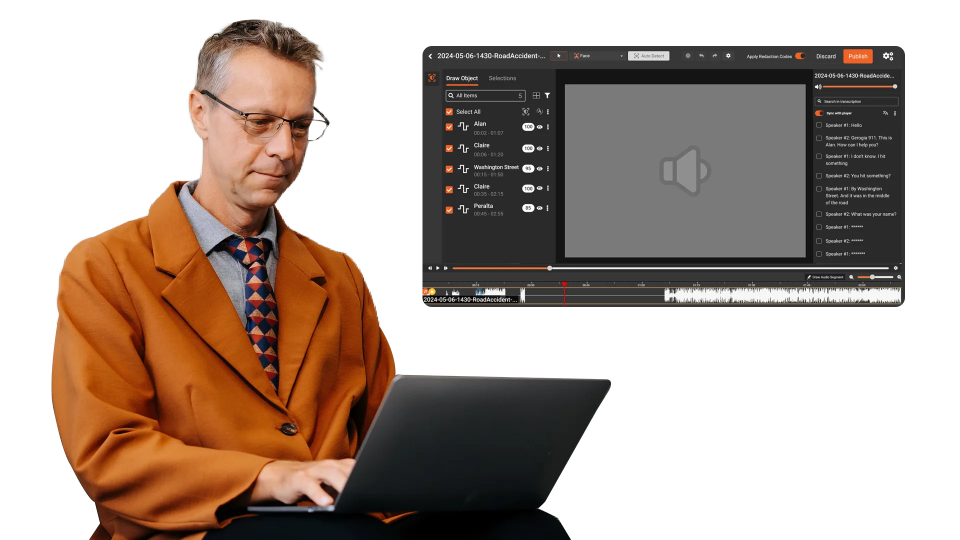
911 recordings are frequently requested through public records laws, court proceedings, and media inquiries. These recordings often contain sensitive information, including Criminal Justice Information (CJI) and Personally Identifiable Information (PII).
Before releasing any 911 audio, agencies must carefully review and redact protected information in accordance with:
- The FBI Criminal Justice Information Services (CJIS) Security Policy
- Applicable federal, state, and local public records laws
- Victim privacy statutes
- Juvenile protection laws
- Other applicable federal or state privacy regulations (e.g., HIPAA, where relevant)
Failure to appropriately safeguard sensitive information may expose agencies to compliance findings, legal liability, or reputational harm.
This guide explains:
- What information may require redaction in 911 calls
- How CJIS requirements apply to handling and dissemination of CJI
- A structured redaction workflow
- How technology solutions can support compliant processes
Why 911 Call Redaction Requires Careful Compliance Controls
The FBI’s CJIS Security Policy establishes minimum security requirements for protecting Criminal Justice Information throughout its lifecycle, including storage, transmission, and dissemination.
911 recordings frequently contain:
- Personally Identifiable Information (PII)
- Criminal history record information (CHRI)
- Case-related identifiers
- Driver’s license numbers
- Social Security numbers
- Biometric references
- Victim and juvenile identities
- Medical or other sensitive personal details
When responding to public records requests or court disclosures, agencies must ensure that protected CJI is not improperly disseminated.
While public disclosure obligations are governed primarily by federal or state public records statutes, agencies remain responsible for safeguarding CJI and complying with CJIS Security Policy requirements when handling and releasing information.
Improper redaction or disclosure may result in:
- CJIS audit findings
- Loss or suspension of CJIS system access
- Civil liability under applicable privacy laws
- Compromised investigations
- Identity theft risks
- Erosion of public trust
Categories of Information Commonly Reviewed for Redaction
Redaction requirements vary by jurisdiction. However, agencies typically review 911 calls for the following categories:
Personal Identifiers
- Full names (particularly victims and minors)
- Dates of birth
- Home addresses
- Phone numbers
- Social Security numbers
- Driver’s license numbers
Criminal Justice Information (CJI)
- Criminal history record information (CHRI)
- FBI numbers or state identification numbers
- Case numbers tied to sensitive investigations
- Biometric identifiers
- Information derived from CJIS systems
Sensitive Investigative Information
- Ongoing investigative details
- Confidential informant references
- Tactical response procedures
- Law enforcement operational methods
Protected Individuals
- Juveniles
- Victims of sexual assault
- Domestic violence survivors
- Witnesses under protective status
Agencies should consult applicable state statutes and legal counsel to determine precise disclosure limitations.
Structured Workflow for Redacting 911 Calls
A documented and repeatable process supports both accuracy and compliance.
Step 1: Generate a Searchable Transcript
Transcribing audio into searchable text improves the ability to identify sensitive terms consistently. Automated speech-to-text tools can assist in generating transcripts for review.
Technology solutions such as VIDIZMO Redactor can automatically transcribe audio files to facilitate review.
Step 2: Identify Potentially Protected Content
Review transcripts and audio for:
- Names and entities
- Addresses and contact information
- Identification numbers
- Criminal history references
- Case-related details
AI-assisted detection tools may help flag potential PII and CJI; however, automated results should always be reviewed by authorized personnel before release.
VIDIZMO Redactor provides automated detection capabilities for:
- Names
- Locations
- Contact numbers
- Identification numbers
- Customizable keywords defined by agency policy
Step 3: Apply Audio Redactions
Redacting audio typically involves:
- Muting specific segments
- Inserting tone masking
- Removing defined time ranges
Precise redaction is critical to avoid altering unrelated portions of the recording or unintentionally disclosing protected data.
VIDIZMO Redactor enables transcript-based audio redaction, synchronized masking, and preview functionality prior to finalization.
Step 4: Conduct Quality Assurance and Supervisory Review
CJIS compliance emphasizes documented security controls and accountability. Agencies should implement:
- Secondary supervisory review
- Verification that redactions are complete
- Confirmation that metadata does not contain residual CJI
- Maintenance of audit logs
VIDIZMO Redactor supports:
- Role-based access controls
- Detailed audit trails
- Version history tracking
- Secure deployment configurations aligned with CJIS Security Policy requirements
Step 5: Secure Storage and Controlled Release
After redaction:
- Store files in secure, access-controlled environments
- Document chain-of-custody
- Distribute only through authorized channels
All storage and dissemination processes should align with CJIS Security Policy security controls and applicable local regulations.
Common Challenges in 911 Call Redaction
Agencies frequently face:
- High volumes of public records requests
- Time-intensive manual review
- Risk of human error
- Inconsistent application of redaction standards
Technology-assisted workflows can improve consistency and reduce administrative burden; however, agencies remain responsible for final review and compliance.
How VIDIZMO Redactor Supports Secure Redaction Workflows
VIDIZMO Redactor provides capabilities designed to assist agencies in implementing structured redaction processes, including:
- AI-powered transcription
- Automated PII detection
- Transcript-based audio redaction
- Audio masking tools
- Role-based access controls
- Audit trails and version history
- Secure deployment options designed to align with CJIS Security Policy requirements
Actual time savings and efficiency improvements may vary based on agency workflows and implementation.
Best Practices for Compliant 911 Call Redaction
- Establish written redaction policies aligned with state law and CJIS requirements
- Use standardized review checklists
- Implement dual-level review procedures
- Maintain audit documentation
- Ensure secure CJIS-compliant storage and transmission
- Provide regular staff training on privacy and disclosure obligations
You can start Your Free trial Today - NO Credit Card Needed

Final Considerations
Redacting 911 calls involves balancing transparency obligations with the responsibility to protect Criminal Justice Information and individual privacy rights.
Agencies should ensure that redaction workflows are:
- Documented
- Consistent
- Legally reviewed
- Technically secure
Technology solutions can assist in improving efficiency and standardization, but ultimate compliance responsibility rests with the agency.
FAQ
Frequently Asked Questions
What information must be redacted from 911 calls for CJIS compliance?
Agencies must redact any Criminal Justice Information (CJI) and personally identifiable information before releasing 911 recordings. This includes:
- Names, addresses, phone numbers, and Social Security numbers
- Criminal history record information (CHRI) and FBI/state ID numbers
- Juvenile identities, victim details, and witness information
- Ongoing investigative details or confidential informant references
Requirements vary by jurisdiction, so consulting legal counsel alongside CJIS policy is essential.
Does CJIS apply to 911 call recordings?
Yes. The FBI CJIS Security Policy applies to any Criminal Justice Information found within 911 recordings. When agencies store, review, or release these recordings, they must follow CJIS minimum security requirements covering access controls, audit logging, data handling, and secure transmission throughout the entire process.
What are the consequences of improper 911 call redaction?
Failing to properly redact 911 calls can result in:
- CJIS audit findings and potential loss of system access
- Civil liability under applicable privacy laws
- Compromised active investigations
- Identity theft exposure for callers or victims
- Significant reputational harm to the agency
How does AI-powered redaction work for 911 audio files?
AI-powered tools like VIDIZMO Redactor first transcribe the audio into searchable text. The system then automatically detects PII and CJI such as names, locations, ID numbers, and custom keywords. Reviewers confirm flagged content, apply audio muting or tone masking to protected segments, and finalize the redacted file after supervisory review.
Can automated redaction tools be trusted for CJIS-compliant releases?
Automated detection significantly improves speed and consistency, but it is not sufficient on its own. CJIS compliance requires that all automated results be reviewed and verified by authorized personnel before any release. Tools like VIDIZMO Redactor support this through role-based access controls, audit trails, and supervisory review workflows.
How does VIDIZMO Redactor compare to manual redaction for 911 calls?
Manual redaction is time-intensive, error-prone, and difficult to scale under high public records request volumes. VIDIZMO Redactor automates transcription, PII and CJI detection, and audio masking, reducing manual effort while maintaining a documented, repeatable process. It also captures audit logs and version history that manual workflows typically lack.
What security controls are required when storing redacted 911 recordings?
After redaction, files must be stored in access-controlled, CJIS-compliant environments. Required controls include:
- Documented chain-of-custody
- Role-based access restrictions
- Secure transmission channels for distribution
- Audit logs confirming who accessed or released each file
VIDIZMO Redactor supports secure deployment configurations aligned with these CJIS requirements.
How should agencies handle 911 calls that also contain HIPAA-protected information?
Some 911 recordings capture medical details that may trigger HIPAA obligations alongside CJIS requirements. Agencies should treat these calls under the stricter of the two frameworks, redacting health-related identifiers in addition to CJI and PII. Legal counsel should review jurisdiction-specific obligations, as HIPAA applicability to law enforcement recordings depends on the agency's role and context.
About the author
Zain Noor is a Product Marketing Executive at VIDIZMO with expertise in AI redaction technology. He focuses on how public safety agencies, government bodies, and commercial organizations adopt and operationalize video intelligence at scale.
You may also like
Turn Meeting Recordings into a Searchable Knowledge Base
Somewhere in your organization's recorded meetings is the exact moment a pricing decision was made, the demo where a ...
How to Automatically Ingest Zoom Recordings into a Video Platform
Every organization that records meetings eventually invents the same bad job: someone downloads files from Zoom and ...
VIDIZMO vs Vimeo: Enterprise Video Comparison
VIDIZMO and Vimeo both host, stream, and manage video for organizations, which is roughly where the similarity ends. ...