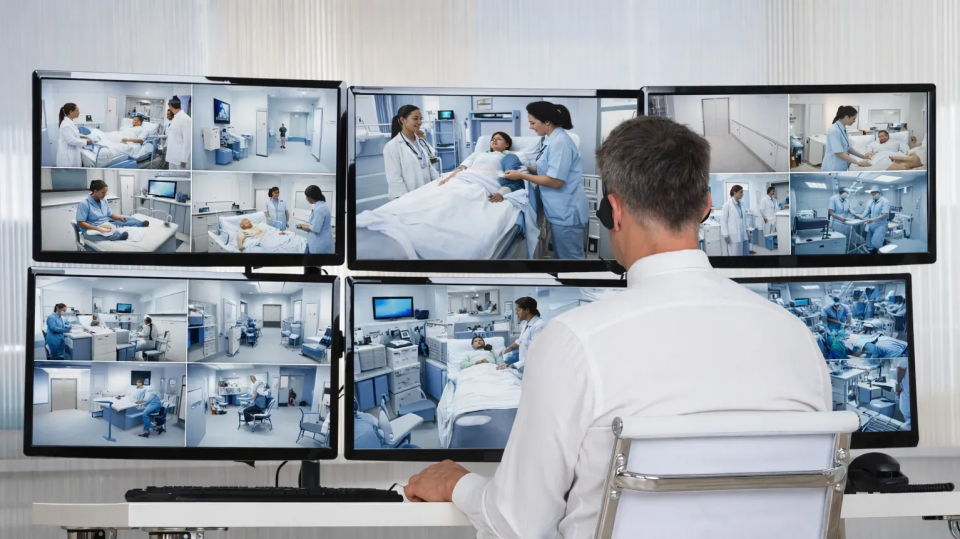
Healthcare organizations operating across multiple campuses, including hospitals, outpatient clinics, behavioral health centers, and long-term care facilities, generate massive volumes of CCTV footage daily. Yet most of that footage remains trapped in facility-level DVRs and NVRs, disconnected from one another and nearly impossible to search at scale.
For security directors, IT leaders, and compliance officers tasked with incident investigations, regulatory audits, or workplace safety reviews, this fragmented landscape creates operational blind spots and significant regulatory exposure.
A healthcare video surveillance management system built on an on-premises Digital Evidence Management System (DEMS) solves this by consolidating footage from every facility into a single, HIPAA-supportive repository, with the access controls, audit trails, and AI-powered search capabilities that healthcare compliance demands.
The Hidden Risks of Facility-Level CCTV Systems in Healthcare
Most multi-facility healthcare organizations inherit a patchwork of surveillance infrastructure. Each campus may run different camera brands, different DVR/NVR hardware, and different retention settings. When an incident occurs, such as a patient elopement, a workplace violence event, or a slip-and-fall liability claim, the security team must physically retrieve footage from the right facility, hope the recording has not been overwritten, and manually transfer it for review.
This fragmentation creates several measurable risks:
- Inconsistent retention: Facility-level systems often lack standardized retention policies, leading to premature deletion of critical footage or excessive storage costs from indefinite retention.
- No centralized search: Investigators cannot search across facilities without physically visiting each site or requesting manual exports, adding hours or days to time-sensitive investigations.
- Compliance gaps: HIPAA requires that any video capturing Protected Health Information (PHI), including patient faces in treatment areas, conversations in exam rooms, and behavioral health unit recordings, be stored, accessed, and shared with appropriate safeguards. Facility-level DVRs rarely offer the encryption, access controls, or audit logging that healthcare regulators expect.
- Slow incident response: The time between an incident and footage retrieval directly impacts investigation quality, legal defensibility, and patient safety outcomes.
For organizations managing ten, fifty, or a hundred facilities, these risks compound with every additional campus.
What a Healthcare Video Surveillance Management System Must Deliver
Before evaluating platforms, healthcare security and IT teams should establish baseline requirements for any centralized system:
-
Multi-source ingestion. The platform must ingest footage from any camera brand or recording device, including IP cameras, analog cameras via DVR, body-worn cameras, and mobile devices, without requiring hardware replacement at every facility.
-
On-premises or hybrid deployment. Healthcare organizations handling PHI often require infrastructure that keeps data within their own network boundary. An on-premises or hybrid deployment model is essential for organizations with strict data residency requirements or institutional policies that restrict sensitive data from leaving the perimeter.
-
HIPAA-supportive controls. The platform must provide encryption at rest and in transit, role-based access control (RBAC), comprehensive audit logging, and secure sharing mechanisms that restrict who can view, download, or export footage containing PHI.
-
Centralized retention management. A single policy engine should govern retention across all facilities, automatically archiving, tiering to cold storage, or purging footage based on configurable rules. This reduces both legal risk from premature deletion and storage costs from indefinite retention.
-
AI-powered search and analysis. Manual review of hours of CCTV footage is not scalable. AI capabilities such as object detection, activity recognition, and transcription allow investigators to surface relevant moments without scrubbing through every recording frame by frame.
Why On-Premises Deployment Matters for Healthcare
For healthcare organizations where footage may capture patient faces, treatment areas, or conversations that constitute PHI, keeping data on-premises is often a compliance imperative rather than a preference.
An on-premises Digital Evidence Management System allows IT teams to:
- Maintain full control over storage infrastructure, encryption keys, and network access policies
- Avoid routing sensitive video through third-party cloud environments, which may introduce data residency or sovereignty concerns
- Integrate directly with existing hospital network architecture, Active Directory, and identity providers like Okta or Ping
- Meet institutional security policies that restrict certain data classifications from leaving the organization's network
This does not mean cloud is never appropriate. Many organizations adopt hybrid models where non-sensitive footage flows to cloud storage while PHI-containing recordings remain on-premises. The right platform supports both deployment models without forcing a single architecture.
How DEMS Centralizes Multi-Facility CCTV Footage
VIDIZMO's Digital Evidence Management System (DEMS) consolidates video and multimedia evidence from distributed sources into a centralized, secure repository. Here is how it addresses the specific challenges healthcare organizations face.
Automated Ingestion from Any Source
Digital Evidence Management System supports content ingestion across 255+ formats, including footage from IP cameras, DVRs, NVRs, body-worn cameras, and mobile devices. Watch folder automation enables DEMS to monitor designated network locations and automatically ingest new footage as it arrives, eliminating manual upload steps and ensuring no recordings are missed.
For healthcare organizations, this means every facility's CCTV output can flow into DEMS continuously, regardless of the camera brand or recording hardware installed at each site. Bulk upload and a desktop application (Windows and Mac) provide additional ingestion pathways for facilities with limited network connectivity.
Portal-Based Multi-Facility Architecture
Digital Evidence Management System uses a portal-based multi-tenant architecture where each facility, department, or security team operates within its own portal, with independent security settings, user permissions, and access policies. A hospital system can create separate portals for each campus while maintaining centralized administrative oversight across the entire organization.
This architecture supports strict evidence segregation. Footage from a behavioral health unit, an internal investigation, or a specific incident can be restricted to authorized personnel only, with autonomous access controls per portal that prevent cross-facility data leakage.
HIPAA-Supportive Security Controls
Digital Evidence Management System supports HIPAA-compliant deployments with:
- AES-256 encryption at rest and TLS 1.3 encryption in transit
- Role-Based Access Control (RBAC) with six permission levels: Manager, Administrator, Moderator, Contributor, Viewer, and Anonymous
- Comprehensive audit logging that tracks every access, download, export, and modification event, exportable as chain-of-custody reports for compliance audits and legal proceedings
- Limited-access URLs with configurable time limits and access counts for secure sharing with legal teams, insurers, or external investigators
- SSO integration with Azure AD, Okta, Ping, and support for SAML 2.0, OAuth 2.0, and OpenID Connect
- IP and domain restrictions that limit system access to approved hospital networks
- SHA-256 hash-based tamper detection to verify footage integrity has not been compromised
AI-Powered Evidence Analysis
Rather than requiring investigators to manually scrub through hours of footage, Digital Evidence Management System applies AI directly to ingested video:
- Object detection identifies faces, persons, vehicles, and specific objects across recordings
- Activity recognition flags events such as falls, altercations, or unusual movement patterns
- Transcription in 82 languages converts audio from surveillance recordings into searchable text
- AI-powered search lets security teams query across the entire footage library using natural-language terms
For a healthcare security director investigating a workplace violence incident, this means searching across all facility footage simultaneously rather than manually reviewing recordings from dozens of cameras across multiple campuses.
Centralized Retention and Disposition
Digital Evidence Management System provides a single retention policy engine that applies consistent rules across all facilities. Security administrators can configure:
- Automatic retention periods by footage type, facility, or classification
- Legal hold to prevent deletion of footage tied to active investigations, litigation, or regulatory inquiries
- Cold storage tiering to reduce costs for older recordings that must be retained but are rarely accessed
- Automated disposition with configurable rules for purging footage that has passed its retention window
Key Considerations
Healthcare organizations evaluating a centralized healthcare video surveillance management system should prioritize these steps:
- Audit existing infrastructure. Catalog camera brands, DVR/NVR models, storage capacity, and network connectivity at each facility to define ingestion requirements.
- Define retention policies. Work with legal and compliance teams to establish standardized retention periods that meet state health regulations, HIPAA, and institutional policy.
- Map access requirements. Identify which roles need access to which facilities' footage and where segregation is required for behavioral health units, internal investigations, or executive safety incidents.
- Evaluate deployment fit. Determine whether a fully on-premises, hybrid, or private cloud model best matches your organization's data governance policies and IT infrastructure.
- Plan for scale. Multi-facility healthcare systems grow through acquisition and expansion. Ensure the platform supports adding new facilities and portals without requiring architectural changes.
Centralize Your Healthcare CCTV Footage with DEMS
Centralizing CCTV footage from multiple healthcare facilities is not just an operational improvement. It is a compliance and risk management imperative. Disconnected DVRs leave security teams unable to investigate across campuses, compliance officers exposed to audit failures, and legal teams scrambling to retrieve footage before it is overwritten.
A healthcare video surveillance management system built on an on-premises DEMS eliminates these gaps by unifying footage ingestion, applying consistent security controls, and enabling AI-powered investigation workflows across every facility.
Contact us for demo tailored to your healthcare organization's multi-facility surveillance needs to see how centralized evidence management works in practice.

FAQ
Frequently Asked Questions
Can DEMS centralize footage from facilities running different camera brands and DVR systems?
Yes. DEMS ingests footage from 255+ media formats, including IP cameras, analog DVRs, NVRs, body-worn cameras, and mobile devices, without requiring hardware replacement. Watch folder automation continuously pulls footage from any facility into a single repository, regardless of the recording hardware installed on-site.
How does an on-premises DEMS support HIPAA compliance for video surveillance?
DEMS supports HIPAA-compliant deployments through AES-256 encryption at rest, TLS 1.3 encryption in transit, role-based access control, and comprehensive audit logging. Every access, download, and export event is tracked and exportable as a chain-of-custody report, giving compliance officers a defensible record for regulatory audits.
How is footage access controlled across multiple facilities?
Each facility operates within its own portal with independent user permissions, security settings, and retention policies. A behavioral health unit, for example, can be restricted to authorized personnel only, while centralized administrators maintain oversight across all portals. This prevents cross-facility data leakage without sacrificing enterprise-wide visibility.
How does AI-powered search reduce investigation time in healthcare incidents?
Instead of manually reviewing hours of footage across multiple cameras, investigators can search the entire footage library using natural-language queries. DEMS applies object detection, activity recognition, and transcription across all ingested recordings, surfacing relevant moments in minutes rather than hours.
Is on-premises deployment mandatory, or does DEMS support hybrid and cloud options?
On-premises is not mandatory. DEMS supports SaaS, private cloud, hybrid, and Government Cloud deployments. Many healthcare organizations use a hybrid model, keeping PHI-containing footage on-premises while routing non-sensitive recordings to cloud storage. The platform adapts to your data governance requirements rather than forcing a single architecture.
What happens to footage retention when a healthcare organization adds a new facility?
Retention policies in DEMS are managed through a single policy engine that applies consistently across all facilities and portals. When a new facility is added, administrators configure retention rules, legal hold settings, and cold storage tiering without requiring architectural changes to the existing system.
TopicsDigital Evidence ManagementHealthcareSecurity and Compliance

About the author
Ali Rind is a Product Marketing Executive at VIDIZMO, where he focuses on digital evidence management, AI redaction, and enterprise video technology. He closely follows how law enforcement agencies, public safety organizations, and government bodies manage and act on video evidence, translating those insights into clear, practical content. Ali writes across Digital Evidence Management System, Redactor, and Intelligence Hub products, covering everything from compliance challenges to real-world deployment across federal, state, and commercial markets.
You may also like

Document Review Training: Proving One Standard
The challenge, when it comes, is almost never that a reviewer was unqualified.

Compliance Training Tracking: What You Have to Prove
The question a regulator asks is narrower than the one most training programs are built to answer.

CLE Video: Delivering the Session, Proving the Credit
Recording the session is the easy half, and the hard half does not announce itself until roughly a year in.