
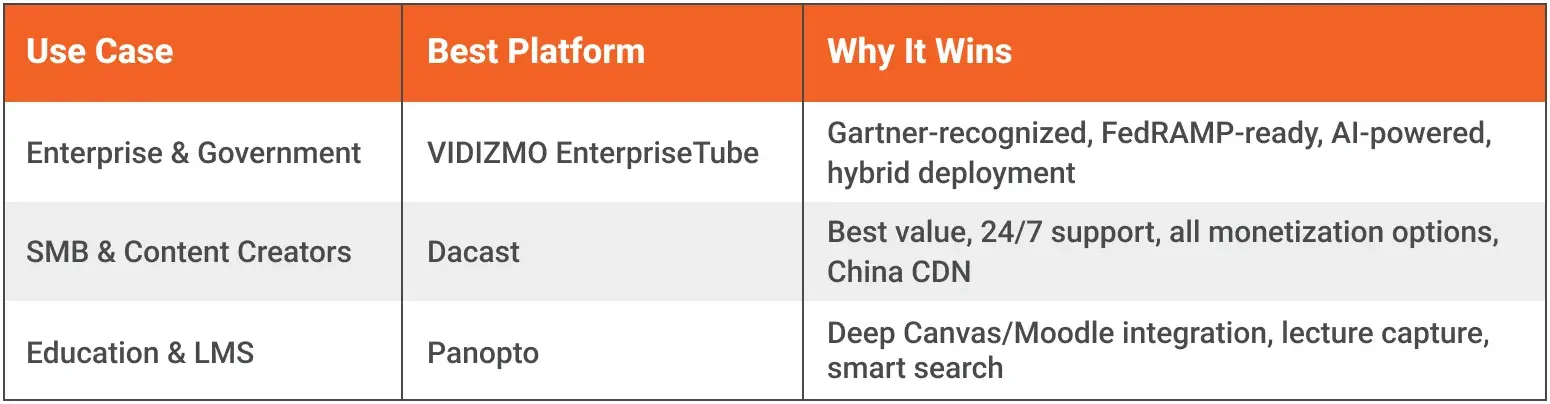
QUICK ANSWER: Top 3 Cloud Video Platforms by Use Case
What is a Cloud Video Platform?
A cloud video platform is a software-as-a-service (SaaS) solution that enables organizations to upload, store, manage, stream, and distribute video content over the internet without maintaining on-premises infrastructure.
Unlike consumer platforms like YouTube, enterprise cloud video platforms provide:
- Secure video hosting with encryption, access controls, and compliance certifications
- Scalable streaming infrastructure that handles thousands of concurrent viewers
- Video content management with metadata, search, and organization tools
- Analytics and reporting on viewer engagement and content performance
- Monetization options including subscriptions, pay-per-view, and advertising
- API access for custom integrations with existing business systems
According to Verified Market Research, the cloud video streaming market is projected to reach $29.46 billion by 2032, driven by explosive growth in enterprise video content for training, communications, and customer engagement.
What to Look For in a Secure Enterprise Streaming Platform
Before comparing vendors, it helps to define what "secure enterprise streaming" actually means. These are the criteria that separate genuine enterprise platforms from creator-first or prosumer tools:
- Authentication & SSO enforcement: SAML 2.0, OAuth 2.0, Azure AD, Okta, and Ping Identity, so only the right people reach content.
- Role-based & granular access controls: control who can view, upload or publish, download, share, and access specific channels or folders.
- Encryption & secure delivery: AES encryption, DRM, domain and IP restrictions, tokenized playback, and TLS/SSL.
- Governance & compliance: GDPR, ISO 27001, SOC 2, and HIPAA where applicable, backed by audit logs and retention policies.
- Enterprise-scale content management: large libraries, metadata, auto-tagging and search, retention rules, and approval workflows.
- Live and on-demand streaming: secure CEO broadcasts and town halls alongside private VOD training libraries.
- Integrations: Microsoft Teams, SharePoint, LMS platforms, intranets and portals, and CRM/CMS systems.
How We Evaluated These Platforms
Our evaluation methodology assessed each platform across seven critical dimensions:
- Core Streaming Capabilities: Live streaming, VOD hosting, transcoding, adaptive bitrate
- Security & Compliance: Encryption, DRM, access controls, certifications (SOC 2, HIPAA, GDPR)
- Content Management: Video CMS, metadata, search, organization features
- Integrations: LMS, CRM, SSO, video conferencing, API availability
- Scalability: CDN coverage, concurrent viewer capacity, global delivery
- Pricing & Value: Transparent pricing, feature-to-cost ratio, contract flexibility
- Support & Reliability: Uptime SLAs, support channels, documentation quality
8 Best Cloud Video Platforms Compared [2026]
1. VIDIZMO EnterpriseTube
Best for: Government agencies, regulated enterprises, organizations requiring hybrid deployment
VIDIZMO EnterpriseTube is a Gartner and IDC-recognized enterprise video platform designed for organizations with stringent security, compliance, and customization requirements. Unlike most SaaS-only competitors, VIDIZMO offers flexible deployment options including public cloud, private cloud, hybrid, and on-premises configurations.
Key Features:
- AI-powered video search with speech-to-text in 50+ languages
- Automatic transcription, translation, and closed captioning
- Advanced redaction tools for PII protection
- Multi-tenant architecture with autonomous video portals
- Deep integrations with Microsoft 365, Teams, SharePoint, and major LMS platforms
- FedRAMP-ready and compliant with HIPAA, GDPR, CJIS, and SOC 2
- Enterprise security controls including SSO, encrypted delivery, audit logs, and role-based access
Pros: Exceptional security posture, flexible deployment (Azure, AWS, GovCloud, on-premises), AI capabilities built-in, true hybrid cloud support, complete white-label customization
Cons: Custom pricing requires sales consultation, best suited for mid-market to enterprise, steeper learning curve due to feature depth
Best Use Cases: Government/public sector, healthcare (HIPAA), legal firms, large enterprises, organizations needing hybrid deployment
2. Dacast
Best for: SMBs, content creators, live event broadcasters on a budget
Founded in 2008, Dacast has established itself as a cost-effective streaming solution that doesn't compromise on features. The platform serves everyone from small content creators to enterprise broadcasters, offering both live streaming and VOD hosting with China video delivery, a rarity at this price point.
Key Features:
- Live streaming with RTMP ingest and HLS delivery
- All three monetization models: SVOD, TVOD (pay-per-view), AVOD
- White-label HTML5 video player
- Multi-CDN delivery including Akamai and Limelight
- 24/7 customer support on all plans
Pros: Transparent pricing starting at $39/month, all monetization options included, China CDN, 24/7 support, no viewer limits
Cons: Interface can feel dated, advanced analytics require higher tiers, limited AI features
3. Brightcove
Best for: Media companies, marketing teams, large enterprises requiring advanced analytics
Brightcove is a pioneer in the video streaming industry, founded in 2004 and publicly traded (NASDAQ: BCOV). The platform powers video experiences for some of the world's largest media companies and enterprises, with particular strength in marketing video and monetization.
Key Features:
- Video Cloud for hosting, management, and delivery
- Marketing Studio with lead generation and CTAs
- Server-side ad insertion (SSAI)
- Audience Insights with AI-powered analytics
- Global CDN with 99.99% uptime SLA
Pros: Industry-leading reliability, advanced marketing integrations, Emmy Award-winning technology, comprehensive analytics
Cons: Premium pricing, requires sales contact, can be complex for simple use cases
4. Panopto
Best for: Educational institutions, corporate training, knowledge management
Panopto specializes in video for learning, making it the go-to platform for universities and corporate training departments. The platform's strength lies in its seamless LMS integrations, lecture capture capabilities, and powerful in-video search functionality.
Key Features:
- Automatic lecture capture and screen recording
- Smart Search: AI-powered search inside video content
- Deep LMS integration (Canvas, Blackboard, Moodle, D2L)
- Video quizzing and interactive elements
- SCORM/xAPI compliance for LMS tracking
Pros: Best-in-class LMS integration, excellent lecture capture, Smart Search indexes every spoken word, strong accessibility features
Cons: Primarily education/training focused, custom pricing only, limited monetization options
5. Kaltura
Best for: Large enterprises and universities requiring maximum customization
Kaltura offers an open-source video platform with extensive customization capabilities. It serves over 1,000 enterprises and educational institutions worldwide, providing everything from virtual classrooms to OTT video services.
Key Features:
- Open architecture with extensive APIs and SDKs
- Virtual Classroom with real-time collaboration
- Video Portal (MediaSpace) for content management
- In-video quizzing and analytics
- Webinars and virtual events platform
6. Wowza
Best for: Developers, broadcasters requiring low-latency streaming, hybrid deployments
Wowza is a streaming infrastructure company that provides both cloud-based and self-hosted solutions. It's particularly popular among developers and broadcasters who need granular control over their streaming workflows and ultra-low latency delivery.
Key Features: Sub-second latency streaming, WebRTC and RTMP support, multi-platform delivery, REST APIs, SOC 2 Type 2 certified
7. Vimeo Enterprise
Best for: Marketing teams, creative professionals, internal communications
Vimeo has evolved from a creator-focused platform to a comprehensive enterprise video solution. Vimeo Enterprise targets businesses needing professional video hosting for marketing, communications, and training without the complexity of traditional enterprise platforms.
Key Features: Ad-free brandable player, live streaming and webinars, AI video editing tools, screen recording and video messaging, marketing integrations
8. Vidyard
Best for: Sales and marketing teams using video for prospecting
Vidyard specializes in video for sales and marketing, with particular strength in personalized video messaging, sales enablement, and marketing automation integration.
Cloud Video Platform Comparison Table
| Platform | Best For | Live | Key Strength |
|---|---|---|---|
| VIDIZMO | Enterprise/Gov | ✓ | Security & Compliance / AI Capabilities / Flexible Deployment |
| Dacast | SMB/Creators | ✓ | Value & China CDN |
| Brightcove | Media/Enterprise | ✓ | Marketing Analytics |
| Panopto | Education | ✓ | LMS Integration |
| Kaltura | Customization | ✓ | Open Architecture |
| Wowza | Developers | ✓ | Low Latency |
| Vimeo | Marketing | ✓ | Ease of Use |
| Vidyard | Sales/Marketing | Sales Video Messaging |
How to Choose the Right Cloud Video Platform
Step 1: Define Your Primary Use Case
- Internal communications & training: Panopto, VIDIZMO
- Marketing & sales enablement: Vidyard, Vimeo, Brightcove
- Live event streaming: Dacast, Wowza
- Developer integration: Wowza, Kaltura
Step 2: Assess Security & Compliance Requirements
- HIPAA compliance: VIDIZMO, Panopto, Brightcove
- FedRAMP/Government: VIDIZMO
- SOC 2 certification: VIDIZMO, Wowza, Brightcove, Panopto
Step 3: Evaluate Integration Needs
- Microsoft 365: VIDIZMO
- LMS (Canvas, Moodle): Panopto, Kaltura
- Salesforce/HubSpot: Vidyard, Brightcove, Vimeo
- Custom development: Kaltura, Wowza
Conclusion
Choosing the right cloud video platform requires balancing your organization's specific needs against each platform's strengths. For government and regulated enterprises, VIDIZMO EnterpriseTube delivers unmatched security and compliance. Budget-conscious SMBs will find excellent value in Dacast. Educational institutions should strongly consider Panopto or Kaltura for their LMS integration capabilities.
The cloud video platform market continues to evolve rapidly, with AI capabilities becoming standard and hybrid deployment options expanding. Regardless of your choice, starting with a free trial and testing with realistic use cases will help ensure the platform meets your needs before committing to a long-term contract.
Ready to find your ideal cloud video platform? Start with VIDIZMO's free trial to experience enterprise-grade video management with AI-powered capabilities.
FAQ
Frequently Asked Questions
What is the best cloud video platform for enterprises?
For large enterprises with complex security and compliance requirements, VIDIZMO EnterpriseTube and Brightcove are top choices. VIDIZMO excels in government and regulated industries with deployment on FedRAMP High-authorized infrastructure and hybrid options, while Brightcove offers industry-leading reliability and marketing analytics.
Can cloud video platforms support live streaming?
Yes, most modern cloud video platforms support live streaming alongside video-on-demand. Platforms like Dacast, Wowza, and IBM Watson Media specialize in live streaming, while others like Vidyard focus primarily on on-demand content.
What security features should I look for?
Essential security features include: AES-256 encryption, DRM protection, SSO integration, access controls (password, domain, IP restrictions), audit logs, and compliance certifications relevant to your industry (SOC 2, HIPAA, GDPR, FedRAMP).
Which cloud video platform is best for education?
Panopto and Kaltura lead in education due to their deep LMS integrations (Canvas, Blackboard, Moodle), lecture capture capabilities, and features designed for learning like in-video quizzing and student engagement analytics.
How do cloud video platforms compare to YouTube?
Unlike YouTube, enterprise cloud video platforms offer: no third-party advertising, complete branding control, advanced security and access controls, compliance certifications, detailed analytics, monetization flexibility, and integration with business systems.
Can I migrate from one cloud video platform to another?
Yes, but complexity varies. Platforms using standard formats (MP4, HLS) allow easier content export. Consider migration when evaluating, check export options, API availability, and whether metadata can be transferred.
What bandwidth do I need for cloud video streaming?
As a viewer: ~3 Mbps for 720p, ~5 Mbps for 1080p, ~25 Mbps for 4K. As a broadcaster, cloud platforms handle delivery, you just need sufficient upload speed for your stream quality (typically 5-10 Mbps for HD).
How do I monetize video content on a cloud platform?
Cloud platforms support three primary models: SVOD (subscription) for recurring revenue, TVOD (pay-per-view) for one-time purchases, and AVOD (advertising) for ad-supported content. Platforms like Dacast, Muvi, and JW Player support all three.
What is the difference between SaaS and self-hosted video platforms?
SaaS platforms (Dacast, Vimeo, Brightcove) are fully managed, the vendor handles infrastructure and updates. Self-hosted platforms (Wowza Streaming Engine, VPlayed) give you complete control but require managing your own servers.
TopicsEnterprise Video PlatformSecurity and ComplianceCIO and IT Leadership
About the author
Hassaan Mazhar is a B2B SaaS content strategist at VIDIZMO specializing in AI redaction, compliance technology, and enterprise content marketing. He builds trust-driven narratives for legal, public sector, and enterprise audiences navigating data privacy and video intelligence challenges.
You may also like

Fire and Smoke Detection as a Second Set of Eyes in Schools
Let the first sentence of this article do the compliance work: nothing described here replaces, modifies, or competes ...

Weapon Detection in Schools: Detection, Verification, Response
No school safety technology carries more emotional weight than weapon detection, and no school safety technology is ...

School Safety Grants: What the Money Can Buy
School safety improvements have a funding problem that is really a sequencing problem: the need is continuous, the ...