
The banking and financial services industry is undergoing a significant digital transformation, and video has emerged as a critical tool for everything from employee training to executive communications. According to Allied Market Research, the global video banking service market is projected to reach $247.9 billion by 2031, growing at a CAGR of 13.6%.
But here's what many organizations discover: consumer-grade video tools like YouTube or basic video conferencing platforms simply aren't built for the unique demands of financial institutions. Banks need enterprise video platforms that combine the ease-of-use of modern video technology with the security, compliance, and governance capabilities that regulators demand.
This guide explores how financial institutions can leverage enterprise video platforms to transform their operations while maintaining strict regulatory compliance.
What Is a Video Platform for Banking?
A video platform for banking is a specialized enterprise video content management system designed to meet the unique requirements of financial institutions. Unlike general-purpose video hosting services, banking video platforms provide:
- Enterprise-grade security: End-to-end encryption (AES-256) and secure video delivery
Regulatory compliance: Built-in support for SOC 2 Type II, FINRA, and GDPR requirements. - Audit capabilities: Comprehensive logging, access tracking, and compliance reporting
- Flexible deployment: On-premises, private cloud, hybrid, or SaaS options to meet data sovereignty requirements
- Integration capabilities: Connection with existing LMS, SSO, and enterprise systems
See more: Enterprise Video Platform
Key Use Cases for Video Platforms in Banking
Financial institutions deploy enterprise video platforms across multiple business functions. Here are the most impactful applications:
1. Regulatory Compliance Training
Banks face an ever-growing list of compliance requirements: Anti-Money Laundering (AML), Know Your Customer (KYC), the Bank Secrecy Act (BSA), and numerous FINRA regulations. Video-based training offers several advantages over traditional classroom instruction:
- Consistent delivery: Every employee receives identical training content, eliminating variations in instruction quality
- Trackable completion: Detailed analytics show who watched what content, for how long, and whether they passed embedded assessments
- On-demand access: Employees can complete required training at their convenience without scheduling conflicts
- Cost efficiency: Eliminates travel costs, venue expenses, and the productivity loss of pulling employees from their desks
With features like in-video quizzes, completion certificates, and SCORM-compliant reporting, enterprise video platforms integrate seamlessly with existing Learning Management Systems (LMS) to create a comprehensive compliance training ecosystem.
See more: Video Training Platform
2. Secure Internal Communications
In an era of distributed workforces and multiple branch locations, video has become essential for internal communications. Banks use enterprise video platforms for:
- Executive town halls: CEO and leadership communications reaching thousands of employees simultaneously
- Policy announcements: Regulatory updates and procedural changes communicated consistently across all branches
- Crisis communications: Rapid deployment of critical information during security incidents or market disruptions
- Meeting recordings: Secure storage and sharing of recorded video conferences from platforms like Zoom, Microsoft Teams, and Cisco Webex
Unlike consumer video platforms, enterprise solutions provide granular access controls, ensuring that sensitive communications reach only authorized personnel.
See more: Corporate Video Streaming
3. Knowledge Management and Institutional Memory
Financial institutions possess vast amounts of institutional knowledge that often exists only in the minds of experienced employees. Video platforms help capture and preserve this knowledge through:
- Subject matter expert recordings: Capture specialized knowledge before key employees retire or change roles
- Process documentation: Visual guides for complex procedures that are difficult to explain in written format
- AI-powered search: Automatic transcription makes video content searchable by spoken words, enabling employees to quickly find relevant information
4. Customer Education and Onboarding
Forward-thinking banks use video to enhance the customer experience through educational content:
- Product tutorials: Step-by-step guides for mobile banking apps, online services, and new features
- Financial literacy content: Educational videos on savings, investing, and financial planning
- Fraud prevention: Awareness videos helping customers identify and avoid common scams
Essential Features of a Banking Video Platform
When evaluating video platforms for financial services, look for these critical capabilities:
Security and Compliance Features
- Encryption: FIPS 140-2 compliant AES-256 encryption for data at rest and in transit
- Access controls: Role-based permissions, IP restrictions, and geo-blocking capabilities
- Single Sign-On (SSO): Integration with enterprise identity providers like Azure AD, Okta, and Ping
- Audit trails: Comprehensive logging of all user actions for compliance reporting
- Data residency: On-premises or regional cloud deployment options for data sovereignty requirements
AI-Powered Capabilities
Modern enterprise video platforms leverage artificial intelligence to enhance productivity and accessibility:
- Automatic transcription: Convert spoken content to searchable text in 40+ languages
- AI-powered search: Find specific content by searching through spoken words, objects, and on-screen text
- Automatic tagging: AI-generated metadata for improved content organization and discovery
- Video summarization: Auto-generated summaries and chapter markers for long-form content
See more: AI Enterprise Video Platform
Integration Capabilities
A banking video platform should integrate seamlessly with your existing technology stack:
- LMS integration: Connect with Moodle, Cornerstone, SAP SuccessFactors, and other learning platforms
- Video conferencing: Automatic ingestion of recordings from Zoom, Microsoft Teams, Cisco Webex, and GoTo Meeting
- Content management: Integration with SharePoint, Drupal, and other CMS platforms
- Analytics tools: Connection with Google Analytics, Woopra, and business intelligence systems
See more: Video Integration
Compliance Standards for Banking Video Platforms
Financial institutions operate under strict regulatory requirements. Any video platform must support compliance with:
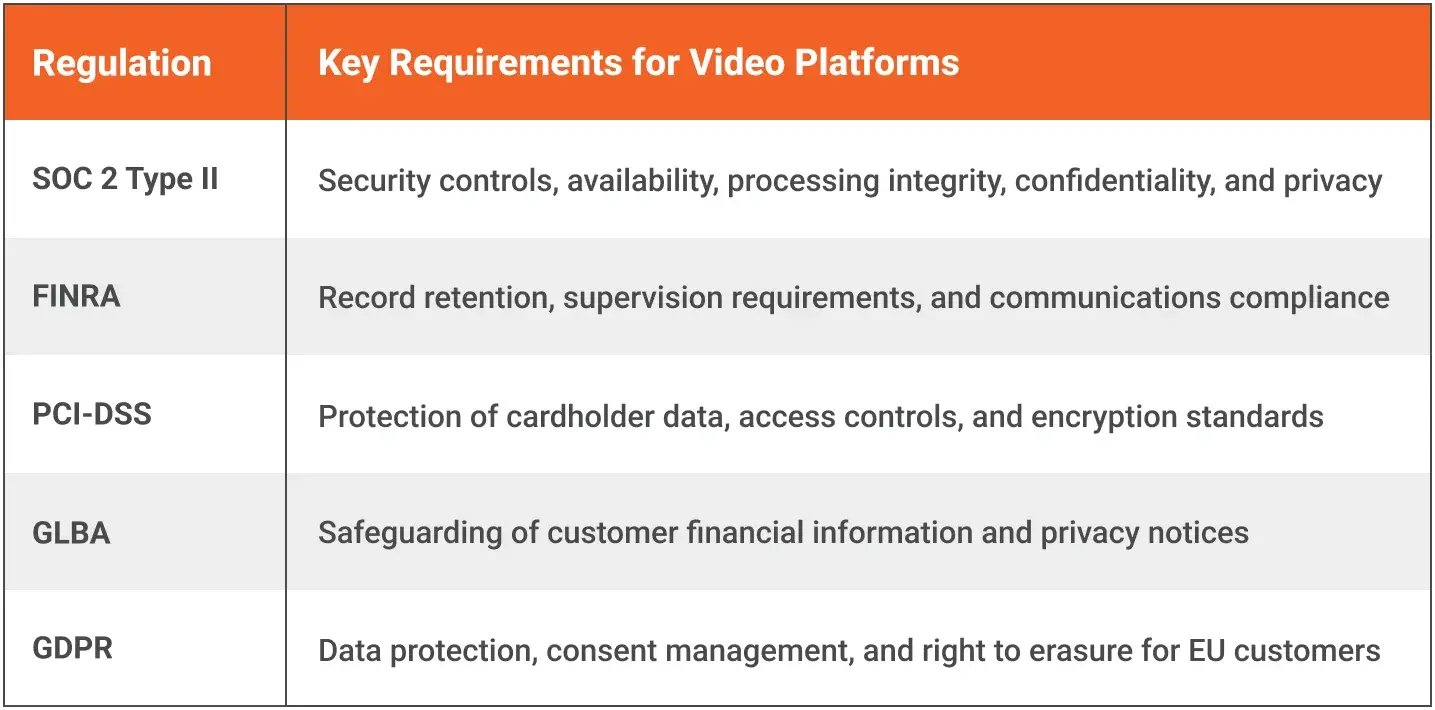
See more: Enterprise Video Platform for Finance
Implementation Best Practices
Successfully deploying a video platform in a banking environment requires careful planning:
- Start with a pilot program: Begin with a specific department or use case—such as compliance training—before expanding organization-wide.
- Engage stakeholders early: Include IT security, compliance, HR, and communications teams in the evaluation process.
- Define governance policies: Establish clear guidelines for content creation, approval workflows, retention periods, and access controls.
- Plan for integration: Map out connections with existing systems, including LMS, SSO providers, and video conferencing tools.
- Train content creators: Provide guidance on creating effective video content that meets both quality and compliance standards.
See more: Video CMS
Measuring ROI: The Business Case for Banking Video Platforms
Financial institutions that implement enterprise video platforms typically see measurable returns across several areas:
-
Training cost reduction: Shifting from classroom to video-based learning typically reduces training delivery costs by eliminating travel, venue, and lost-productivity expenses
-
Knowledge retention: Industry research consistently shows video-based training improves retention compared to text-based materials alone
-
Time savings: AI-powered search cuts the time employees spend manually scrubbing through footage to find specific information
Getting Started with VIDIZMO EnterpriseTube
VIDIZMO EnterpriseTube is a Gartner-recognized enterprise video platform trusted by financial institutions worldwide. With ISO 27001 certification, SOC 2 compliance, and flexible deployment options including Azure Government and AWS GovCloud, EnterpriseTube provides the security, compliance, and functionality that banks require.
Key capabilities for financial services include:
- End-to-end encryption with FIPS 140-2 compliant AES-256
- AI-powered transcription, search, and content intelligence
- Integration with Zoom, Microsoft Teams, and leading LMS platforms
- Comprehensive audit trails and compliance reporting
- On-premises, private cloud, and hybrid deployment options

FAQ
Frequently Asked Questions
What is the difference between video banking and a video platform for banking?
Video banking refers to customer-facing solutions that enable video calls between customers and bank staff for services like account opening or loan applications. A video platform for banking is an enterprise content management solution for internal use cases like training, communications, and knowledge management. Many financial institutions use both, video banking for customer interactions and enterprise video platforms for internal operations.
What security standards should a banking video platform meet?
The vendor should hold ISO 27001 and SOC 2 Type II, and support regulatory frameworks like GDPR and SEC/FINRA recordkeeping rules directly, with GLBA and PCI-DSS coverage available through integrated redaction capabilities where financial or payment data needs to be removed before sharing.
How does GDPR affect banking video recordings?
If a recording contains personal data or biometric data, GDPR applies. Banks must establish a lawful basis, enforce retention limits, and support data subject rights.
Should banks use cloud or on-premises video platforms?
The decision depends on regulatory requirements, risk appetite, and data residency obligations. Many institutions adopt a hybrid model, regulated communications remain on-premises or in a private cloud, while internal content may use compliant SaaS.
How are banks using video platforms for compliance training?
Banks deliver AML, KYC, GDPR, and cybersecurity training via on-demand video with embedded quizzes. The system generates auditable completion records, certificates, and LMS reporting (SCORM/LTI) for examiner review.
Can banks rely solely on Microsoft Teams or SharePoint?
Teams supports collaboration, but does not natively provide WORM retention, MiFID/SEC-compliant archival, or detailed supervisory audit trails. Most banks use additional compliance recording and archival solutions alongside Teams.
What video retention policies should banks implement?
Retention must align with applicable regulations (often 3, 7+ years, depending on record type). The platform must support automated retention schedules, litigation holds, and defensible deletion policies.
How does AI-powered search support compliance?
AI converts spoken content into searchable transcripts with timestamps and speaker identification. This enables supervisory review, regulatory response, and eDiscovery without manually reviewing thousands of hours of footage.
What is the business case for an enterprise video platform?
It reduces regulatory risk exposure, lowers audit preparation effort, and improves training efficiency. Avoiding a single FINRA, SEC, or GDPR enforcement action can offset multiple years of platform investment.
Can a banking video platform integrate with our existing LMS?
Yes, enterprise video platforms like VIDIZMO EnterpriseTube integrate with major LMS platforms including Moodle, Cornerstone, SAP SuccessFactors, and others through SCORM compliance and API connections. This integration enables seamless content delivery and automatic reporting of training completion data.
TopicsFinancial ServicesSecurity and ComplianceCIO and IT Leadership
About the author
Hassaan Mazhar is a B2B SaaS content strategist at VIDIZMO specializing in AI redaction, compliance technology, and enterprise content marketing. He builds trust-driven narratives for legal, public sector, and enterprise audiences navigating data privacy and video intelligence challenges.
You may also like

Fire and Smoke Detection as a Second Set of Eyes in Schools
Let the first sentence of this article do the compliance work: nothing described here replaces, modifies, or competes ...

Weapon Detection in Schools: Detection, Verification, Response
No school safety technology carries more emotional weight than weapon detection, and no school safety technology is ...

School Safety Grants: What the Money Can Buy
School safety improvements have a funding problem that is really a sequencing problem: the need is continuous, the ...