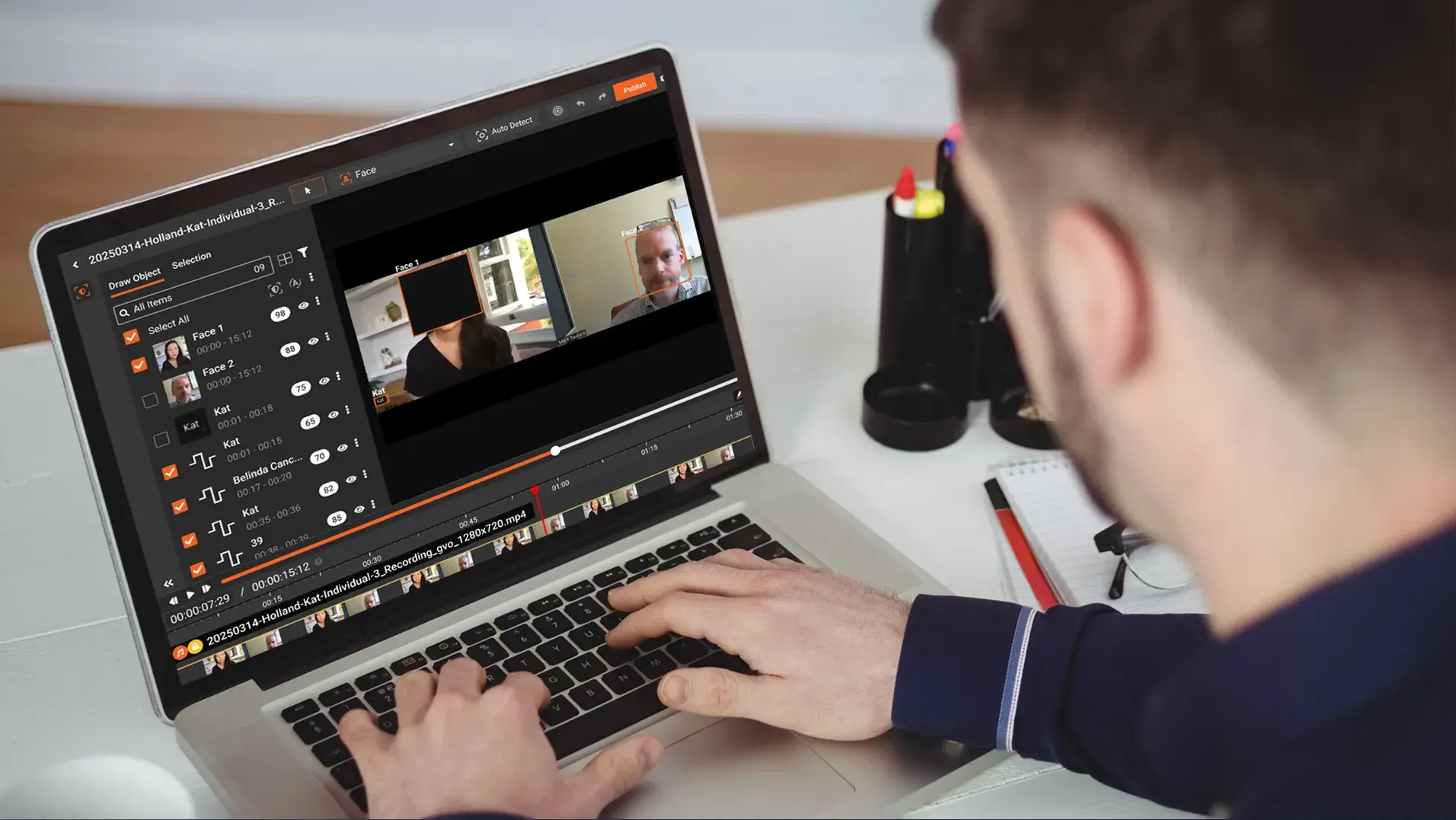
Most organizations that redact screen recordings start manually. A compliance analyst opens a video editor, scrubs through the recording, and drops blur boxes on the frames that contain sensitive content. This works for small volumes and low stakes. It stops working the moment either variable changes.
The question of AI versus manual screen recording redaction usually arrives once the volume grows, the stakes rise, or an audit surfaces a recording that was missed. At that point the tradeoff is no longer theoretical. The organization has to choose a workflow that can scale with the library and that can be defended if a regulator, court, or auditor asks how the decisions were made.
This piece compares the two approaches across the criteria that usually matter in an enterprise decision: accuracy, speed, cost per recording, scalability, audit trail, and defensibility. It also covers where each approach fits and how hybrid workflows combine them. It sits under our broader screen recording redaction guide and builds on the risk context covered in hidden PII risks in screen recordings.
Why the AI vs. Manual Redaction Decision Matters
The redaction approach shapes more than cost. It shapes what kinds of recordings the organization can responsibly produce, how quickly those recordings can move through review, and how defensible the organization's privacy posture is when the practice is questioned.
A manual approach caps the volume of recordings a team can safely handle. That cap ripples into policy. Recordings that cannot be redacted in a reasonable time window are either not produced, shortened, held longer in their raw state, or shared as-is because the review bottleneck was too large. Each of those responses has costs the organization may not be pricing.
An AI-assisted approach moves the cap higher, sometimes by an order of magnitude or more, and changes the role of the human reviewer from finder to confirmer. The change is not purely about speed. It changes what a defensible workflow looks like, because the audit trail now includes model decisions, thresholds, and review confirmations rather than manual edits only.
How Manual Screen Recording Redaction Actually Works
Manual screen recording redaction uses a general-purpose video editor or a specialized redaction UI. The analyst plays the recording, identifies frames that contain sensitive content, and applies a blur or mask either as a static overlay or as a tracked region that follows an object across frames.
The work is linear and granular. Every minute of recording requires the analyst to watch the full minute, sometimes several times. The analyst has to identify each distinct piece of sensitive content, track it across the frames where it appears, apply a mask, and verify that the mask holds across scene changes, scrolls, and UI updates.
Review is where the workflow most often fails. A single recording can contain dozens of independent pieces of sensitive content, each appearing on different frames with different durations. A small oversight on any one of them is a disclosure. Experienced analysts rotate through recordings in pairs, with one redacting and one reviewing, specifically because the error rate on solo manual work is too high to defend.
Tooling has improved. Some video editors now offer tracking, auto-blur on moving objects, and region-of-interest masks that follow simple motion. These help at the margin but do not change the fundamental pattern. The human is still reading every frame.
How AI Screen Recording Redaction Works
AI screen recording redaction inverts the workflow. The AI reads the frames, the human reviews the result.
Under the hood, the AI pipeline typically combines several components. An OCR stage extracts text from each frame of the recording, including dashboard labels, form fields, chat messages, and document content. A detection stage identifies faces, license plates, and other visual objects. A classification stage, using named entity recognition and pattern matching, decides which extracted text qualifies as sensitive. A tracking stage maintains the identity of each detected region across consecutive frames so masking persists as content scrolls or shifts. Our deep dive on how OCR text redaction works in screen recordings covers the mechanics in detail.
Confidence thresholds govern how aggressively the model applies masks. A low threshold catches more content at the cost of more false positives. A high threshold produces cleaner output at the cost of more missed detections. Mature platforms expose this threshold to the user and allow it to be tuned per recording type.
The human role shifts to confirmation. The reviewer sees the redacted output alongside the original, typically in a split-screen comparison, and can accept, adjust, or reject each detection. The reviewer can also add redactions the model missed or remove false positives. This split-screen comparison is what most compliance teams rely on to trust the output before approving export.
Head-to-Head Comparison of AI and Manual Redaction
The two approaches differ across nine criteria that usually matter in an enterprise decision. Here's how they compare.
Accuracy on recurring patterns. Manual redaction is highly accurate when the analyst is experienced, but quality varies across analysts and across recordings. AI redaction is consistent across every recording it processes, with configurable thresholds that let teams tune for the sensitivity of the content.
Accuracy on novel content. Manual redaction depends entirely on analyst attention, which means new patterns are caught if the analyst happens to notice them. AI redaction depends on training data and whether the pattern is supported, which means new patterns are caught reliably only if the model or the custom rules have been configured for them.
Throughput. Manual redaction is measured in hours per hour of recording. A one-hour support session can take an experienced analyst several hours to redact properly. AI redaction is measured in minutes per hour of recording, with additional time for the human review step.
Cost per recording. Manual redaction is labor-dominated and grows linearly with volume. Every additional hour of recording requires proportional analyst time. AI redaction has a platform cost plus review labor, and the marginal cost per recording drops substantially at scale.
Consistency across reviewers. Manual redaction varies substantially between people. Two analysts reviewing the same recording will produce different outputs. AI redaction applies the same model behavior across every reviewer, which makes the redaction step itself uniform. Variation shifts to the review step, where it is easier to control.
Audit trail. Manual redaction typically produces an edit history in the editing tool, which is often incomplete and difficult to export for compliance reporting. AI redaction generates a system-level log of detections, thresholds, model version, reviewer decisions, and final approvals, available as a searchable record.
Defensibility. Manual redaction is defensible when the process is well-documented and every recording is reviewer-confirmed. AI redaction is defensible when thresholds are documented, the review step is consistently applied, and the audit trail is preserved.
Handling of scale. Manual redaction caps at the analyst hours the organization has available. Beyond that cap, recordings either wait or get shared without redaction. AI redaction scales with compute, with the human review step as the remaining constraint. Scaling the review step is usually easier than scaling detection.
Handling of novel PII types. Manual redaction is flexible but slow. An analyst can identify and redact a new type of sensitive content immediately, but doing so at scale across many recordings is labor-intensive. AI redaction requires either model tuning or custom pattern configuration to handle novel types, which is a one-time investment that then applies across every recording.
Adoption effort. Manual redaction requires minimal tooling investment, usually just a video editor the team already has. AI redaction requires configuration, integration with upstream and downstream systems, and training for the review workflow before it goes into production.
Where Manual and AI Redaction Each Fit Best
Manual redaction fits three profiles.
The first is very low volume with low recurrence, such as occasional FOIA or litigation productions that arrive once or twice a year. The setup cost of an AI pipeline may not pay back at that volume.
The second is highly novel content that existing AI models do not cover well, where the time spent validating AI output would exceed the time spent redacting manually.
The third is highly sensitive recordings where the organization's risk tolerance requires a human-first workflow regardless of cost.
AI-assisted redaction fits the common enterprise profile.
Recurring recording types at meaningful volume. Support sessions, training content, meeting recordings, product demos, and QA captures all belong here. The patterns of sensitive content are similar across recordings, which rewards a model that learns them once and applies them consistently.
Regulatory environments with tight response windows. FOIA productions, subject access requests, and discovery deadlines all punish slow workflows. AI shifts the bottleneck from content detection to human confirmation, which most teams can scale more readily.
Large back-archive cleanup. An organization with years of recordings that need to be brought into compliance is usually better served by AI on the archive and manual on the ongoing pipeline until the archive is cleared.
Hybrid Screen Recording Redaction Workflows That Combine Both
In practice, most mature programs do not choose purely one or the other. They combine them.
A common hybrid pattern puts AI at the detection layer and a human at the confirmation layer. The AI finds candidate redactions, the human reviews each one in a split-screen comparison, and the human approves the export. This pattern delivers most of the speed advantage of AI without sacrificing the defensibility advantage of human review.
Another common pattern segments recordings by risk. Low-risk recordings flow through a fully AI-driven workflow with light sampling review. Higher-risk recordings route to a detailed human review of every AI detection. Highest-risk recordings require a full manual pass regardless of the AI output. The segmentation reduces total review labor by concentrating it on the recordings that warrant it.
A third pattern uses AI for the first pass and a second human reviewer for a sample of the AI output as a quality control measure. The sample rate is tuned based on the accuracy of the model on the organization's content.
The hybrid models work because they treat AI and human labor as complements rather than substitutes. The AI handles the volume. The human handles the judgment.
What to Look for in AI Screen Recording Redaction Tooling
Teams moving to an AI-assisted workflow usually evaluate tools against a similar set of criteria. These are the eight that tend to matter most in practice.
Detection quality on rendered application UIs. Screen recordings are not natural-scene content. They are rendered UIs with specific fonts, high contrast, dense information layouts, and rapid transitions. Most general-purpose video AI was trained on natural scenes, which is why detection quality on screen content varies so much between tools. Evaluate on actual application recordings, not stock demo clips.
Coverage of the data types that appear in the organization's recordings. Generic PII coverage is table stakes. What separates viable options is support for the specific categories the organization handles, including structured patterns like account numbers, invoice totals, and internal identifiers, and unstructured entities like names, organizations, and addresses in context.
Configurable confidence thresholds. One threshold setting does not fit every recording type. A legal export needs a very low miss rate. A marketing walkthrough can accept more false positives in exchange for speed. The tool should expose the threshold and allow it to be tuned per recording type, without requiring a different workflow for each.
A review interface that supports efficient human confirmation. The review step is where defensibility sits. The interface should offer a split-screen comparison of original and redacted output, easy accept/reject on individual detections, and the ability to manually add redactions for content the model missed. Reviewers who spend more time fighting the UI than confirming detections will disengage.
A complete audit log. Compliance reporting depends on a searchable record of detections, thresholds applied, model version, reviewer decisions, and final exports. The audit log should generate automatically rather than requiring manual documentation. It should also be exportable for external audit and retainable alongside the redacted output.
Integration with existing recording, storage, and compliance tools. Recordings already live somewhere. They flow through video platforms, storage systems, evidence management tools, and case management platforms. The redaction step should integrate into those pipelines rather than requiring a side workflow. API access, watch folders, and connectors for common platforms all matter here.
Deployment options that match data residency and classification requirements. Shared SaaS is fine for some organizations. Others require private cloud, government cloud, or on-premises deployment for data residency, classification, or air-gapped environments. Confirm the deployment options as part of vendor selection rather than assuming flexibility after the fact.
Bulk and batch processing capabilities. Organizations with back-archives or continuous recording pipelines need batch upload, queued processing for overnight runs, and API-driven ingestion for automated workflows. Single-file processing is fine for pilots. Production use at enterprise scale requires throughput tooling.
VIDIZMO Redactor meets these criteria. It handles video, audio, image, and document redaction with configurable confidence thresholds, supports split-screen review, and generates a full audit trail of all redaction actions. Learn more about video redaction software or request a free trial.

How to Move From Comparison to Implementation
Most organizations that settle on an AI-assisted approach sequence their rollout in three stages.
Stage 1: Pilot on a single recording type. Start with a recording category that has a well-understood sensitive content profile, clear volume, and a willing internal owner. Customer support captures, training recordings, or QA screen captures are common first pilots because their content patterns are predictable. The pilot surfaces where the model performs well out of the box, where it needs custom regex or NER tuning, and where the review workflow fits or friction shows up. Expect the pilot to run three to six weeks before the configuration stabilizes.
Stage 2: Expand by volume and risk. Once the pilot workflow is stable, expand to additional recording types in a deliberate order. The usual sequencing is to take on the highest-volume recurring types first (because they deliver the largest time savings), then the highest-risk types (because they justify the investment in tuning). Document the threshold setting, custom patterns, and review configuration for each type as it comes online. That documentation becomes the operational playbook for the team running the redaction workflow.
Stage 3: Integrate upstream and downstream. The final stage is wiring the redaction step into the existing content pipeline so it stops feeling like a side process. Upstream, that means automated ingestion from recording platforms and storage.
Downstream, it means routing redacted output into the systems that consume it, whether that is a video hosting platform, an evidence management system, or a compliance archive. At this stage, the redaction step becomes a standard transformation in the content pipeline rather than a manual handoff.
FAQ
Frequently Asked Questions
Is AI screen recording redaction accurate enough for compliance work?
AI screen recording redaction is accurate enough for compliance work when it is paired with human review and configured to the organization's content. Confidence thresholds, custom patterns for organization-specific identifiers, and a split-screen review step together produce output that most compliance programs consider defensible. Fully autonomous AI redaction without review is generally not yet the standard for high-stakes recordings, though it is used for low-risk categories.
How much faster is AI redaction than manual redaction?
AI redaction is typically faster than manual redaction by at least an order of magnitude on recurring content, though the exact difference depends on the recording length, complexity, and the quality of the model on the organization's content. Most of the remaining time in an AI workflow is the human review step, not the detection. Throughput gains are usually largest on longer recordings with many independent pieces of sensitive content.
Does AI redaction produce an audit trail that holds up under review?
AI redaction produces a system-generated audit trail of detections, thresholds, reviewer decisions, and final approvals, provided the tool is configured to log those events. The trail is typically more complete than what manual workflows generate, because the system records actions the analyst would otherwise have to document by hand. The trail is only as good as the process, however, and the reviewer's role in confirming the output should be documented alongside the system logs.
What kinds of content does AI redaction struggle with?
AI redaction struggles most with novel patterns the model has not seen, low-resolution recordings where OCR quality degrades, heavily animated UIs where tracking is harder, unusual layouts that do not match common application patterns, and domain-specific identifiers that require custom regex or NER training. Most of these gaps are closable with configuration, but they should be identified during the pilot rather than after production rollout.
Can we run AI redaction on-premises for data residency reasons?
AI redaction can run on-premises, in government cloud, or in private cloud deployments in addition to shared SaaS, depending on the vendor. Organizations with strict data residency, classification, or air-gapped requirements typically specify the deployment model as part of vendor selection. The tradeoffs between deployment models usually involve scalability and update cadence rather than functional capability.
How do we handle false positives in AI redaction?
False positives are handled in the review step, where the reviewer can reject a detection and restore the original content. Patterns of false positives surface during the pilot and inform threshold tuning and custom pattern configuration. A small false positive rate is usually preferable to a small false negative rate, because false positives are visible to the reviewer while false negatives leave the output.
Does switching to AI redaction eliminate the need for human review?
No. Switching to AI redaction reduces human effort substantially but does not eliminate the review step. The review is where defensibility sits. An AI workflow without human review may be acceptable for low-risk recordings, but for higher-risk recordings the human confirmation is part of what makes the result defensible. Most mature programs keep the human in the loop for at least a sample of recordings at every stage.
How do we compare redaction tools before committing?
Compare tools on the specific recordings the organization actually produces, not on vendor-provided demo clips. Run a pilot with a representative set of recordings, measure detection quality, throughput, and the review experience, and verify the audit trail meets the compliance team's requirements. Evaluate integration with the organization's storage, recording, and compliance tools. Deployment model, pricing model, and support terms all factor in.
TopicsRedactionVideo RedactionRedactorSecurity and ComplianceCIO and IT Leadership

About the author
Ali Rind is a Product Marketing Executive at VIDIZMO, where he focuses on digital evidence management, AI redaction, and enterprise video technology. He closely follows how law enforcement agencies, public safety organizations, and government bodies manage and act on video evidence, translating those insights into clear, practical content. Ali writes across Digital Evidence Management System, Redactor, and Intelligence Hub products, covering everything from compliance challenges to real-world deployment across federal, state, and commercial markets.
You may also like

What Is a Real-Time Crime Center? A Guide for Cities and Counties
Somewhere in the last two years, someone probably asked your department whether it should have a real-time crime ...

Staffing a Real-Time Crime Center When Software Does the Watching
Most chiefs who hear a pitch for a real-time crime center ask the same question before any other, which is whether they ...
RTCC, EOC or Situational Awareness Center: What Each Room Is For
Walk into a real-time crime center, then into a city's emergency operations center, and you will see much the same ...