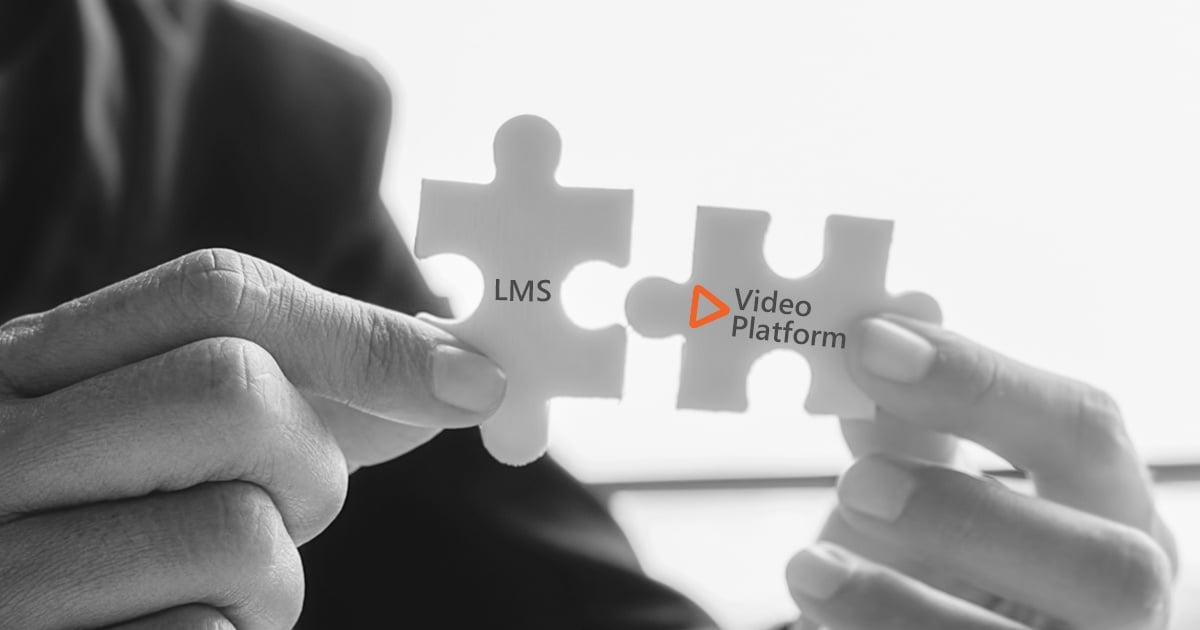
The learning management system has long been the center of corporate training and development. It manages enrollments, course structures, assessments, and learner records, and it scales formal training across departments and regions. For most organizations, the LMS is a long-standing investment that is too embedded in operations to replace.
Yet the way people actually learn at work has changed. Employees and students expect short, searchable, on-demand video. They expect playback that works on any device, in any region, without buffering or broken links. They expect to find the answer they need inside a recording in seconds, not scrub through 60 minutes of footage. The LMS was not designed for any of this, and that gap is where most video-based learning programs struggle today.
The fix is not to replace your LMS. It is to extend it with a dedicated enterprise video platform that handles everything the LMS was never built to do, while the LMS continues to do what it does well.
Why Video Is Now the Default Format for Learning
Video is no longer a supplement to traditional training. It has become the default medium for onboarding, compliance, leadership development, product education, and customer enablement. Several shifts pushed it there:
Remote and hybrid work created asynchronous learning expectations across time zones. Short, focused videos consistently outperformed static slide decks for engagement and retention. Subject matter experts began recording quick walkthroughs instead of writing long manuals. New hires arrived expecting a streaming-quality viewing experience, not file downloads or locked PDFs.
In this environment, video carries the weight of modern learning programs. When videos live in generic file stores, public hosting platforms, or as raw attachments inside the LMS, organizations lose fine-grained control over how content is consumed, reliable tracking of who watched what, consistent access across regions and devices, and integration with assessments and completion logic.
The result is fragmented infrastructure that hurts engagement, makes reporting unreliable, and quietly erodes the return on every hour of training content produced.
Where the LMS Falls Short on Video
LMS platforms serve a clear purpose, but they were built around text, documents, SCORM packages, and structured course catalogs. Video was an afterthought, and the limitations show up quickly at scale.
Large video files are stored as basic attachments or assets with inconsistent compression and transcoding. Playback quality varies by device and bandwidth, and learners in distributed locations frequently hit buffering or quality drops. There is no granular playback control, so learners skip ahead and miss critical segments in compliance or safety content. Interactive elements like in-video quizzes, timed annotations, and chapters are either unsupported or require clunky workarounds.
Even the more advanced LMS platforms that support some level of video provide only foundational hosting and playback. None of them offer the YouTube-like search, recommendation, and discovery experience that learners now take for granted.
They cannot search inside video by spoken word or on-screen text. They cannot automatically generate transcripts in multiple languages. They cannot deliver video reliably across global offices through edge caching or adaptive bitrate streaming.
This is not a fault of the LMS. It is a question of design intent. The LMS was built for course logic, gradebooks, and compliance records. Video delivery at scale needs a platform built specifically for video.
Why Replacing the LMS Is Not the Answer
It is tempting to look at video shortcomings and consider switching to a different LMS or a learning experience platform that promises better video. In most enterprise and education environments, that path creates more problems than it solves.
Course structures are deeply embedded in the current LMS, often built over years of curriculum design. Assessments, quizzes, and gradebooks are tightly coupled to the system. Historical learner data, compliance records, and certification proof cannot be put at risk during a migration. Integrations with HR systems, student information systems, single sign-on, and reporting tools are all wired into the existing platform.
Swapping the LMS to address video limitations becomes a multi-year project that diverts budget away from actual learning outcomes. Meanwhile, stakeholders continue to demand better video experiences, deeper analytics, and secure global delivery.
The more realistic approach is to keep the LMS as the system of record and add a specialized video layer alongside it. This decouples video infrastructure from course management, so each can evolve at its own pace without compromising the other.
How an Enterprise Video Platform Complements the LMS
The model is straightforward. The LMS continues to manage enrollments, courses, assessments, and grades. The enterprise video platform handles everything related to video: ingestion, storage, transcoding, streaming, transcription, analytics, and access control. Videos are embedded into LMS courses through standards-based connections, so learners experience video inside the LMS interface they already know, while the video platform works behind the scenes.
This is the architectural shift that lets you enhance video-based learning without disrupting the LMS. You protect what works and upgrade what does not.
Capabilities the Video Layer Should Cover
Not every video tool is suitable for this role. To support video-based learning inside an LMS, the platform needs a specific set of capabilities.
Playback control and completion tracking
For compliance, safety, and certification content, you need to influence how learners interact with video, not just whether they press play. That means the option to disable skipping, configure minimum watch percentages, and automatically push completion status back to the LMS through SCORM or LTI. This closes the gap between video consumption and course completion.
Deep analytics built for learning
View counts are not enough. Learning teams need to see where learners drop off in critical modules, which regions or departments struggle with playback, and how engagement with specific videos correlates with quiz performance. Granular video analytics tied to user identity make instructional design evidence-based instead of guesswork.
Accessibility, transcription, and multilingual support
Modern programs require accurate, time-synced transcripts in multiple languages, closed captions on every asset, multilingual subtitles and audio tracks, and the ability to search inside video by spoken word or on-screen text. AI-powered transcription supports accessibility compliance while also making video skimmable and discoverable.
Secure, global video delivery
Security and reach need to work together. That means authenticated, encrypted streaming, domain-restricted or LMS-only embedding to prevent content leakage, distributed delivery through a CDN or eCDN for consistent global performance, and fine-grained access control with audit logs for regulated environments.
Easy integration with existing systems
The video platform should connect to your LMS, single sign-on, identity provider, content management system, and video conferencing tools without custom development. Out-of-the-box integrations reduce IT overhead and keep the learner experience consistent across tools.
What This Looks Like with VIDIZMO EnterpriseTube
In an LMS-first setup, VIDIZMO EnterpriseTube handles everything related to video while your LMS continues to run courses, assessments, and learner records. Nothing about your existing course structure changes. Learners stay in the same LMS portal they already use, and L&D teams keep their current workflows intact.
What shifts is what happens behind the scenes. Video plays smoothly across regions and devices, even in bandwidth-constrained or firewall-restricted environments. Compliance training can require full viewing, so completion records reflect what learners actually watched. Global teams get content in their own language without separate production cycles. And when a learner finishes a video, that completion flows straight back into the LMS gradebook, so course progress stays accurate without manual tracking.
The practical outcome is fewer support tickets about playback, cleaner audit trails for compliance, and analytics that actually help instructional designers improve content. L&D leaders get a unified view of engagement and completion across both systems, while learners get an experience that finally matches what they expect from modern video. For high-volume training programs, this also extends into a dedicated video training platform deployment tailored to corporate L&D workflows.
The LMS keeps doing what it does well. The video layer takes care of what it was never built for. Together they give you a learning ecosystem that scales without forcing a disruptive migration.
For more on how your organization can use video, read our blog 51 business video use cases in the modern enterprise.
When This Approach Makes Sense
The embedded video platform model is a strong fit when a few things are true: your LMS is well-established and tied to years of course content, your training relies heavily on video, you serve learners across multiple regions or languages, and you need reliable proof of what people watched for compliance or audits. If you also face clear video issues today, like poor playback or weak reporting, the gains in engagement, completion, and audit quality come quickly with minimal disruption.
It is less of a fit in a few cases. If you are already planning to replace your LMS soon, it makes more sense to finish that move first. If video plays only a small role in your programs, simpler hosting may be enough. And if your audience is small and local, the global delivery and governance features that justify an enterprise platform may be more than you need right now.
The Cleaner Path Forward
The LMS is not the problem. It was simply never built to be a modern video platform, and forcing it to act like one creates friction for learners and administrators while hiding the real gap.
The better path is to let each system do what it does best. The LMS stays as your system of record for courses, assessments, and learner data. An enterprise video platform sits alongside it and handles streaming, accessibility, control, and analytics. The two connect through standard integrations, and each can evolve at its own pace.
This is how organizations modernize video-based learning without disrupting the foundation their training and education programs already run on.
To see how VIDIZMO EnterpriseTube fits with your current LMS, request a walkthrough with a solution specialist. Bring your LMS environment, your video use cases, and your global delivery needs, and we will map out integration options that work with what you already have.

FAQ
Frequently Asked Questions
How does LMS video integration work in practice?
The video platform handles uploads, storage, transcoding, and streaming. The LMS pulls videos into courses using SCORM, LTI, or secure embed codes. Learners watch inside the LMS interface they already use, while the video platform manages performance, analytics, and access in the background. Completion events sync back to the LMS gradebook automatically.
Will adding an enterprise video platform disrupt existing courses?
No. The LMS remains the system of record. Existing courses, enrollments, assessments, and learner data stay intact. The video platform adds a delivery and intelligence layer for video content without changing course logic or workflows.
How does video analytics complement LMS reporting?
LMS reports show course completion and quiz scores. Video analytics add engagement detail: where learners drop off, which segments are rewatched, which regions experience playback issues, and how viewing patterns correlate with quiz performance. Together they give learning teams a complete picture instead of two separate views.
Can we enforce video completion for compliance training?
Yes. The video platform can require minimum watch percentages, disable skipping, and only mark a video complete when the learner meets the defined criteria. That completion status is then pushed back to the LMS so the course progress reflects actual viewing, not just a click on the play button.
How does AI transcription support accessibility in video-based learning?
AI generates time-synced transcripts and captions automatically at upload. This supports learners with hearing impairments, non-native speakers, and anyone working in sound-sensitive environments. It also makes video content searchable by spoken word, which helps every learner navigate long recordings.
What about multilingual learning for global audiences?
Modern video platforms generate transcripts and translations in dozens of languages, with multilingual subtitles and the option for translated audio tracks. This lets one piece of source content serve learners across regions without separate production cycles for each language.
Is secure video delivery compatible with remote learners?
Yes. Authenticated, encrypted streaming combined with domain-restricted embedding and identity-based access control means remote learners can access content securely from any approved device or network. Audit logs track who watched what and when, which is essential for regulated industries.
How is global delivery handled across regions?
Enterprise video platforms use a distributed CDN, and in some cases an eCDN, to cache content close to viewers. This reduces buffering, supports adaptive bitrate playback, and ensures consistent performance in bandwidth-constrained regions or behind corporate firewalls.
Do we need to switch LMS vendors to use an enterprise video platform?
No. A well-designed enterprise video platform integrates with the major LMS systems through standard protocols. You keep your current LMS and add video capabilities alongside it, without forcing a migration or replacement.
How should we evaluate different video platforms for LMS integration?
Focus on standards-based integration (SCORM 1.2/2004, LTI 1.3), playback control and completion sync, depth of analytics, AI transcription and translation coverage, security and deployment options, global delivery infrastructure, and the strength of out-of-the-box integrations with your existing LMS, SSO, and content systems.
TopicsEnterpriseTubeIntegrationsCIO and IT Leadership
About the author
Rafay Muneer is a Senior Product Marketing Strategist at VIDIZMO with deep expertise in data protection, AI redaction, and privacy compliance. He covers how public safety agencies, legal teams, and enterprise organizations build defensible, technology-driven approaches to sensitive data management.
You may also like
Making a Digital Recording the Official Record
Most guidance about digital court recording assumes the argument is over. It describes microphones, channels, ...

A Maturity Model for Court Digital Evidence: Foundational, Developing, Advanced
Budget conversations about court technology go badly when the ask is a product and well when the ask is a stage.

Online Evidence Portal or eFiling: Where Should Exhibits Actually Be Submitted?
Courts deciding where exhibits should be submitted are choosing between an online evidence portal for court exhibits ...