Video Content Management, EnterpriseTube, Security and Compliance, CIO and IT Leadership
 Updated September 10, 2026
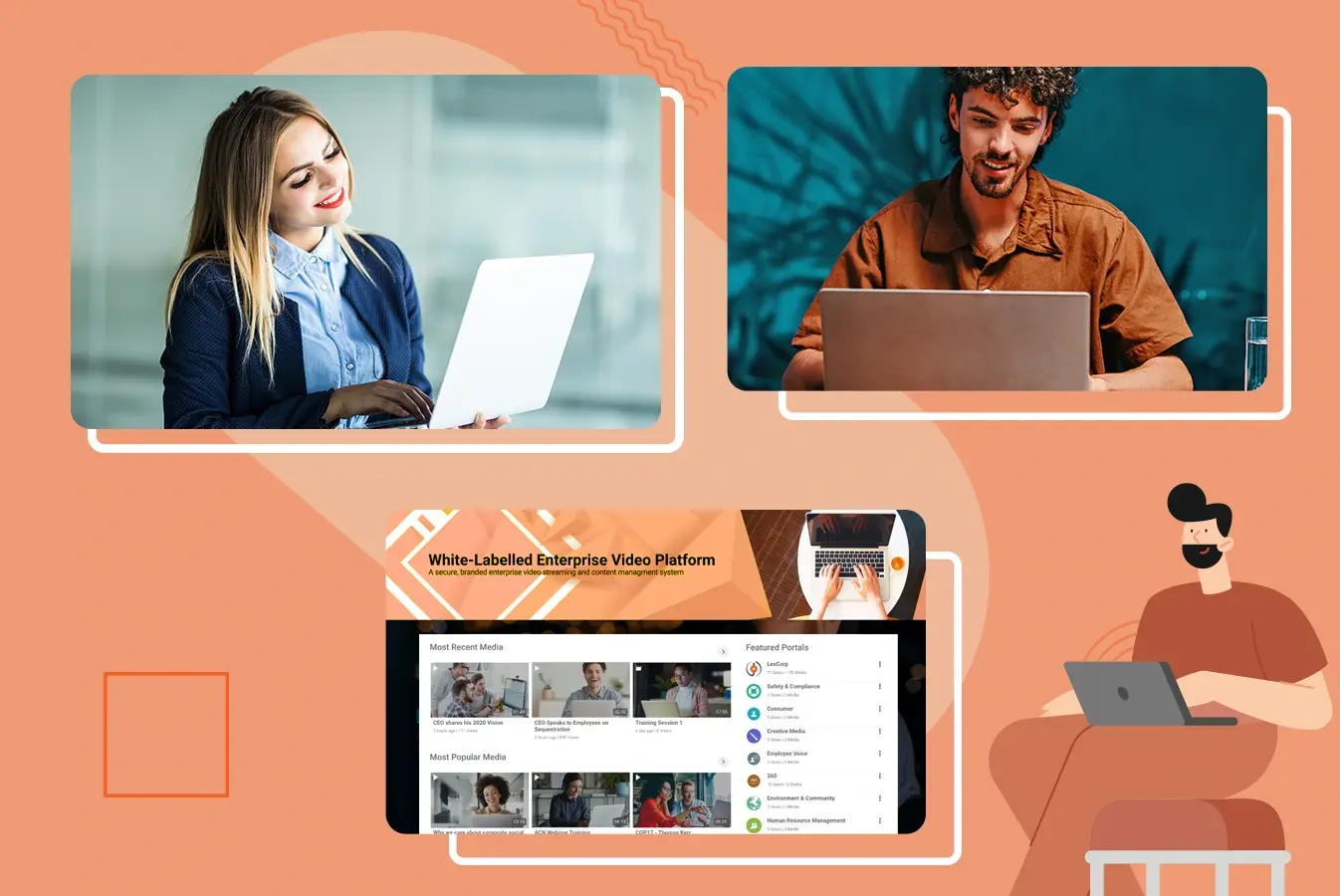
Video is everywhere, and there is a reason for it. Research on video marketing growth shows that 68% of consumers prefer video as their main way to learn about a new product. When enterprises use video for external audiences, a free public platform like YouTube or Vimeo stops being enough.
On a third-party video platform, the ball is always in the platform's court. Recommendations, ads, watermarks, and "watch next" carousels all promote someone else's brand alongside the content you produced. What enterprises need instead is their own white label video streaming platform.
Branding matters most when video is going out to external viewers. Marketing video is the obvious example. Showing a customer a product video on a platform that promotes another brand is counterproductive.
What is a white label video streaming platform
A white label video streaming platform is a video hosting and streaming product the vendor builds and you brand as your own. The vendor handles hosting, transcoding, security, and delivery. You control the brand: domain, logo, colors, player, portal, and notifications. Viewers experience it as a product from your company, not the vendor's.
White label platforms are paid solutions. Free public platforms like YouTube and Vimeo are not white label because you are using their service, not buying a product to rebrand. That is one reason enterprises cannot rely fully on a free platform. They need more than YouTube has to offer, and branding is only one part of it. The fuller picture sits inside an enterprise video content management guide.
The same branded portal and player work for both live broadcasts and on-demand video, so a white label platform doubles as a white label video on demand platform once you publish the recordings.
What to expect from a white label video streaming platform
Modern video platforms are capable, but enterprises should know what to ask for before choosing one.
A brandable platform should let you customize the entire interface to match your brand guidelines. Many platforms offer a custom video player or a custom color scheme, and stop there. That is not enough. The portal is the face of your brand, an extension of your brand promise, and it should be treated that way.
A 2026 white label shortlist also looks different from a 2024 shortlist. AI features (transcription, translation, summarization, chaptering, AI search) used to be premium add-ons, and are now expected in the base product. Security expectations have moved past password protection to tokenized URLs that expire, geo and IP restrictions, multi-year audit retention, and access policies down to portal, category, and content level. And identity is platform-layer now, with SSO via SAML or OAuth, SCIM provisioning, and group-driven permissions tied to Active Directory or Okta. The video access control mechanics sit underneath all of it.
The branding features that actually matter:

Let us explore some of these valuable branding features at your disposal:
1. Color scheme and logos
The most important branding elements are the logo and the brand color palette. A white label video platform should let you apply your brand color theme across the portal: navigation bar, header, search bar, toggle switches, dropdowns, buttons, and more. It should also let you place your logo in the navigation bar, on the home page, and as the browser favicon.
VIDIZMO applies all of these. Color theme covers the portal interface; logo placement covers the navigation bar, home page, hamburger menu, and favicon.
2. Custom domain
Even with your logo and colors on the portal, a video link that points to the vendor's domain quietly promotes their brand instead of yours. Most platforms hand customers a subdomain or directory, which means the URL itself still references the platform provider.
A real white label platform lets you point the portal to your own domain. EnterpriseTube customers can use a directory under the vendor domain, a subdomain like mydomain.enterprisetube.com, or a fully custom domain like mydomain.com with SSL.
3. Video player
The player is the most-viewed element of the whole platform. When someone watches a shared video, the player is where they notice the details, including whose brand sits in the corner.
VIDIZMO lets you customize the player to match the portal: color scheme, fonts, and your logo in the player chrome. You can also toggle individual controls (autoplay, loop, mute, seek, fullscreen) per portal or per audience using the portal settings. Custom CSS extends this further across the primary color, secondary color, hover, play button, seek bar, time tooltip, and thumbnail border.
Player customization matters because videos are not always watched on the portal. They get embedded on websites, in blog posts, and shared on social media. Branding has to stay consistent everywhere the player shows up.
4. Multilingual interface
Enterprises operate globally. Assuming English-only is a mistake. A Middle Eastern enterprise will want Arabic. A German enterprise will want German. An international enterprise will want viewers to choose for themselves.
VIDIZMO supports multilingual interface across multiple languages. The platform can run on one default language at the org level while letting each individual user pick their own.
5. Custom CSS
Predefined controls cover the common branding requests. They cannot cover everything. To handle the cases vendors cannot anticipate, a white label platform should expose custom CSS so your web team can extend the styling.
VIDIZMO allows custom CSS across font family, size, weight, primary, hover, navbar, search bar, background color, typography, buttons, and contextual backgrounds. The same custom CSS can be applied to the video player itself, covering player colors, controls, seek bar, time tooltip, thumbnail borders, and player font.
6. Multi-tenant white label
Single-portal branding works for a single brand. Large enterprises with multiple departments or a house of brands need more.
VIDIZMO supports multiple autonomous portals within one enterprise video platform, each with its own branding, admins, users, content library, access rules, and security posture. A house of brands can run one portal per brand. An enterprise with multiple departments can run one portal per department. All from a single platform instance, with separate icons representing each portal in the navigation.
7. Branded thumbnails and watermarking
Auto-generated thumbnails, a random frame grab from the video, look inconsistent and off-brand. Branded thumbnail templates with a fixed logo position, brand colors, and clear text overlays keep the library on-brand and easy to scan. Dynamic watermarks go further, overlaying a viewer's name or a brand mark during playback, which both reinforces your identity and deters unauthorized redistribution.
8. Branded notifications and sharing pages
Brand consistency usually breaks at the last mile, when a viewer leaves the player. A complete white label experience extends branding beyond the portal to the sharing pages recipients land on, the email notifications they receive (new-content alerts, access invitations), the embed code that keeps your styling on external sites, and even training-completion certificates that carry your brand rather than the vendor's.
Beyond branding: what else to evaluate
Branding is the reason most teams start looking, but it is rarely the only thing that decides the purchase. A few criteria matter almost as much as the branding controls.
Content ownership. On a public platform like YouTube you follow someone else's policies, and content can be demonetized, age-gated, or pulled when those policies change. A white label platform keeps the content, the rules, and the viewing experience under your control, with no injected ads or recommended-video panels.
Analytics. Look for granular, per-viewer analytics (watch time, drop-off, interactivity, device and location trends, heatmaps) rather than aggregate view counts, ideally with an export or a connector to Google Analytics or your BI stack.
Streaming quality. Smooth playback at scale depends on adaptive bitrate streaming (ABR) and CDN or eCDN delivery. Without them, a large live audience or a bandwidth-constrained office is where playback breaks down.
Content management. The portal is also a library. Categories, metadata, access rules, and search across spoken words and on-screen text are what keep a growing on-demand catalog usable.
Comparing specific products? See our roundup of the best white label video streaming platforms.
VIDIZMO: a complete white label video streaming platform
VIDIZMO offers an end-to-end white label video streaming platform built around the points above. Portal branding, custom domain with SSL, a brandable player, multilingual interface, custom CSS, and multi-tenant portals all work out of the box.
Beyond branding, EnterpriseTube ships with what 2026 enterprise buyers actually ask about: AI transcription in 82 languages, SSO via SAML, OAuth, and OIDC with pre-validated IdPs, SCIM provisioning, role-based access at portal and content level, and deployment across SaaS, on-premises, hybrid, and government cloud. For the technical view, see our breakdown of enterprise VOD architecture across SaaS, on-premises, hybrid, and air-gapped deployments.
To see VIDIZMO EnterperiseTube on your own use case, start a free trial or contact our team.

FAQ
Frequently Asked Questions
What is a white label video CMS?
A white label video CMS is a customizable software platform that lets businesses manage, host, and distribute video content under their own branding, without third-party logos or restrictions. The vendor builds the platform. The customer brands it.
How does a white label video CMS benefit my business?
It improves brand consistency, builds viewer trust, gives full control over content, and provides analytics that connect video viewing back to business outcomes. For enterprise use cases, it also adds SSO, role-based access control, compliance certifications, and integration with internal systems, which public platforms do not offer.
How is a white label video CMS different from YouTube or Vimeo?
YouTube and Vimeo are public platforms. Videos sit on their domains. The player carries their brand. End-card recommendations push viewers toward their ecosystem. A white label video CMS runs on your domain, with your branding throughout, and the experience around your video does not promote anyone else. It also adds enterprise features the public platforms do not offer: SSO, granular access control, compliance certifications, and deployment flexibility.
What features should I look for in a white label video CMS?
Full brand customization (logo, colors, custom domain, player branding, custom CSS), multilingual interface, multi-tenant portals if you run multiple brands, SSO and SCIM, role-based access control at portal and content level, AI features (transcription, translation, search), compliance certifications by industry (HIPAA, FedRAMP, CJIS, GDPR, SOC 2), and deployment flexibility (SaaS, on-premises, hybrid, government cloud).
Can a white label video CMS integrate with my existing business systems?
Yes. A capable platform integrates with SSO IdPs via SAML or OIDC, LMS systems through SCORM and LTI (Canvas, Moodle, D2L Brightspace, Blackboard), CRM (Salesforce, HubSpot), conferencing tools (Zoom, Teams, Webex, GoTo Meeting, BlueJeans), and document repositories (SharePoint). Pre-built native integrations matter more than "we have an API." Native works on day one. API integrations turn into professional services work.
TopicsVideo Content ManagementEnterpriseTubeSecurity and ComplianceCIO and IT Leadership
About the author
Daniyal Hassan is a Product Marketing Executive at VIDIZMO researching video content management and AI technology. He focuses on how organizations across government and enterprise can harness intelligent video platforms to streamline operations and unlock measurable business value.
You may also like
Finding Every Recording a Person Appears In
Some investigations open with the answer already in hand. There is a name, and there is a photograph, taken from a ...
What Analysis Can Still Do With an Incident Already Recorded
A person came to attention on one of your cameras today, and the next question is whether they have been here before. ...
How an Incident on Camera Becomes Known
A camera estate runs unwatched. That is arithmetic rather than a failure of discipline, because a site with a few ...