
by Ali Rind, Last updated: June 11, 2026

The term sovereign AI has moved from policy briefs into procurement documents. It now appears as a hard requirement on RFPs from federal civilian agencies, defense primes, regulated banks, and any organization with a data residency mandate. The phrase is also overloaded. It gets used to describe national AI strategies, sovereign cloud regions, on premises deployments, and air gapped enclaves, often interchangeably and almost always imprecisely.
This page is the working reference for what sovereign AI actually means when the workload is video, audio, and document intelligence, and how to evaluate the deployment spectrum honestly before a vendor section enters the conversation.
What sovereign AI actually means
Sovereign AI is the property that an AI system can be deployed and operated entirely within boundaries the customer controls. Those boundaries cut across three dimensions that buyers tend to collapse into one. They are not the same thing, and conflating them produces procurement decisions that look compliant on paper and fail under audit.
Data sovereignty
Data sovereignty is the simplest of the three. It governs where the data lives, both in storage and in transit. A workload that keeps training data, inference inputs, and outputs inside a defined geographic and legal boundary satisfies data sovereignty. A workload that sends a single inference request to an API endpoint hosted in another jurisdiction does not.
Infrastructure sovereignty
Infrastructure sovereignty governs where the compute happens. It is broader than data residency. A US headquartered cloud provider running inference in an EU region still creates jurisdictional exposure under the US CLOUD Act, which allows US law enforcement to compel American companies to provide data stored abroad. EU regions of AWS, Azure, and Google Cloud are subject to this regime. True infrastructure sovereignty requires the operator of the compute, not just its location, to fall under the customer's preferred legal framework.
Operational sovereignty
Operational sovereignty is the dimension procurement teams most often miss. It governs who controls the model lifecycle. Who decides when the model is updated. Who has access to inference logs. Who owns the fine tunes. A deployment that sits on the customer's own hardware but whose model weights are remotely updated by the vendor, or whose telemetry is shipped back to the vendor for "improvement," is not operationally sovereign. Operational sovereignty requires the customer to have final authority over model selection, update cadence, and observability data.
Treat the three together. A workload that satisfies one and fails the others is not sovereign.
Why sovereign AI is non-negotiable for certain buyers
For many enterprises, sovereignty is a preference. For a defined set of buyers, it is a requirement that comes from regulation, contract, or both.
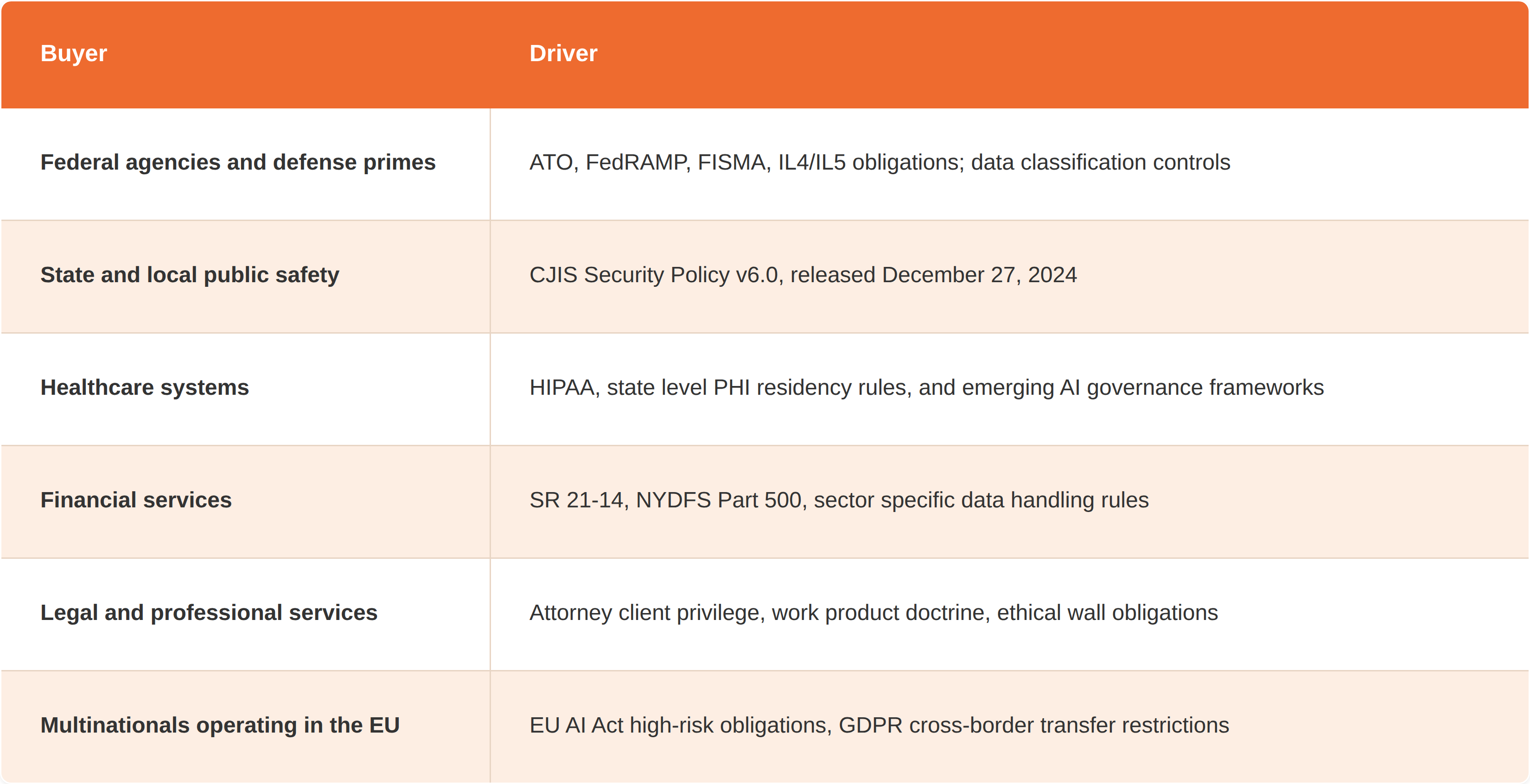
The EU AI Act entered force in August 2024. Its general-purpose AI obligations took effect in August 2025, and its high-risk system obligations are currently scheduled to become fully applicable on August 2, 2026. A Digital Omnibus proposal published by the European Commission on November 19, 2025 may push that high-risk deadline to December 2, 2027, but as of May 2026 the deferral has not been adopted, so August 2026 is still the operative deadline. Gartner's November 2025 survey of 241 Western European CIOs reported that 61 percent are increasing reliance on local or regional cloud providers in response to geopolitical pressure. These buyers are not asking for sovereign AI because the marketing told them to. They are asking because their auditors will.
The sovereign AI deployment spectrum, stated honestly
Sovereign AI is not a single deployment model. It is a spectrum of choices, each with real trade-offs between control, capability, and operational cost. The honest version of this spectrum looks like this.
Fully air-gapped on-premises
No external network connectivity. Models, embeddings, fine tunes, and inference all run inside the customer's perimeter. Updates are applied via reviewed media transfer. This is the maximum control deployment, used in classified environments, defense networks, and parts of intelligence community workloads. It is also the highest friction deployment to operate. Model updates lag behind public releases by months, and capability is bounded by what fits on the customer's hardware.
On-premises with internal-only network
Customer owned hardware, no public internet egress, but the platform may reach internal services (identity, storage, monitoring). This is the standard posture for sensitive enterprise workloads. It buys most of the sovereignty of air gap with materially better operational ergonomics.
Sovereign cloud (Azure Government, AWS GovCloud, Oracle Government Cloud)
Government purpose cloud regions like Azure Government, AWS GovCloud, or Oracle Government Cloud. The cloud operator is US headquartered, but the regions are physically and logically separated, staffed by cleared personnel, and authorized at FedRAMP High or higher impact levels. Sovereign cloud satisfies most US federal sovereignty requirements. It does not satisfy EU sovereignty requirements where the CLOUD Act exposure is the concern.
Private cloud or dedicated tenancy
A dedicated cloud environment hosted by a vendor on the customer's behalf. Logical isolation, often physical isolation, sometimes single tenant hardware. Good for organizations that want sovereignty controls without owning the operations. Weaker than on premises for operational sovereignty unless the customer retains model lifecycle authority by contract.
Hybrid deployment
The most common real-world pattern. Sensitive workloads on premises or in sovereign cloud, less sensitive workloads in standard public cloud. The discipline lives in the routing layer. A hybrid deployment is only as sovereign as the policy that decides which workload runs where.
SaaS
Multi tenant cloud. Lowest control, fastest deployment, broadest capability. Appropriate for workloads where the data is not subject to sovereignty constraints. Inappropriate as a default for video, audio, or document intelligence in regulated industries.
Pick the leftmost option on this spectrum that meets the workload's sensitivity, and resist the pressure to move right for capability reasons alone. The capability gap between an open-weight model running on-premises and a frontier commercial model has narrowed substantially since 2024.
Why sovereign AI is harder for video, audio, and document workloads
Multimodal data is harder to keep sovereign than text data. Three reasons.
The models are larger. Multimodal foundation models that handle video frames, audio streams, and document layout together require more memory and more inference compute than text only models. Running them inside a customer perimeter requires on premises GPU infrastructure, not just a CPU box.
The data is heavier. A single hour of recorded video is gigabytes. Shipping it to a remote inference endpoint and back is expensive, slow, and exactly the cross boundary data movement that sovereign requirements forbid. Inference has to come to the data.
The workflows are agentic. Video intelligence is rarely "send a clip, get a tag." It is "transcribe, OCR, identify objects, summarize, search across the resulting index, route to a human reviewer." Each of those steps is a model call. Sovereignty has to apply across the entire agent graph, not just the front-door API.
A platform that delivers sovereign AI for multimodal workloads has to support self-hosted multimodal LLMs (not just self-hosted text LLMs), on-premises GPU inference at workload scale, workflow and agent customization without external API calls during execution, and in-tenant training and fine-tuning of embeddings and downstream classifiers. Any one of those missing turns the deployment into a leak waiting to be audited.
Regulatory frameworks that drive sovereign AI requirements
Five frameworks come up most often in sovereign AI procurement. The summary below is for framing, not legal advice. Always work with your compliance team on specific applicability.
FedRAMP Moderate and High
FedRAMP authorizes cloud services for use by US federal agencies. Moderate covers controlled unclassified information (CUI); High covers sensitive but unclassified data including law enforcement and emergency services. A FedRAMP authorization is granted to a specific cloud service running in a specific environment. A software product is not itself "FedRAMP-authorized" in the abstract; it inherits authorization through the environment that hosts it.
CJIS Security Policy v6.0
The FBI's CJIS Security Policy governs handling of Criminal Justice Information. Version 6.0, released December 27, 2024, is the largest update in over a decade. It expands the framework to more than 180 primary controls and 1,300 subcontrols, mandates multifactor authentication for every user accessing CJI, and introduces Supply Chain Risk Management Plan requirements for all agencies. P1 controls are immediately auditable and sanctionable; P2 through P4 controls become fully auditable by October 1, 2027. CJIS workloads typically require sovereign cloud (Azure Government) or on-premises deployment.
FISMA and NIST SP 800-53
FISMA requires federal agencies and their contractors to implement information security programs against NIST SP 800-53 control baselines. The control catalog covers access control, audit, configuration management, incident response, and supply chain risk, among others. FedRAMP authorizations inherit from this control catalog.
HIPAA
The Health Insurance Portability and Accountability Act governs PHI. The Security Rule's administrative, physical, and technical safeguards apply to any system processing PHI, including AI workloads. Business Associate Agreements (BAAs) are required for any vendor that processes PHI on a covered entity's behalf, and they constrain where and how data can be processed.
GDPR and the EU AI Act
GDPR governs personal data of EU residents. Article 44 onward restricts cross-border data transfers to jurisdictions without adequacy decisions. The EU AI Act adds risk-tier obligations for AI systems, with the strictest obligations applying to high-risk systems and to general-purpose AI providers. For EU sovereignty, the operative concern is the CLOUD Act exposure of US-headquartered providers, regardless of the physical region the workload runs in.
How Intelligence Hub delivers sovereign AI for multimodal workloads
VIDIZMO Intelligence Hub is built so that the data, the models, and the operations stay inside the boundaries the customer requires.
-
Deployment. Air gapped on premises, internal network on premises, sovereign cloud (Azure Government for CJIS and IL4/IL5 workloads), private cloud, hybrid, and SaaS. Customers choose the deployment that matches their sovereignty profile.
-
FedRAMP posture. Intelligence Hub achieves FedRAMP Moderate and High compliance through hosting on a FedRAMP authorized environment operated by Project Hosts, a long-standing partner. The application meets the technical requirements; the hosting partner operates the authorized environment.
-
Self-hosted LLMs. Intelligence Hub supports self hosted models through Ollama and vLLM, in addition to Azure OpenAI, Google Gemini, and Anthropic Claude where the deployment posture allows commercial APIs. For sovereign workloads, Ollama and vLLM keep inference inside the perimeter.
-
No external transmission. No data is transmitted externally to public model providers, and no customer data is used for LLM training.
-
In-tenant fine-tuning. Embedding providers (Anthropic, Google, HuggingFace, Infinity, Ollama, vLLM) and fine tunes run inside the customer's tenancy. Customer data does not leave to train shared models.
-
Encryption. AES-256 at rest, TLS in transit.
-
Audit and observability. Source citations on every model response, threshold based confidence scoring, prompt monitoring with SIEM and SOAR integration where the customer environment supports it.
The result is a platform that can run agentic, multimodal AI (chatbots, video search, computer vision, document intelligence) inside a sovereign perimeter without the customer compromising on capability.
Make the next move
If your procurement requires sovereign AI for video, audio, or document workloads, the conversation starts with deployment posture, not features. Talk to a VIDIZMO AI specialist about your environment, or read the related coverage on insider threat detection in recorded sessions
About the Author

Jump to

How AI Detects Insider Threats Hidden in Recorded Admin Sessions

Enterprise AI Strategy: How to Choose & Sequence Your First Workloads


No Comments Yet
Let us know what you think