A Zoom meeting holds the people in it. Live streaming is for everyone else: the all-hands watched by thousands of employees who are not panelists, the webinar whose registration outgrew its capacity, the public session that belongs on the open web. Zoom handles the room; streaming decides how the broadcast reaches the audience beyond it, and where that broadcast lives afterward as part of your Zoom recording management.
This guide covers Zoom live streaming end to end: what Zoom's own streaming does well, where it stops fitting organizational needs, and the exact setup steps for a Zoom live stream of a meeting or webinar into a video platform when you need more control.
What Zoom Offers Natively
On paid plans, Zoom can push a live meeting or webinar out to an external audience without any third-party tooling:
- Streaming to YouTube Live or Facebook Live, configured in a few clicks, which puts your session on infrastructure built for unlimited public viewing
- Streaming to any custom RTMP destination, which is the generic door to whatever streaming service or platform you choose
- Zoom Webinars and Zoom's event products, which scale attendance from hundreds into the thousands for audiences you want inside the Zoom experience itself (Zoom's plans list current capacities)
For a public broadcast where anyone may watch and YouTube's player is acceptable, the native options are genuinely enough, and no part of this article should talk you out of them.
Where Native Streaming Stops Fitting
The limits show up when the audience is internal, large, or both:
Public platforms are the wrong home for private broadcasts. Streaming an internal all-hands to YouTube means access control by obscurity: an unlisted link that anyone can forward. There is no sign-in requirement tied to your organization, no viewer identity, and no record of who watched. For town halls, financial updates, or anything said under the assumption of an internal audience, that trade-off is usually unacceptable.
Corporate networks buckle under internal streaming. A thousand employees in three offices watching the same stream means a thousand copies of it crossing the same internet links, unless something inside the network is caching and redistributing it. That something is an enterprise content delivery network, and neither Zoom's native streaming nor YouTube provides one for your LAN.
The broadcast has an afterlife. The stream ends and becomes a recording that people will request for months. On public platforms it sits outside your governance: no retention policy, no access rules, invisible to the searchable library where your other recordings live.
Viewers arrive late and on bad connections. Live DVR (jumping back within an ongoing stream) and adaptive bitrate (quality that steps down gracefully on weak links) decide whether remote offices actually watch or give up.
These are audience-scale and governance problems, not flaws in Zoom's streaming. The native options were built to reach the open web, and they do.
Streaming Into a Video Platform Instead
The organizational pattern is to use Zoom as the production room and stream its output into an enterprise video platform, which then handles delivery and everything after. With VIDIZMO's EnterpriseTube as the destination, the stream reaches only signed-in, authorized viewers, an eCDN carries one copy of the stream into each office network instead of thousands, viewers get DVR and adaptive playback, and when the session ends the recording is already in the governed library with retention, access rules, and search applied, alongside the recordings that flow in automatically from Zoom.
The connection uses Zoom's own custom streaming option, so there is nothing exotic in the setup. Here is the complete walkthrough.
Enable Custom Live Streaming in Zoom
You will need a paid Zoom account (Pro, Business, Education, or Enterprise) and a role that can edit account settings.
- Sign in to your Zoom account
- Click Account Management, then Account Settings
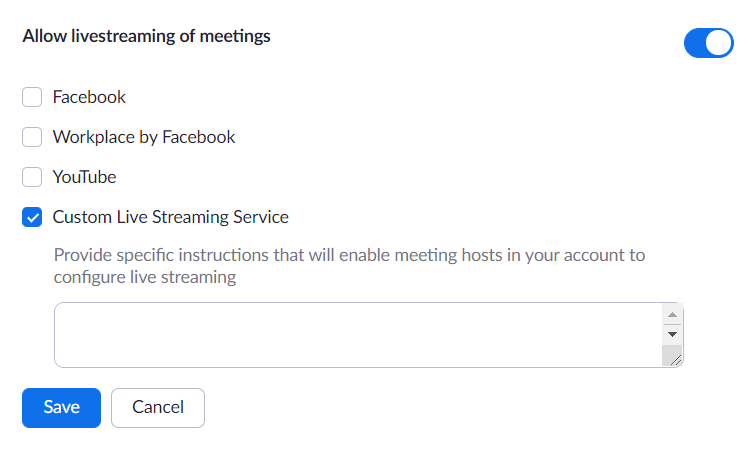
- Under In Meeting (Advanced), enable Allow live streaming meetings (and Allow live streaming webinars if you run webinars)
- Check the Custom Live Streaming Service option and click Save
Prepare the Destination on VIDIZMO
- Configure an eCDN node with your streaming server provider
- Create a publishing point against the configured node
- You will need a Moderator, Manager, or Administrator role to schedule the live stream
Connect and Go Live
- In VIDIZMO, click Add New Media and choose Schedule Live Webcast
- Add the title, description, audience, and schedule, then open the Live Source tab and choose your publishing point
- Start your Zoom meeting
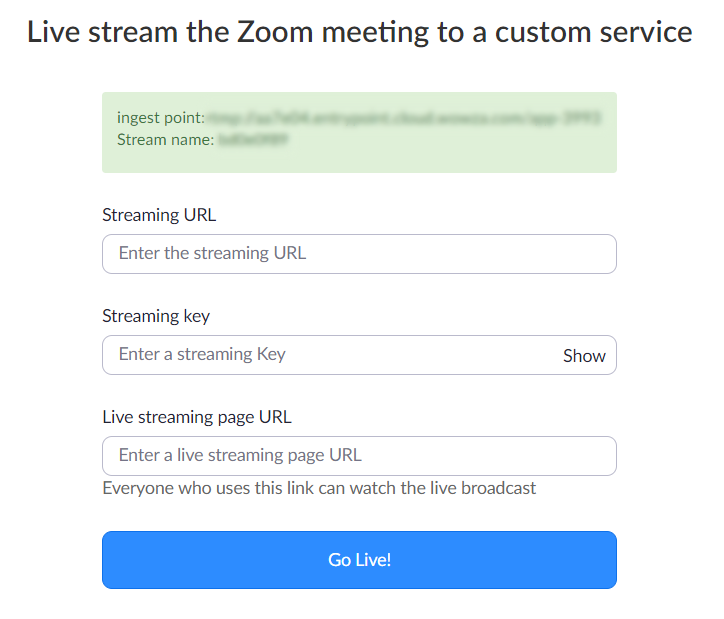
- In Zoom's meeting controls, click More and select Live on Custom Live Streaming Service
- Copy the Ingest URL and Stream Name from VIDIZMO's Live Source tab into Zoom's Stream URL and Stream Key fields, and your portal address into the Live Streaming Page URL
- Click Go Live! in Zoom and save the webcast in VIDIZMO
To start a scheduled stream later: open Media Manager under the Admin tab, select the scheduled stream, open Live Control Room, and click Start Session.
Which Route Fits Your Broadcast
A short decision test covers most cases. If the session is public and the audience unbounded, stream natively to YouTube and enjoy the simplicity. If the audience is your own organization, if you need to know who watched, if offices share constrained networks, or if the recording must land under retention and access policies the moment the stream ends, route the stream into a governed platform. Many organizations run both patterns side by side, choosing per event, which Zoom's custom streaming option makes a per-meeting decision rather than an architecture.

FAQ
Frequently Asked Questions
Can Zoom live stream a meeting without extra tools?
Yes. Paid Zoom plans stream meetings and webinars to YouTube Live, Facebook Live, or any custom RTMP destination, enabled under Account Settings. For public broadcasts where anyone may watch, the native options are enough.
How do I stream a Zoom meeting to a custom platform?
Enable Custom Live Streaming Service in Zoom's account settings, then during the meeting choose More, then Live on Custom Live Streaming Service, and paste the destination platform's ingest URL and stream key. The stream then plays wherever the destination serves it.
Can I live stream a Zoom meeting to an internal audience only?
Not well with public platforms, where access control is an unlisted link anyone can forward. Streaming into an enterprise video platform restricts viewing to signed-in, authorized users, records who watched, and uses an eCDN so office networks carry one copy of the stream instead of one per viewer.
What happens to the stream after it ends?
It becomes a recording, and where it lands matters. On public platforms it sits outside retention and access policies. Streamed into a governed video platform, the recording is already in the library with permissions, retention, and search applied the moment the session ends.
TopicsEnterpriseTubeVideo StreamingSecurity and ComplianceCIO and IT Leadership

About the author
Ali Rind is a Product Marketing Executive at VIDIZMO, where he focuses on digital evidence management, AI redaction, and enterprise video technology. He closely follows how law enforcement agencies, public safety organizations, and government bodies manage and act on video evidence, translating those insights into clear, practical content. Ali writes across Digital Evidence Management System, Redactor, and Intelligence Hub products, covering everything from compliance challenges to real-world deployment across federal, state, and commercial markets.
You may also like

What Is a Real-Time Crime Center? A Guide for Cities and Counties
Somewhere in the last two years, someone probably asked your department whether it should have a real-time crime ...
Staffing a Real-Time Crime Center When Software Does the Watching
Most chiefs who hear a pitch for a real-time crime center ask the same question before any other, which is whether they ...

RTCC, EOC or Situational Awareness Center: What Each Room Is For
Walk into a real-time crime center, then into a city's emergency operations center, and you will see much the same ...