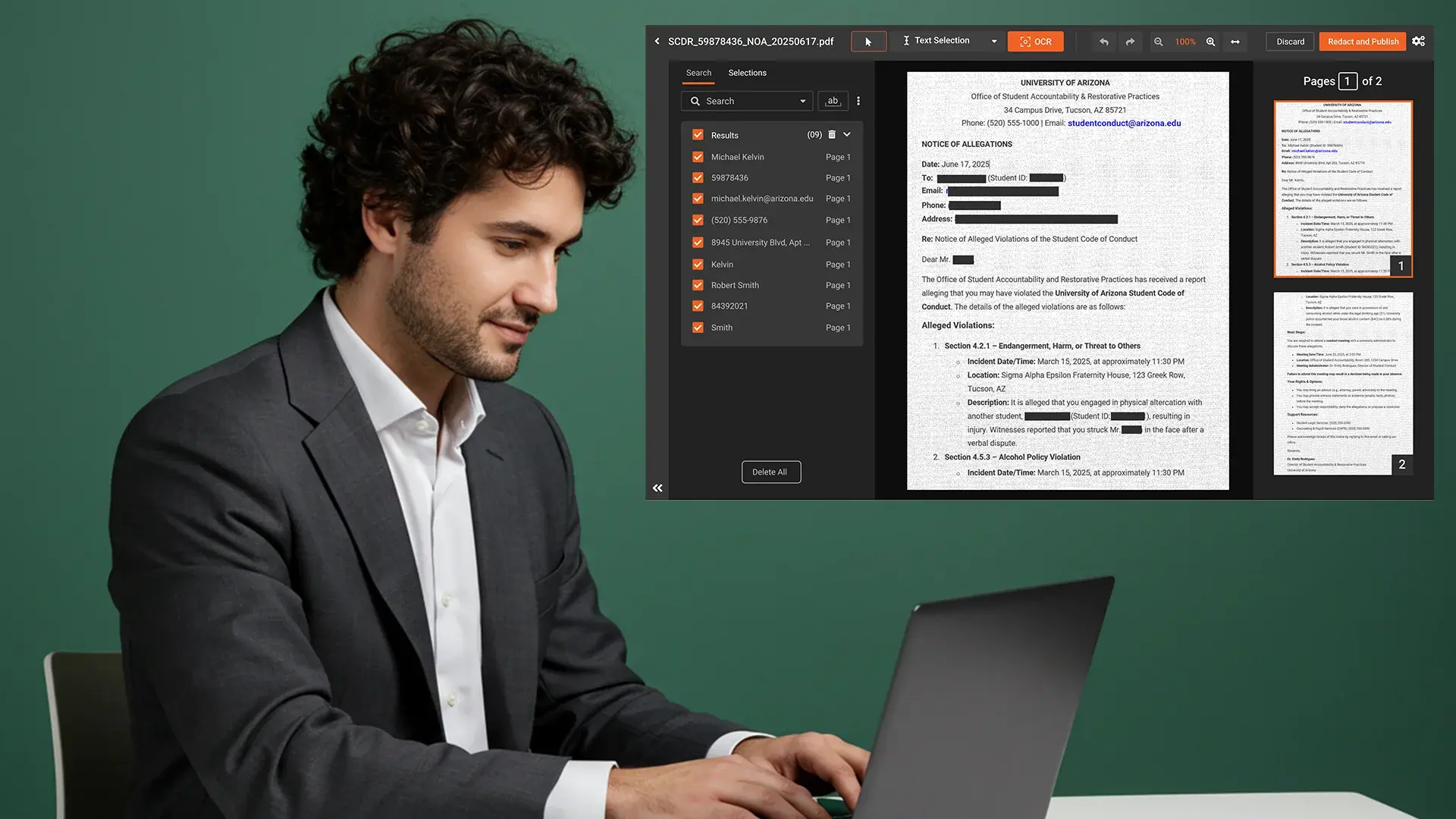
Resumes are among the most widely shared documents in hiring, yet they often contain far more personal information than necessary. Names, contact details, photos, locations, and social media profiles are routinely shared among recruiters, hiring managers, vendors, and platforms.
In 2026, resume redaction is no longer a niche practice. It has become a practical necessity for protecting candidate information and enabling fair, unbiased screening.
This guide explains what resume redaction really means, why it matters today, how to do it correctly, and how organizations can scale resume redaction effectively using VIDIZMO Redactor.
What Is Resume Redaction (and What It Is Not)
Resume redaction is the process of permanently removing sensitive or identifying information from a resume before it is shared or reviewed.
True redaction means:
- The information is completely removed from the file
- It cannot be recovered through copy-paste, text extraction, or file inspection
- It works across formats such as PDFs, Word documents, and scanned resumes
What redaction is NOT:
- Drawing black boxes over text
- Changing text color to white
- Blurring content without removing the data
- Hiding information behind shapes or layers
Many people still rely on visual masking, unaware that the hidden text can often be recovered. In 2026, correct redaction must be verifiable and irreversible.
Why Resume Redaction Matters in 2026
1. Resumes Contain More Personal Information Than Needed
A typical resume may include:
- Full name
- Phone number and email
- Home location
- Photo
-
Links to social profiles or portfolios
This information is rarely required for initial screening and can be easily over-shared as resumes progress through hiring workflows.
Resume redaction helps limit exposure and ensures only relevant information is reviewed at each stage.
2. Bias-Free Hiring Is a Priority
Organizations increasingly adopt blind hiring practices to reduce unconscious bias related to:
- Names
- Gender
- Age
- Ethnicity
- Location
- Appearance
By removing identifying details from resumes, hiring teams can focus on skills, experience, and qualifications, rather than personal characteristics.
Resume redaction plays a key role in enabling consistent, bias-aware screening.
3. “Looks Redacted” Is Not the Same as “Is Redacted.”
One of the most common mistakes is assuming that covering text visually makes it safe.
Improperly redacted resumes may still expose data through:
- Copy and paste
- Text extraction tools
- Hidden document layers
- OCR text in scanned files
In 2026, resume redaction must be done in a way that removes the data entirely, not just hides it.
Redact for Bias-Free Screening
- Photos
- Gender identifiers
- Age or graduation year
- Nationality
- Marital status
- Location (when not relevant to the role)
How to Redact a Resume Correctly (Step-by-Step)
Step 1: Identify the Resume Format
Resumes may come in:
- PDF format
- Word documents (DOCX)
- Scanned images or PDFs
- Bundles with cover letters or attachments
Each format requires proper handling to ensure data is fully removed.
Step 2: Use True Redaction Tools
A proper redaction solution should:
- Permanently remove text and objects
- Support OCR for scanned resumes
- Automatically detect common personal identifiers
- Allow manual review and adjustments
Avoid tools that rely only on annotations or overlays.
Step 3: Verify the Redaction
Before sharing a redacted resume:
- Try copying text from the redacted areas
- Extract text from the file
- Inspect for hidden layers or objects
If information can still be retrieved, the resume is not truly redacted.
Manual vs Automated Resume Redaction
Manual Redaction
Best for:
- Individual job seekers
- One-off resume sharing
Limitations:
- Time-consuming
- Easy to miss information
- Inconsistent results
Automated Redaction
Best for:
- Recruiters and HR teams
- Staffing agencies
- Organizations handling large resume volumes
Advantages:
- Faster processing
- Consistent application of redaction rules
- Reduced human error
- Scalable workflows
How VIDIZMO Redactor Helps Redact Resumes Effectively
VIDIZMO Redactor is designed for teams that need accurate, scalable resume redaction without compromising usability.
Key Capabilities
-
AI-Powered Detection
Automatically identifies names, emails, phone numbers, faces, and signatures. -
OCR for Scanned Resumes
Redacts text from scanned PDFs and images, not just digitally created files. -
True, Irreversible Redaction
Ensures sensitive information cannot be recovered. -
Bulk Resume Processing
Ideal for recruiters and staffing firms handling high resume volumes. -
Custom Redaction Rules
Align redaction with blind hiring or internal review practices. -
Multi-Format Support
Redact resumes, cover letters, and supporting documents in one platform.
VIDIZMO enables organizations to focus on hiring decisions, not manual document cleanup.
Start Your Free Trial Today - No Credit Card Needed

Who This Guide Is For
Recruiters & HR Teams
- Enable blind screening
- Standardize resume anonymization
- Save time during early hiring stages
Staffing Agencies
- Process resumes at scale
- Share candidate profiles safely
- Maintain consistent redaction across clients
Hiring Managers
- Review candidates without bias
- Focus on skills and experience
Job Seekers & Freelancers
- Share resumes confidently
- Limit unnecessary personal exposure
- Control how information is presented
Final Thoughts
In 2026, resume redaction is about hiring better, protecting candidate information, reducing bias, and improving screening efficiency.
With the right approach and the right tools, resume redaction becomes a simple, reliable part of modern hiring workflows.
VIDIZMO Redactor helps organizations redact resumes accurately, consistently, and at scale, making blind and secure hiring practica,l not complicated.
FAQ
Frequently Asked Questions
Is blacking out text in a resume enough?
No. Visual masking does not remove the underlying data.
Does resume redaction help reduce hiring bias?
Yes. Removing identifiers supports fairer, skills-focused screening.
How can I check if a resume is properly redacted?
Test copy-paste and text extraction. If content appears, it is not fully redacted.
Can resumes be redacted in bulk?
Yes. Automated tools like VIDIZMO Redactor are designed for high-volume processing.
What information should be redacted from a resume before screening?
Redact any detail that reveals identity rather than qualifications. This includes full name, phone number, email, home address, photo, age or graduation year, gender identifiers, nationality, and social media links. Keeping only skills, experience, and achievements allows hiring teams to evaluate candidates on merit alone.
Is drawing black boxes over resume text enough to protect the data?
No. Black boxes and color overlays are visual tricks, not real redaction. The underlying text remains in the file and can be retrieved through copy-paste, text extraction tools, or hidden document layer inspection. True redaction permanently deletes the data from the file so it cannot be recovered by any method.
Does resume redaction actually reduce hiring bias?
Yes. Removing names, photos, locations, and demographic identifiers prevents unconscious bias based on gender, ethnicity, age, and appearance. Blind screening shifts recruiter focus to skills and experience, which consistently leads to fairer, more defensible hiring decisions.
How do I know if a resume has been properly redacted?
After redaction, run three quick checks:
- Try copying text from the redacted areas
- Use a PDF text extraction tool to scan the file
- Inspect the document for hidden layers or objects
If any information surfaces, the resume is not fully redacted and needs to be reprocessed with a true redaction tool.
What is the difference between manual and automated resume redaction?
Manual redaction works for individual cases but is slow, inconsistent, and prone to missed fields. Automated redaction uses AI to detect and permanently remove personal identifiers across hundreds of resumes at once, applying consistent rules every time. For any team handling more than a handful of resumes, automation is the practical choice.
Can redaction tools handle scanned resumes or image-based PDFs?
Yes, provided the tool includes OCR (Optical Character Recognition). OCR converts image text into readable data so the redaction engine can detect and remove it. Without OCR, scanned resumes pass through unredacted because the tool cannot read the text embedded in the image.
Is resume redaction a legal requirement for hiring teams?
In many jurisdictions, yes. Privacy regulations including GDPR, CCPA, and similar frameworks require organizations to limit collection and processing of personal data to what is strictly necessary. Sharing unredacted resumes across hiring platforms and vendors without a legal basis creates direct compliance risk. Redaction is one of the most practical ways to reduce that exposure.
How does VIDIZMO Redactor handle resume redaction at scale?
VIDIZMO Redactor uses AI-powered detection to automatically identify names, emails, phone numbers, photos, and signatures across PDF and Word resumes. It supports OCR for scanned files, applies true irreversible redaction, and processes resumes in bulk. Custom redaction rules can be configured to align with specific blind hiring or compliance requirements, making it suitable for recruiters, staffing agencies, and HR teams managing high resume volumes.
About the author
Zain Noor is a Product Marketing Executive at VIDIZMO with expertise in AI redaction technology. He focuses on how public safety agencies, government bodies, and commercial organizations adopt and operationalize video intelligence at scale.
You may also like

What Is a Real-Time Crime Center? A Guide for Cities and Counties
Somewhere in the last two years, someone probably asked your department whether it should have a real-time crime ...

Staffing a Real-Time Crime Center When Software Does the Watching
Most chiefs who hear a pitch for a real-time crime center ask the same question before any other, which is whether they ...

RTCC, EOC or Situational Awareness Center: What Each Room Is For
Walk into a real-time crime center, then into a city's emergency operations center, and you will see much the same ...