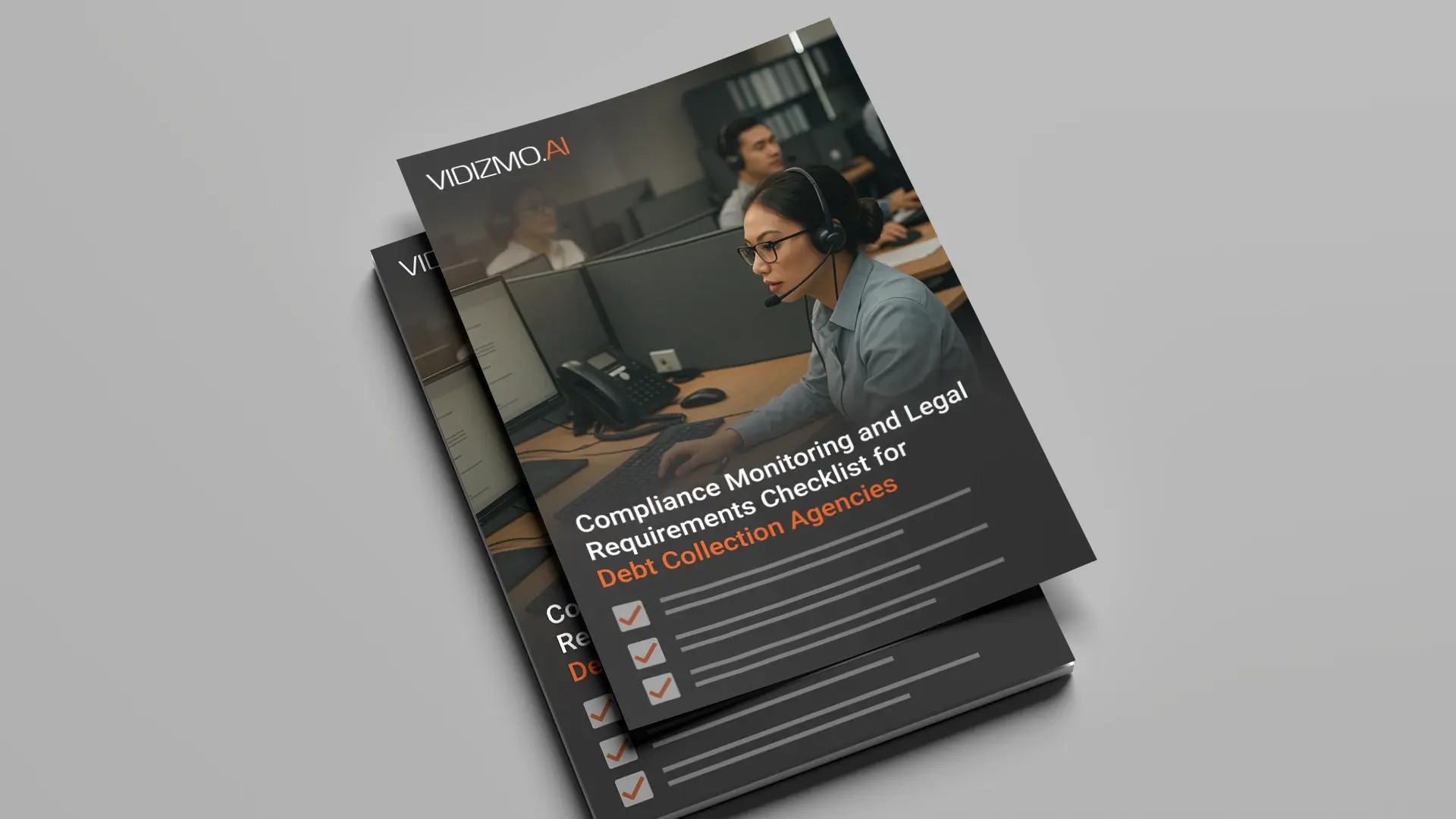
Debt collection agencies record high-volume calls containing sensitive data -- personally identifiable information (PII), protected health information (PHI) for medical debt, and payment card data (PCI). A single compliance failure across GLBA, PCI-DSS, FDCPA Regulation F, or HIPAA can result in regulatory penalties, lawsuits, and reputational damage.
This checklist provides a structured approach to ensuring compliance across five areas: regulatory understanding, accurate redaction, retention and access control, compliance auditing, and staff training.
Relevant VIDIZMO product: VIDIZMO Redactor provides AI-powered spoken PII detection and redaction for call recordings, with automated retention policies, audit logging, and support for GLBA, PCI-DSS, FDCPA, and HIPAA compliance standards.
1. Regulatory Compliance Understanding
Before implementing any redaction workflow, teams must understand the specific requirements of each applicable regulation.
1.1 Gramm-Leach-Bliley Act (GLBA)
- Ensure the security and confidentiality of customer information
- Protect against anticipated threats or hazards to the security or integrity of such information
- Protect against unauthorized access that could result in substantial harm to any customer
- Conduct risk assessments to design and implement safeguards
- Implement and periodically review access controls, including technical and physical controls
1.2 Payment Card Industry Data Security Standard (PCI-DSS)
- Encrypt cardholder data both in transit and at rest
- Ensure only authorized personnel have access to payment card information
- Enforce strict access controls for legitimate users only
- Never store CVV codes once a payment is authorized, and keep card numbers and expiration dates only as long as necessary, encrypted or tokenized
- Schedule periodic security assessments to identify vulnerabilities
1.3 Fair Debt Collection Practices Act Regulation F (FDCPA)
- Ensure debtors are not contacted before 8 a.m. or after 9 p.m.
- Avoid making claims that a debtor will be arrested for failure to pay
- Do not place more than seven calls within a seven-day period
- Refrain from claiming the right to seize assets without court approval
- Do not attempt to contact debtors at their place of employment
- Provide clear and conspicuous validation information to the alleged debtor
- Retain records for three years after the collector's last activity on the debt
- Implement configurable retention policies to ensure recordings are stored for the legally required duration
1.4 HIPAA for Medical Debt
- Follow federal and state call-recording consent laws, since HIPAA sets no consent rule for recording, and treat recordings that capture medical information as PHI
- Implement strong security measures to protect PHI from unauthorized access during calls, in transit, and in storage
- Limit access to PHI to employees who need it for their job duties
- Store medical data in a secure platform to prevent unauthorized exposure
1.5 Mapping Sensitive Data
- Identify all sensitive information requiring redaction: PII (names, SSNs, phone numbers, addresses, email), PHI (medical/treatment information), and PCI (credit card numbers, CVVs, account numbers)
2. Ensure Accurate Redaction for Compliance
Verify that your redaction process performs accurate and comprehensive redaction using robust security protocols.
2.1 Redaction Verification Process
- Use AI-powered automated redaction software with spoken PII detection to redact PII, PHI, and PCI data
- Ensure redaction features and security protocols meet GLBA, HIPAA, and PCI-DSS standards
- Evaluate redaction service providers for potential vulnerabilities
- Ensure the software has automated retention policies for FDCPA Regulation F compliance
- Conduct random sampling of redacted calls to verify accuracy
2.2 Redaction Logging
- Maintain an audit log of all redaction activities, capturing key details
- Track and document any edits made to stored calls with audit logs
- Ensure the redaction software provides audit logging capability
3. Retention and Access Control
Under FDCPA Regulation F, redacted call recordings must be securely stored for 3 years, with access restricted to authorized personnel only.
3.1 Retention Policies for Redacted Calls
- Establish clear retention schedules for all data types, including redacted calls
- Retain call recordings for a minimum of three years per FDCPA Regulation F
3.2 Secure Storage of Redacted Calls
- Ensure all redacted calls are encrypted at rest and in transit
- Implement granular access control so only authorized staff can access recordings
- Maintain encrypted backup copies of redacted recordings
3.3 Access for Audits and Dispute Resolution
- Establish a protocol for accessing redacted calls during dispute resolution or regulatory audits
- Ensure authorized personnel can retrieve and review redacted calls efficiently
Download the Full Checklist
The complete checklist includes 2 additional sections covering compliance auditing and reporting, and staff training with corrective action protocols. 40 checklist items total.