
by Rafay Muneer, Last updated: June 3, 2026

In today's world of remote work and virtual communication, video has become an indispensable tool. Research shows that audiences are more engaged with video content than traditional text. This holds true not just for consumers, but for enterprises and large organizations as well.
This is where an enterprise video platform plays a crucial role, ensuring businesses can securely manage and stream their video content efficiently. In a fast-paced, pandemic-influenced world, enterprise video solutions are vital for staying connected and productive with a global workforce.
Enterprise video content management has become essential for organizations that produce, store, and distribute video at scale. From corporate training and internal communications to compliance recording and public-facing media, businesses need a secure and scalable way to manage video content across the enterprise.
Fun Fact: YouTube is now the second most-searched website globally, right after Google.
Today, the streaming market is complete. However, YouTube is not designed for business and different types of video platforms in the market fulfill business-specific needs. Enterprise video platforms are one of them.
You can harness the power of video through video platforms that enable businesses to stream video to achieve their objectives. We did a detailed guide on video platforms that you can always have a look at to get an overview of the video platform market.
In this blog, we will cover:
- What exactly is an enterprise video platform (also known as an enterprise video content management system or enterprise video streaming platform)
- The best enterprise video platforms for different use cases
- How is EnterpriseTube different from a simple YouTube?
- Factors to consider when buying it, including:
- Security & Data Governance
- End-to-End Video Content management
- Personalization/Branding
- Artificial Intelligence
- Integrations



What is an Enterprise Video Platform?
An enterprise video platform is an enterprise-grade video streaming solution, specially designed for large-scale organizations with an increasing amount of videos piling up in their storage.
Videos are spread out in different apps and devices – difficult to find at the time of need and definitely difficult to secure and restrict to authorized individuals.
Enterprise video platforms help organizations securely stream and manage their video content from a centralized video library.
Share videos. Embed on an external site. Host video courses. Create a video archive. Manage recorded work meetings. An enterprise video platform can do it all.
They are different from other video platforms in the sense that they provide a complete enterprise solution. This improves video management and governance as IT admins won’t have to manage multiple platforms in one organization.
Unlike consumer platforms like YouTube or Vimeo's free tier, enterprise solutions provide the security, compliance, and governance features that businesses require for internal communications, employee training, customer engagement, and corporate events.
These platforms have been of significance in the post-COVID world, where businesses have gone virtual and the need to manage video content has increased. According to ReportLinker, the global enterprise video platform market is expected to reach $17.5 billion by 2027.
Read Our Blog: 7 Technologies to Make Remote Working an Organizational Success
How Enterprise Video Platforms Differ from Consumer Video Hosting
Consumer platforms like YouTube and personal Vimeo plans are designed for public video sharing. Enterprise video platforms serve fundamentally different requirements:
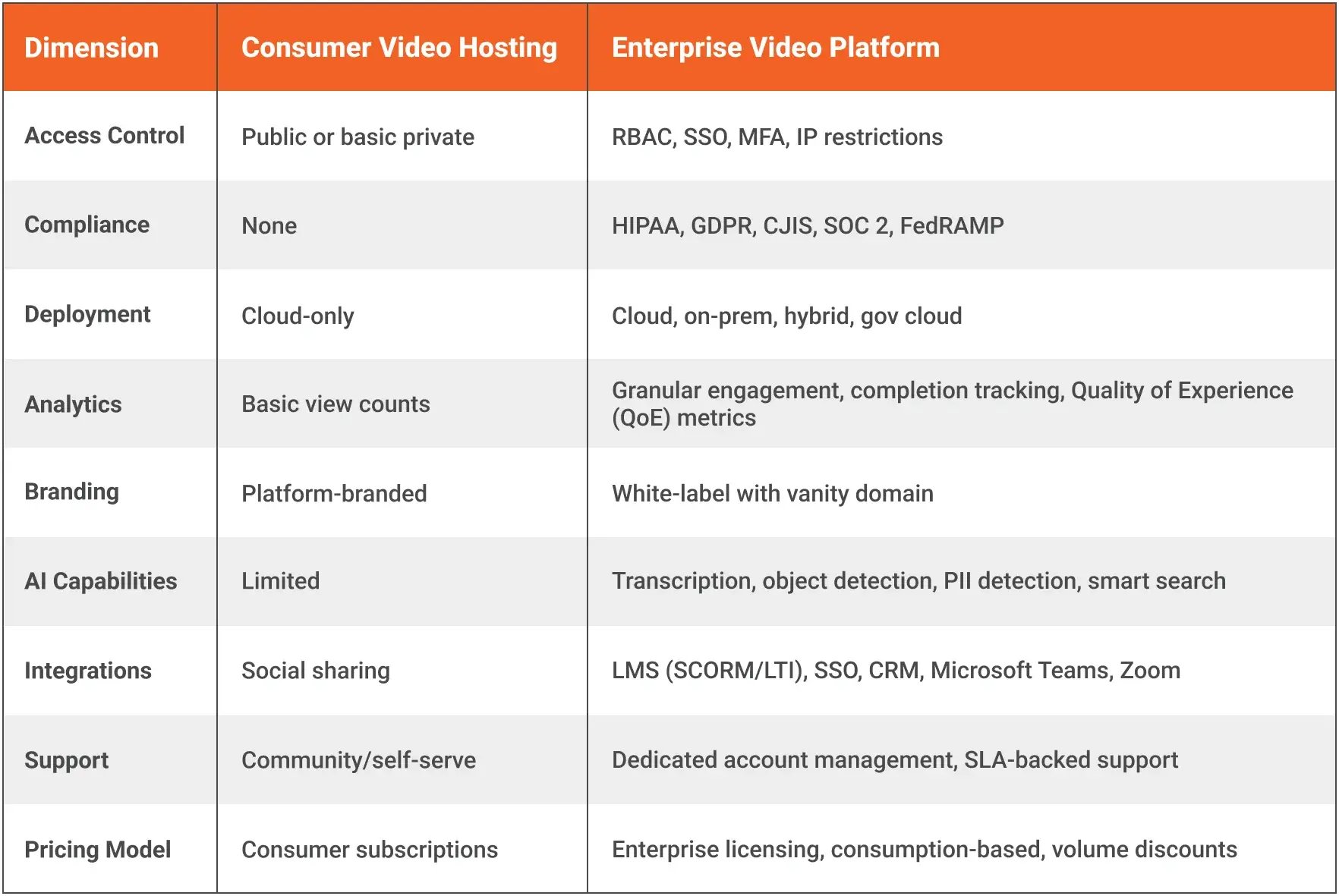
Organizations handling sensitive data, employee training records, regulated communications, government proceedings, require the security and administrative depth that only enterprise platforms provide.
Comparing the Top 6 Enterprise Video Platforms
1. VIDIZMO EnterpriseTube
Known as the Corporate YouTube, VIDIZMO offers a Gartner-recognized end-to-end enterprise video platform that is truly YouTube-like with a suite of advanced AI-powered enterprise video content management capabilities.
-4.jpg?width=7935&name=EnterpriseTube%20New%20Layout-02%20(2)-4.jpg)

This is over and above its live and on-demand video streaming capabilities that cater to both internal and external audiences.

VIDIZMO EnterpriseTube is the best enterprise video platform for organizations seeking to host and stream live and on-demand video content, to internal and external audiences in a secure and compliant way, with end-to-end encryption, granular access and sharing.
On top of that, VIDIZMO has a broad range of integrations and AI capabilities available. Let’s have a look at all that VIDIZMO offers:
Main Features
- Interactive live streaming (RTMP, RTSP, HLS) with interactivity
- Live streaming from drone and CCTV
- Desktop application for offline viewing
- SSO integration (25+ types of SSO supported) – users and groups are automatically synced and updated with SSO through SCIM
- Can create groups and portals to map access based on your organization's departments
- Set video access as anonymous or for the entire organization, specific portals, specific groups or users
- Limited sharing (no. of views and time period)
- Email sharing (external recipients will need to authenticate temporarily to view content)
- White-label video streaming platform - brand video portals using in-built options or custom CSS
- Audit trails available for system and individual video files
- Audit trails with level access – where users can only view logs based on their access
- Create custom metadata to filter and improve search (e.g., author name, unique ID, stadium location etc.)
- Search inside video through AI-generated transcripts and visual insights for spoken words, on-screen text, faces and objects
- Automatic and manual tags to improve search
- Automatic video redaction capabilities to meet compliance requirements
- Flexible deployment options: Cloud (Azure, AWS), On-premise, or Hybrid deployment
Other Features
- Public videos are indexed on Google
- FIPS 140-2 compliant end-to-end encryption of videos
- Set a custom video retention policy
- Video embedding on external sites – secure embedding possible through SSO
- Multitudes of integrations are available, including:
- LMS integrations
- Zoom, MS Teams, Cisco Webex, BlueJeans integration to ingest and securely manage recorded meetings
- CMS integration
- SharePoint video integration
- Google Analytics integration
- Widgets to embed in existing IT systems
- Video API support
- Monetization features are not offered by default and need to integrate with 3rd party tools
- Documents (Word files, PPTs, and PDFs) can be added, but no editing features for these
- Password protect videos
- Set Geo-restrictions and IP restrictions
- Set custom login timeout
- Set a customizable security policy (For example, restrict external sharing for the entire organization or for certain departments)

2. Kaltura
Kaltura is best for organizations seeking to create, host, and stream live and on-demand video content, to internal and external audiences.

Kaltura has great content creation tools, AI capabilities and video management tools, but lacks in a few places in terms of security, usability and adaptability by end-users.
Main Features
- A range of OTT-focused services and monetization features
- Allows you to add quizzes and polls in videos
- Provides detailed analytics for videos
- Offers video portal branding to customize its look and feel
- Available in AWS and Azure Commercial cloud
- Offers on-premise video streaming
Other Features
- SSO integration
- Role-based access control
- Audit trails
- Not an easy-to-use UI
- Fragmented platform – complex to stitch together to get it running
- No video redaction capabilities
- The deployment process is highly complex – requires a great deal of time and investment
- Lack of human technical support – mainly just documentation is available that a layman won’t understand
- No desktop application for offline viewing
- Integrations available:
- SSO integrations available
- Zoom integration available
- LMS integrations available
- CMS integrations available
- Can’t generate multiple links
- Limited sharing (time and no. of views) options are not available
Learn more about Kaltura and its alternatives.
3. Panopto
Panopto is best for educational institutes seeking to create, host and stream live and on-demand video content. Panopto has great content creation tools, AI capabilities, video sharing and management.

However, it has a few limitations in security and compliance, and the external video streaming user experience is not the best.
Main Features
- Detailed and user-friendly content creation tools that work best for lecture capture
- Desktop application available with offline viewing
- Role-based access control
- SSO integrations
- Can embed videos on external sites
- Link sharing
- Search inside video for spoken words (ASR)
Other Features
- Can set custom media retention policy, but can’t configure the number of days media stays in recycle bin
- Data secure in transit using SSL
- Data is encrypted at rest, but Panopto does not mention encryption cryptography and mechanism
- Can create groups and department folders to segregate access to content based on teams or departments
- Share the video with the public, entire organization or specific groups or users
- Doesn’t offer drone mapping and KLV metadata support
- No backup live stream option
- Limited branding and customizations for the video player
- Integration:
- Zoom integration available
- LMS integrations available
- CMS integrations available
- SSO integrations available
Learn more about Panopto and its alternative video hosting platforms.
4. VBrick
VBrick Systems is a private enterprise video platform company founded in 1997, headquartered in Herndon, Virginia.
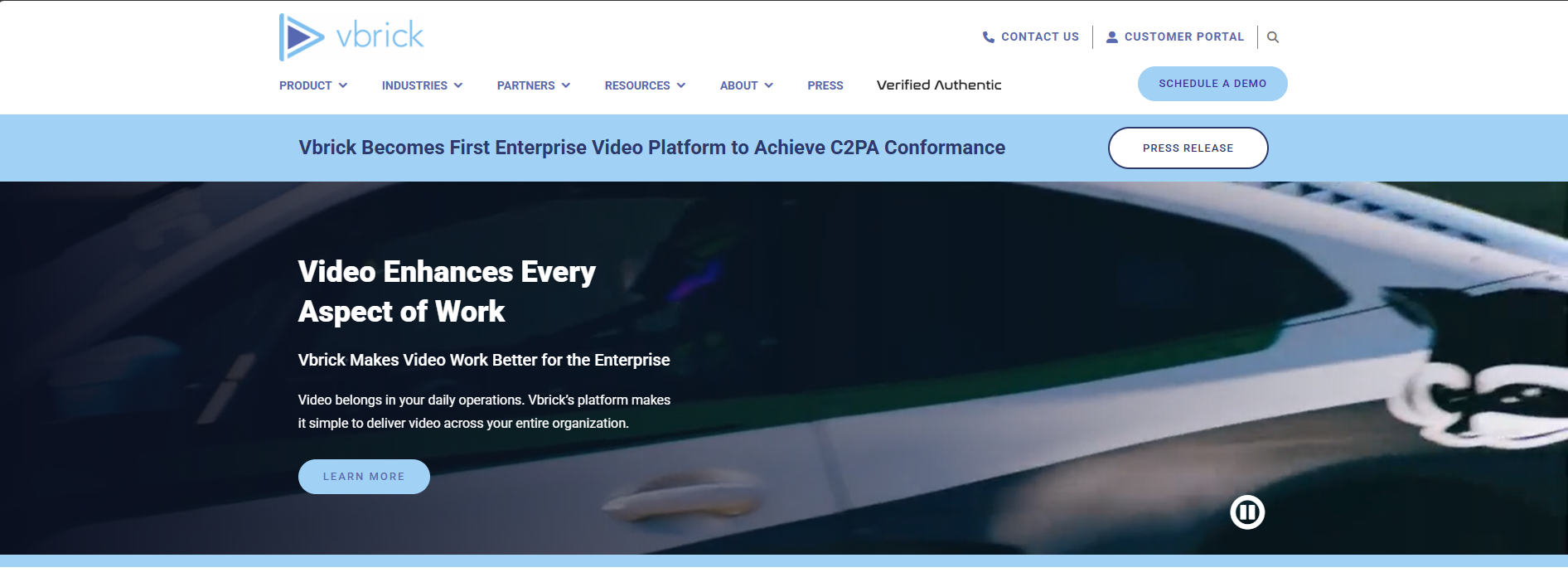
The company has approximately 200–245 employees and is recognized as a Leader by Aragon Research for nine consecutive years in the Enterprise Video category. In 2025, VBrick received the Frost & Sullivan Global Company of the Year Award. VBrick Rev is a cloud-native platform designed primarily for large-scale corporate communications, town halls, and knowledge sharing.
Deployment options: Cloud, on-premises (via proprietary Distributed Media Engine hardware appliance).
Key capabilities: Native eCDN built into the platform, proven performance at 60,000+ concurrent viewers with under 0.3% rebuffering, deep Microsoft Teams and Zoom integrations, enterprise-grade SSO and RBAC, and AI-powered transcription and search.
Key considerations: Premium pricing positions VBrick above mid-market reach; limited interactive video capabilities, no native in-video quizzes, surveys, or interactive hotspots; on-premises deployment requires significant IT involvement; mobile viewing experience has been reported as needing improvement.
5. Brightcove
Brightcove is another well-known name in the market of enterprise video platforms – mainly catering to external streaming for entertainment content and the OTT market.

Brightcove is best for public video streaming, both live and on-demand, for external audiences with features like monetization, broadcast-grade live streaming, marketing-focused integrations, social sharing, etc.
Main Features
- OTT-focused offering
- Monetization available through plug-ins in custom plans
- SSO integration
- Built-in branding capabilities where you can do things like change portal colors, place logos, etc.
- Interactivity features like clickable CTAs within videos
- Mobile optimization
Other Features
- Closed captions
- Audio descriptions
- No AI except automatic transcription
- No integrations with video conferencing tools such as Zoom or MS Team to automatically ingest your meeting recordings
- Other internal comms and training integrations LMS are also missing
- Cannot restrict a video to certain specific users or groups
- Only cloud deployment available – no on-premise deployment option
Learn more about Brightcove and its alternatives.
6. Vimeo Enterprise
Vimeo is a video hosting platform founded in 2004 and headquartered in New York City.
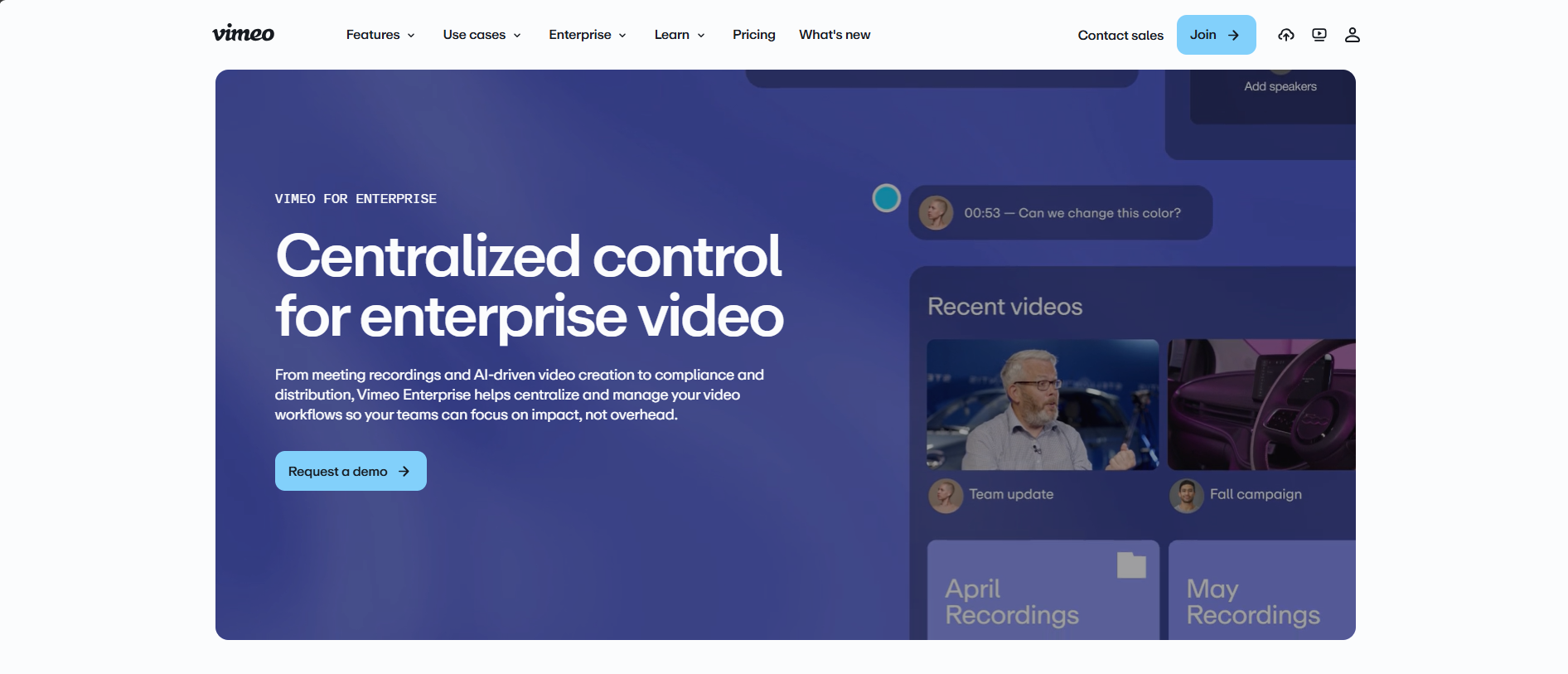
In November 2025, Vimeo was acquired by Bending Spoons (Milan, Italy) in an approximately $1.38 billion all-cash transaction and delisted from NASDAQ. In January 2026, Vimeo laid off the majority of its staff following the acquisition, raising significant questions about long-term product direction and support quality.
Deployment options: Cloud only (SaaS).
Key capabilities: Widely regarded video player quality; AI-powered highlight reels, caption translation, and content recommendations; granular privacy controls including domain-level restrictions and password protection; eCDN partnerships (Hive, Kollective) for enterprise streaming.
Key considerations: Ownership transition and significant post-acquisition staff reductions create meaningful uncertainty about roadmap stability and support reliability; cloud-only with limited compliance certifications for regulated industries; hard storage and bandwidth caps across all plans force mandatory upgrades; seat-based pricing can escalate significantly for larger teams; limited API and developer tooling depth.
Top 6 Enterprise Video Platforms Compared
Below is our analysis of the leading enterprise video platforms, based on feature depth, security capabilities, integration options, and real-world deployment feedback. Platforms are listed alphabetically to provide an unbiased comparison.
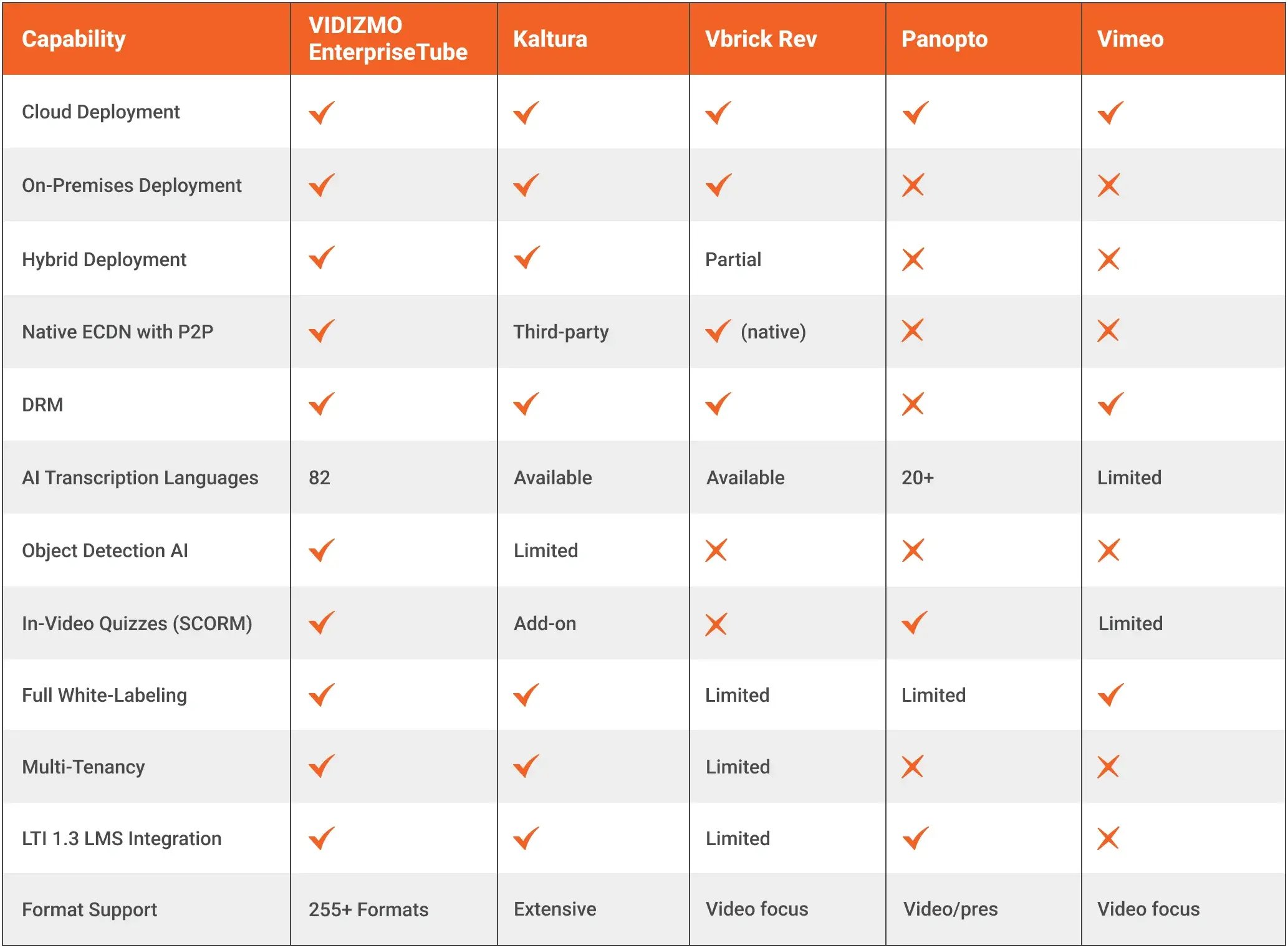
Side-by-Side Feature Comparison
The table below reflects documented capabilities across each platform. Always verify current features and compliance posture directly with each vendor before making a procurement decision.
Enterprise Video Platform vs. Free Public Streaming Sites (Like YouTube)
Video streaming sites like YouTube are free, but as the famous adage goes, “there’s no such thing as a free lunch”.
Where you save money on YouTube, you pay in terms of compromised data, security, and audience attention.
Here are all the problems faced by enterprises on public sites like YouTube that they don’t have to face when they opt for an enterprise video platform:
- Loss of content ownership and control
- Ads disrupt the viewing experience
- Competitor ads and recommendations on your videos
- No authentication layer possible for private videos
- Cannot integrate with other enterprise apps like Zoom and LMS
- Cannot custom brand portal and player according to your needs
- No secure, temporary video sharing options
- And many other problems listed in this article on YouTube vs. Corporate YouTube

Factors to Consider Before Choosing an Enterprise Video Platform
Businesses that use video streaming platforms for training and other business communication have one question in mind: How can we make video data secure and safe while helping us generate the max value out of these assets?
Here are the factors that come into play in achieving this goal:
Security
With rising data breaches and threats from cyber attacks, security is not optional. It is important to consider on both an application-level and data storage level – whether an enterprise video platform is secure or not.

Salient features to look for include end-to-end encryption in transit and at rest, role-based access controls, customizable security policies etc.
Privacy and Confidentiality
Speaking of YouTube, why not post all your videos there?
YouTube is the leading video platform; however, it is an open platform for typical use. Everyone has access to watch the videos you post on YouTube.
An enterprise video platform should be able to handle restricted videos intended for clients, training or recorded meetings.
A good video platform will also allow safe viewing of your private videos. Along with an authentication process, your system must encrypt the connection between spectators, browsers, and your hosting server to prevent unauthorized access to your video streams.
Personalization/Branding
Given that you are creating your own private video platform, branding is critical to truly own it as your own.
For businesses, it is also important to follow their branding guidelines. Hence, choosing a white-label enterprise video platform is critical to custom brand it according to your requirements.
This added feature makes the platform look personal and gives users the freedom to change the design, layout, and characteristics as per their needs.
Integrations
Like any other form of data, one of the biggest challenges that organizations face with video data is that a lot of it is siloed and exists in separate IT systems.
This makes it difficult to implement effective mechanisms for governance, security, compliance etc. It also makes it difficult to use video data in combination with other types of data.

Therefore, it’s important to consider the integration options that your video platform supports. Also, look for whether it provides API access to support communication with your existing IT systems.
Based on how video data is used and the value it brings, we would recommend looking for the following integrations:
- Online Meeting Solutions or Video Conferencing (Zoom, MS Teams, Cisco Webex etc.)
- Content Management System (CMS)
- Learning Management System (LMS)
- Single Sign-On (SSO)
- Analytics Applications
- Cloud Storage
If your primary use case is revenue generation, enterprise video strategies for marketing and sales breaks down how to get measurable ROI from your platform.
What's best for you?
Enterprise video platform is no ordinary YouTube – you get your own private and secure video library to store, manage and share your organizational videos securely from a central location or bring them right to the apps your users are on.
Choosing the right platform might be tricky but with the factors we shared above it should be an easy decision for you.
If VIDIZMO caught your interest, go ahead and sign up for a free demo or better yet try the solution free through a 7-day free trial!

About the Author
Jump to

Comparing 9 Best Video Sharing Platforms in 2026
.webp)
10 Best VOD Platform Providers for Enterprise & Business (2026 Comparison)


No Comments Yet
Let us know what you think