
by Akhlaq Khan, Last updated: May 5, 2026
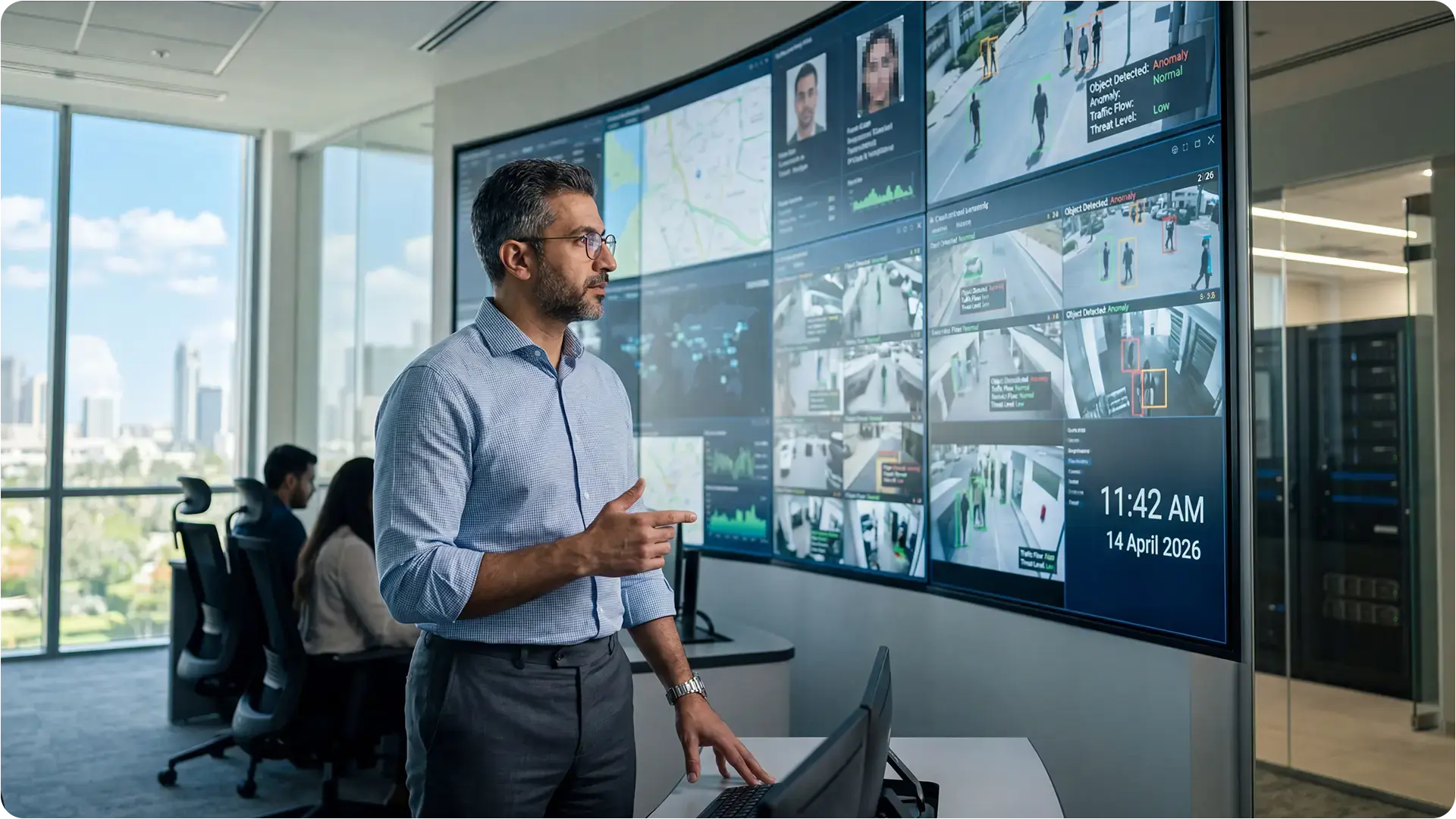
Threat detection has shifted from a human-watched screen problem to a pattern-recognition problem. Most organizations already own the cameras they need. What they lack is the ability to watch every feed, every minute, without the attention drift that lets weapons, intrusions, and unauthorized vehicles slip past a tired operator at 3 a.m.
The gap between camera coverage and actual detection has grown wider every year. Industry research and operator studies have consistently shown that human attention degrades sharply once a single analyst is responsible for more than roughly a dozen simultaneous live feeds. That math doesn't work in modern security operations centers, and it's why AI-driven threat detection moved from a nice-to-have to a baseline expectation in security planning through 2026.
This guide walks through what modern threat detection actually does, where it fits in physical security operations, and how to evaluate it without falling for vendor demos that look great in a controlled lab and fall apart in the field.
Key Takeaways
- Threat detection in 2026 is software-defined. The cameras stay, the intelligence layer changes.
- Human monitoring breaks down once a single operator is watching too many feeds, which is why hybrid SOC models now dominate critical infrastructure.
- Pretrained models cover common threats (weapons, intrusion, abandoned objects). Fine-tuning is what unlocks site-specific detections like copper theft or perimeter loitering.
- The biggest pilot failures we've seen come from skipping integration with alerting and dispatch systems. Detection without action is just a logged event.
- On-prem and air-gapped deployment matter more than vendors admit. Federal sites, utilities, and corrections facilities can't push video to a public cloud.
What Is Threat Detection in a Modern Security Stack?
Threat detection is the automated identification of people, objects, behaviors, or conditions that indicate a security risk, drawn from live or recorded video, sensor data, or both. In a modern stack, it sits between camera infrastructure and incident response, converting raw pixels into structured events that operators and dispatch systems can act on.
The category covers a wide range. On the simple end, it's a person crossing a virtual line at an unauthorized hour. On the harder end, it's recognizing a weapon being drawn from a waistband, a vehicle making three loops of a perimeter road, or a stack of debris growing on a substation fence line over six hours.
What's changed since 2023 is the underlying model architecture. Transformer-based temporal models, the same family powering modern language models, now handle activity recognition reliably enough that "behavior" is a real detection target rather than a marketing claim. Federal transportation research programs have documented this shift in surveillance specifically, where event-based recording replaced continuous review for many monitoring use cases.
Why Has AI Threat Detection Become a 2026 Priority?
Three forces converged. First, camera counts kept climbing while monitoring headcount stayed flat or shrank. Second, the cost of an undetected incident, whether a workplace violence event, an infrastructure attack, or a cargo theft, kept climbing. Third, AI models reached a point where false-positive rates dropped low enough to be operationally usable rather than just demo-able.
The numbers tell the story bluntly. Cyber-physical attacks against critical infrastructure rose sharply through 2023 and 2024, with IBM's X-Force Threat Intelligence Index flagging valid-credential abuse and identity-based intrusion as the fastest-growing initial access vectors. On the physical side, the U.S. Department of Energy has estimated that copper theft alone costs U.S. businesses around $1 billion annually, with utilities, telecoms, and remote infrastructure sites disproportionately affected. Workplace violence remains a leading cause of fatal occupational injury per Bureau of Labor Statistics data.
From what we have seen across deployments, organizations don't usually move on threat detection because of one dramatic incident. They move because their insurance carrier asks pointed questions about monitoring coverage, or because their operations team finally admits they can't keep up with the camera count. Both conversations happened a lot more in 2025 than in any year before.
How Does AI-Powered Threat Detection Actually Work?
At a basic level, an AI threat detection system pulls video from cameras over standard streaming protocols, runs frame-by-frame inference using detection models tuned for specific objects or activities, and emits structured events when a confidence threshold is crossed. The plumbing matters more than most buyers realize, so it's worth breaking down.
Camera Input and Stream Handling
Cameras connect via ONVIF or RTSP, the two industry standards that let any reasonably modern IP camera talk to any compliant analytics layer. This is the part that decides whether a project is a software install or a hardware overhaul. If a vendor needs proprietary cameras, the project just became a capital project rather than an operational one.
Detection Models
Two model categories do the heavy lifting. Object-detection models identify what's in the frame: a person, a vehicle, a firearm, a license plate, a piece of dropped equipment. Temporal or activity-recognition models reason about what's happening across multiple frames: someone climbing a fence, a vehicle stopping in a no-stopping zone, a crowd suddenly compressing toward an exit.
Event Generation and Routing
When a model fires, the system creates a structured event record: timestamp, camera ID, geographic location, detection type, confidence score, severity. That event then routes somewhere useful, an operator console, an SMS to a roving guard, a 311 ticket, an integration with a video management system. A common mistake is treating this routing as an afterthought. Detection without routing is just an audit log nobody reads.
Which Threats Can Modern AI Reliably Detect?
The honest answer is that reliability varies by threat type, lighting, camera placement, and how much data the model has seen. Pretrained models handle the high-frequency, well-studied threats out of the box. Lower-frequency or site-specific threats usually need fine-tuning before they're production-ready.
-2.png?width=1627&height=798&name=image%20(8)-2.png)
The pattern that holds across all of them: the more specific the detection, the more value fine-tuning adds. Generic "person detected" is a starting point. "Person at substation fence between 10 p.m. and 5 a.m. carrying a tool that looks like bolt cutters" is the actual operational signal a utility wants. That second detection only exists because someone trained the model on local footage of that exact pattern.
What Are the Real-World Use Cases That Justify the Investment?
Generic threat detection pitches don't move budgets. Specific operational scenarios with measurable outcomes do. Here are the ones we have seen organizations use to build their business case.
-
Active threat in public space. Schools, courthouses, and large retail are deploying weapon detection on existing entry-area cameras. The goal is shaving seconds off response time, not replacing physical screening.
-
Critical infrastructure protection. Water utilities, substations, and telecom huts use loitering and unauthorized-access detection to catch precursor activity before damage occurs. Copper theft is the headline use case for utilities specifically.
-
Perimeter and after-hours monitoring. Logistics yards, data centers, and corporate campuses use AI to flag intrusion attempts that an operator watching dozens of feeds simply can't see in real time.
-
Transit and station safety. Major transit operators have pushed into platform-edge detection, fare-evasion analytics, and crowd-density monitoring as ridership recovered through 2024 and 2025.
-
Workplace violence early warning. Healthcare and corrections facilities use behavior-analytics models to flag escalating physical encounters before they become full incidents.
-
Cargo and asset theft. Distribution centers and ports apply ALPR plus behavior detection to catch the loading-dock patterns that precede theft, not just respond after.
One thing worth flagging: the highest-ROI use cases tend to be the boring ones. Detecting someone who shouldn't be in the yard at 2 a.m. saves more cumulative loss across a year than catching the rare violent incident, even though the violent incident drives the headlines.
What Should You Look For When Evaluating Threat Detection Software?
Most evaluation criteria from the legacy VMS era still apply, but a few new ones matter more in 2026 than they did even two years ago.
Camera Compatibility Without Replacement
If the vendor's first answer is "we'll need to swap your cameras," walk. Modern analytics layers run on ONVIF and RTSP and shouldn't care whose camera produced the stream. Hardware lock-in adds capital cost, slows deployment, and ties the security strategy to one supplier's roadmap.
Model Fine-Tuning Capability
Pretrained models are table stakes. The differentiator is whether the platform lets your team, or a partner, fine-tune detection models on your footage without sending data to a vendor's shared training pool. For sensitive sites this isn't preference, it's a contract requirement.
Deployment Flexibility
On-prem, hybrid, cloud, and air-gapped should all be options. Federal facilities, utilities under NERC CIP, and any site with classified operations cannot push live video to a public cloud. NERC CIP-007 and CIP-014 impose specific monitoring and access requirements on bulk electric system sites that effectively rule out most SaaS-only platforms.
Integration Surface
Detection events need to land somewhere actionable. REST APIs, webhooks, native VMS integrations, and routing into 311, CRM, or work-order systems all matter. The part most teams overlook is that the integration work, not the AI, is usually the longest part of deployment. Vendors who ship robust webhooks and documented APIs save weeks compared to vendors who promise integration as a "professional services engagement."
Scalability Math
Ask explicitly how many simultaneous camera streams a single inference server handles, how horizontal scaling works, and what GPU footprint is required for the camera count you actually have. A platform that handles 32 streams per server with linear scale-out behaves very differently than one that bottlenecks at 8 streams and needs a re-architecture at 100.
How Do Compliance and Privacy Requirements Shape Threat Detection?
Threat detection lives squarely inside the YMYL territory regulators care about: criminal justice data, healthcare facilities, public records, government surveillance. Picking a platform without thinking through compliance early is one of the fastest ways to kill a project in legal review.
The frameworks that come up most often in our work with public-sector and regulated buyers:
-
CJIS. Criminal-justice agencies and any contractor handling CJIS-tagged video must meet the FBI CJIS Security Policy, now in version 6.0 as of December 2024. Section 5.10.1.2.2 requires that CJI at rest outside a physically secure location be protected with FIPS 197 certified AES encryption at 256-bit strength. Threat-detection platforms supporting CJIS-relevant deployments need to inherit these controls from their hosting environment.
-
HIPAA. Healthcare facilities deploying AI surveillance in clinical or patient areas fall under the HIPAA Security Rule, 45 CFR 164.312. Even if PHI isn't the detection target, recorded video that captures patient identifiers can become regulated content.
-
FedRAMP. Federal civilian and DoD deployments require platforms supporting FedRAMP High and IL4/IL5 controls, typically through Azure Government or AWS GovCloud hosting tied to NIST 800-53 Rev. 5 baselines.
-
State biometric and surveillance law. Illinois BIPA, Texas CUBI, and California's facial-recognition restrictions all impose specific consent, retention, and disclosure requirements on facial detection, even when used purely for security.
Compliance and cyber-physical convergence consistently rank among the top concerns physical security leaders cite when delaying AI surveillance projects, often ahead of cost or technology readiness.
Where Do AI Threat Detection Pilots Tend to Fail?
Across the deployments we've watched, the failure modes cluster into four buckets, none of which are about AI accuracy.
-
Camera placement was never re-evaluated. AI works with the picture it gets. If a camera is mounted 30 feet up, pointed at a glare-prone parking lot, with motion blur on every passing vehicle, no model is going to detect a person reliably. A two-hour camera audit before kickoff saves months of "the AI doesn't work" complaints.
-
The pilot scope was too broad. Trying to detect 12 different threat types on day one is how pilots stall. Pick one or two that matter most, prove them, expand from there. In practice, a 12-week pilot with 40 to 50 cameras and two detection types is the pattern we have seen succeed most often.
-
Alerts went into a black hole. Detection events that fire into a dashboard nobody watches don't change outcomes. The alerting workflow, who gets notified, how, and what they're expected to do, has to be designed before go-live.
-
Confidence thresholds were never tuned. Out-of-the-box thresholds are usually too low for production traffic and produce alert fatigue within a week. Tuning them based on the first month's data is non-negotiable.
For agencies under tight budget pressure, cloud-hosted threat detection with phased camera rollout is almost always the right starting point. The capital expense of full on-prem inference clusters rarely pays back unless data-residency rules force it.
How VIDIZMO AI LiveSight Analytics Approaches Threat Detection
VIDIZMO AI LiveSight Analytics is the part of the VIDIZMO platform that handles real-time video analytics across existing camera infrastructure. It connects to current VMS deployments and IP cameras over RTSP and ONVIF with no rip-and-replace, and runs detection models for the threats covered earlier in this guide: weapons, intrusion, ALPR, abandoned objects, crowd anomalies, and site-specific patterns.
Two things differentiate it for buyers focused specifically on threat detection. First, fine-tuning happens inside the customer's tenant. Footage used to train a copper-theft model for a utility doesn't get pooled into shared training data, which matters for both compliance and competitive sensitivity. Second, deployment options cover the full spectrum: on-premises for air-gapped sites, Azure Government Cloud hosting that supports FedRAMP High aligned workloads, hybrid for organizations splitting workloads, and SaaS for everything else. That flexibility tends to clear the procurement and InfoSec hurdles that stall single-deployment-mode platforms.
The platform handles up to 32 simultaneous camera streams per AI Live Server instance, scaling horizontally by adding more servers. Across production deployments, that pattern has supported camera counts from a few dozen at pilot scale to several thousand at full rollout. Detection events route through configurable alert channels (email, SMS, 311/CRM, ITS, work-order systems) and surface in a multi-camera operator console with confidence and severity controls per detection type. AI LiveSight Analytics is built on ISO 27001:2022 certified information security management, with AES-256 encryption at rest and TLS 1.2 in transit.
If you're evaluating threat detection for a specific site or agency and want to see how an AI overlay would behave on your existing camera infrastructure, request a demo of AI LiveSight Analytics and we'll walk through a deployment scoped to your environment.
Frequently Asked Questions
What is threat detection in video surveillance?
Threat detection in video surveillance is the use of AI models to automatically identify security-relevant objects, people, or behaviors in live or recorded video. It replaces the need for an operator to spot every event manually, generating structured alerts when a configured threshold is crossed. Modern threat detection covers weapons, intrusion, ALPR, abandoned objects, crowd anomalies, and site-specific patterns like copper theft or fence breach.
How accurate is AI-based threat detection in 2026?
Accuracy depends heavily on the threat type, lighting, camera placement, and whether the model has been fine-tuned for the specific site. Mature categories like person detection and ALPR routinely operate above 95% precision in production, while newer categories like behavioral anomaly detection still benefit from site-specific fine-tuning to reach operational thresholds. The honest framing is that AI handles the high-volume detection work better than humans can, while humans still adjudicate edge cases.
How does AI threat detection compare to traditional video monitoring?
Traditional monitoring relies on operators watching live feeds, which research has shown breaks down past roughly 9 to 12 simultaneous feeds per analyst. AI monitoring runs continuously without attention drift, processes all feeds in parallel, and surfaces only events that meet a confidence threshold. The two work best together: AI handles the watching, humans handle the judgment calls and response coordination.
Do I need to replace my cameras to add AI threat detection?
No. Modern threat detection platforms run as a software overlay on existing IP cameras using ONVIF and RTSP standards. Any vendor whose first requirement is hardware replacement is selling a capital project, not an analytics layer. The cameras you already own, including older models, can usually feed an AI detection pipeline without modification.
What compliance frameworks apply to AI threat detection deployments?
Common frameworks include CJIS for criminal justice agencies, HIPAA for healthcare facilities, FedRAMP for federal workloads, NERC CIP for bulk electric system operators, and state biometric laws like Illinois BIPA when facial detection is involved. The right framework depends on what is being recorded, who operates the system, and where data is stored. Procurement teams should map applicable frameworks during the RFP stage, not after deployment.
Can AI threat detection run fully on-premises or air-gapped?
Yes, and for many federal, utility, and corrections deployments it has to. Look for platforms that offer on-prem GPU servers, hybrid configurations, and fully air-gapped options. Cloud-only architectures don't fit sites with strict data-residency or classified-network requirements, and forcing them into a cloud model usually creates compliance problems that show up in audit.
What is a realistic pilot scope for AI threat detection?
A 12-week pilot covering 40 to 50 cameras with two or three detection types is the pattern that most consistently produces a clean go/no-go decision. Trying to validate a dozen detection types or hundreds of cameras at once usually stalls because the integration and tuning work outpaces the pilot timeline. Start narrow, prove value on a single corridor or facility, then expand.
About the Author
Jump to
Video Redaction for EMS & Fire Agencies: HIPAA, CJIS & Public Records

HIPAA Compliance for Community Health Centers: What You Must Know
.png)

No Comments Yet
Let us know what you think